
@SignOfficial #SignDigitalSovereignInfra
In the world of blockchain infrastructure, tokenomics is often treated as a marketing exercise a spreadsheet of percentages designed to trigger a temporary hype cycle. However, when you peel back the layers of Sign Protocol’s ($SIGN) distribution model, you find something far more deliberate than a standard "pump-and-dump" schedule. With a clear divide between the initial 40% allocation and the future-facing 60% reserve, Sign isn't just distributing a token; it’s attempting to engineer long-term economic behavior.
The 40%: The Foundation of Early Capital
The 40% of the supply allocated to the pre-TGE phase covering the team, private backers, and early investors is the "engine room" of the project. It’s easy to look at these numbers and cry foul over centralization, but the reality of building a global attestation layer is that it requires years of high-cost development and strategic capital.
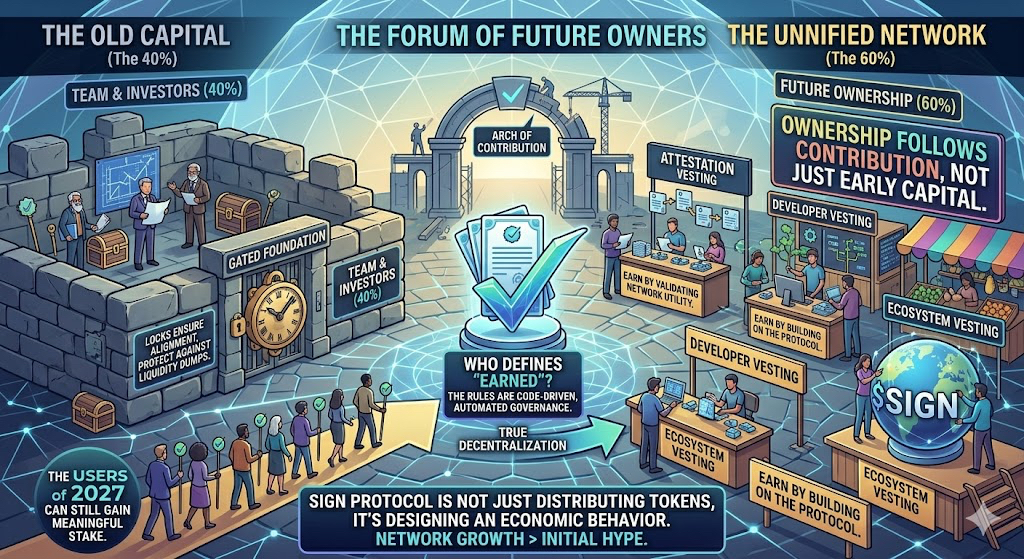
The real test of decentralization here isn’t the size of the slice, but the transparency of the lock. With a 48-month linear release for the team and a 24-month schedule for backers (including a 6-month cliff), Sign has built-in protection against early-stage liquidity dumps. If investors don't understand these guardrails, the claim of a community-driven network starts to feel hollow. For Sign, this 40% represents the price of the initial build, but it’s the remaining majority that holds the true potential.
The 60%: Ownership as a Reward for Contribution
The most striking feature of the $SIGN model is the 60% reserved for the future. In an industry where "VCS" often exit before a product even hits mainnet, keeping more than half the supply for future users, contributors, and ecosystem participants is a rare bet on longevity.
The theory is clear: Ownership should follow contribution, not just capital. This 60% is meant to be earned through active participation whether that’s building on the protocol, validating attestations, or integrating the SignPass identity infrastructure. However, this raises the ultimate structural question: Who defines earned?
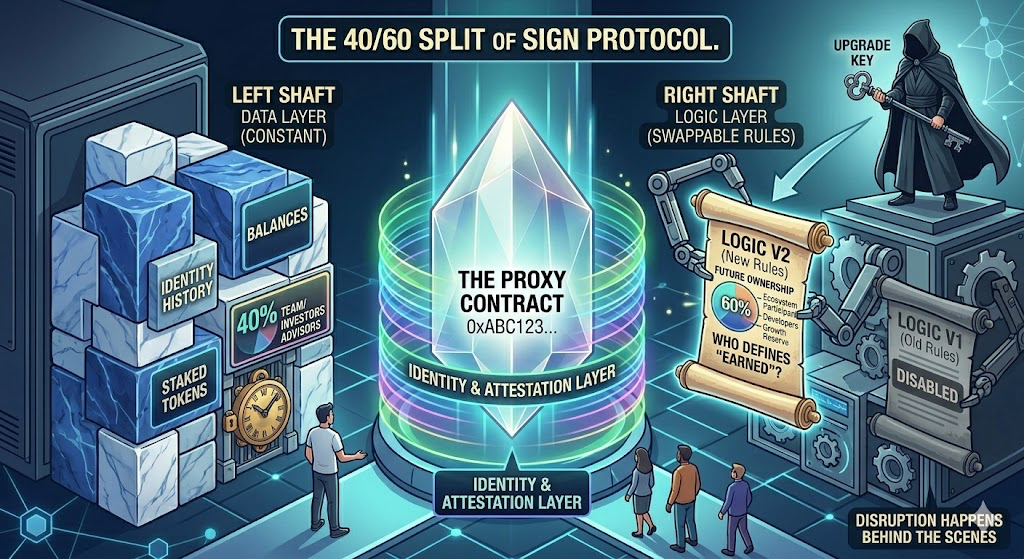
If the logic for what constitutes a valuable contribution is controlled by a central committee, then the 60% is just a delayed treasury. For true decentralization to take root, the rules of this distribution must eventually move from a team-controlled spreadsheet to an automated, code driven governance model.
Betting on Network Growth Over Initial Hype
By locking away the majority of its value for the future user, Sign Protocol is making a massive bet that network utility will eventually outpace initial speculation. They are designing a system where the users who join in 2027 or 2028 can still gain a meaningful stake in the infrastructure they use.
This is the risky, yet vital, heart of the project. It’s an experiment in digital sovereignty where the owners of the network are those who actually verify data and secure identities. The structure is thoughtful, the intent is structural, and the execution will determine if Sign becomes the plumbing of the decentralized web or just another high-potential whitepaper.
In the end, whoever holds the upgrade keys to the distribution logic holds the real power. As a user, your job isn’t just to track the price
it’s to watch the governance of that 60%. That is where the real story of Sign Protocol will be written.