
The real world is messy. While everyone is excited about moving buildings and treasury bonds onto the blockchain, they often forget a simple truth: you can't actually put a brick and mortar house inside a digital block.
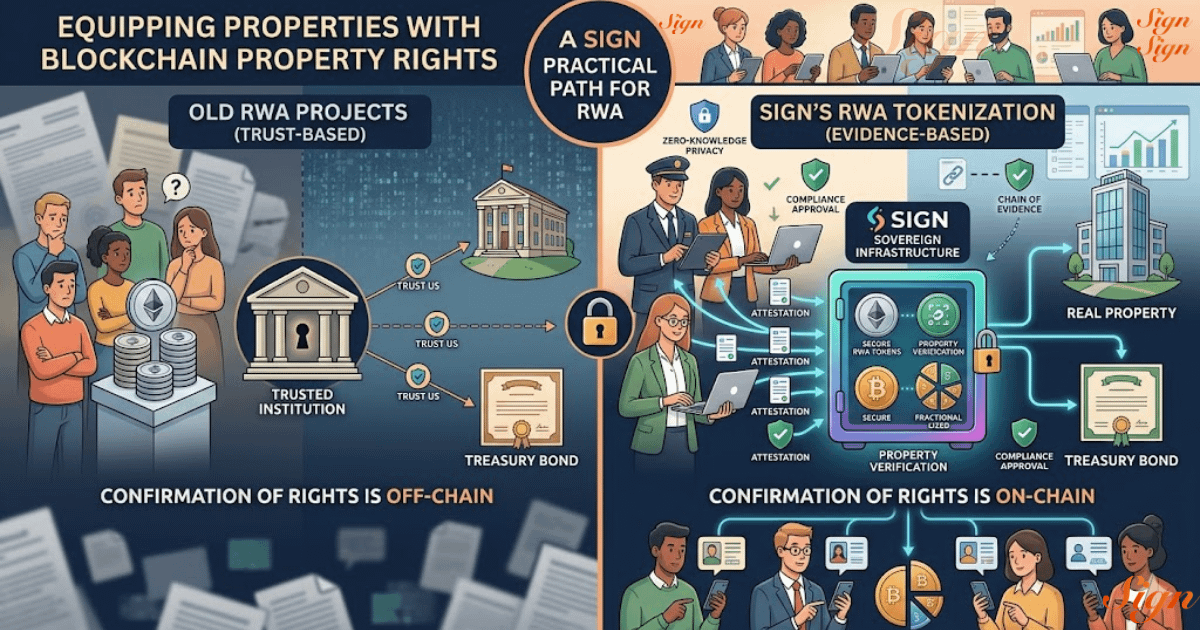
Right now, most Real World Asset (RWA) projects rely on a trust me 😀 model. Trust our company our project is looking very good in simulation
NOTHING JUST EMPTY CLAIMS WITH FANCY SIMULATION صرف دعویٰ
A company Tells you a digital token represents a specific apartment. If that company disappears or the property records are faked, your token is just a string of useless code.
I've been looking at how @SignOfficial handles this, and they are solving the actual problem.
not just the token part, but the legal right part.
The $16 Trillion Problem :
The World Bank and IMF have pointed out for years that insecure property rights are a massive wall for economic growth.
In many developing nations, up to 70% of land remains undocumented or poorly recorded, leading to endless legal battles and blocked credit.
By 2030, the market for tokenized assets is projected to hit $16 trillion.
But that money won't flow if investors are scared of "ghost assets" or fake ownership.
How Sign Fixes the Last Mile:
$SIGN doesn't just mint a coin and hope for the best.
They use something called Flow C to bridge the gap between a physical building and the digital world.
Question come in my mind how it will works?
Evidence First:
Before a token even exists, an official authority like a land registry or a licensed appraiser creates a digital attestation.
This is a cryptographically signed proof that says →, "Yes, this building exists, and here is who owns it right now."
Rules You Can't Break:
When that asset is tokenized through TokenTable, the transfer rules are baked in.
You can't just send the token to a random person. The system checks if the buyer has their own identity attestation and meets all the legal requirements first.
A Chain of Truth:
Every time a property changes hands, it creates a new piece of evidence.
If there’s a dispute three years later, you don’t need to hunt for lost emails or dusty paper files.
You just check the chain to see the exact moment the rights were transferred and who approved it.
Trusting Data, Not People :
The traditional way is: Trust the Institution. Infact @SignOfficial Sign’s way is: Trust the Evidence.
You aren't betting on whether a company is honest.
Infact You are → verifying digital signatures that can't be forged.
If a country's property office connects to $SIGN Ecosystem.
Every single transaction → hundred’s thousands of per year → becomes a permanent, verifiable record.
Why This Matters for $SIGN
Every single step in this process uses the network.
Verifying the property? Attestation.
Registering the asset? Attestation.
Approving a buyer? Attestation.
Executing the sale? Attestation.
This isn't about people gambling on prices.
However it about the essential plumbing of the global economy.
When an asset management firm or a government registry starts using @SignOfficial Ecosystem for their records.
The network stops being a crypto project and starts being a critical utility.
The day we see the first official land registry move to this system, the conversation around digital assets changes forever. We move from speculating on coins to owning the world's property records.
What do you think? Would you feel safer buying a fractional piece of a building if you could verify the legal terms yourself with one click?
#SignDigitalSovereignInfra #RWA #Sign
