
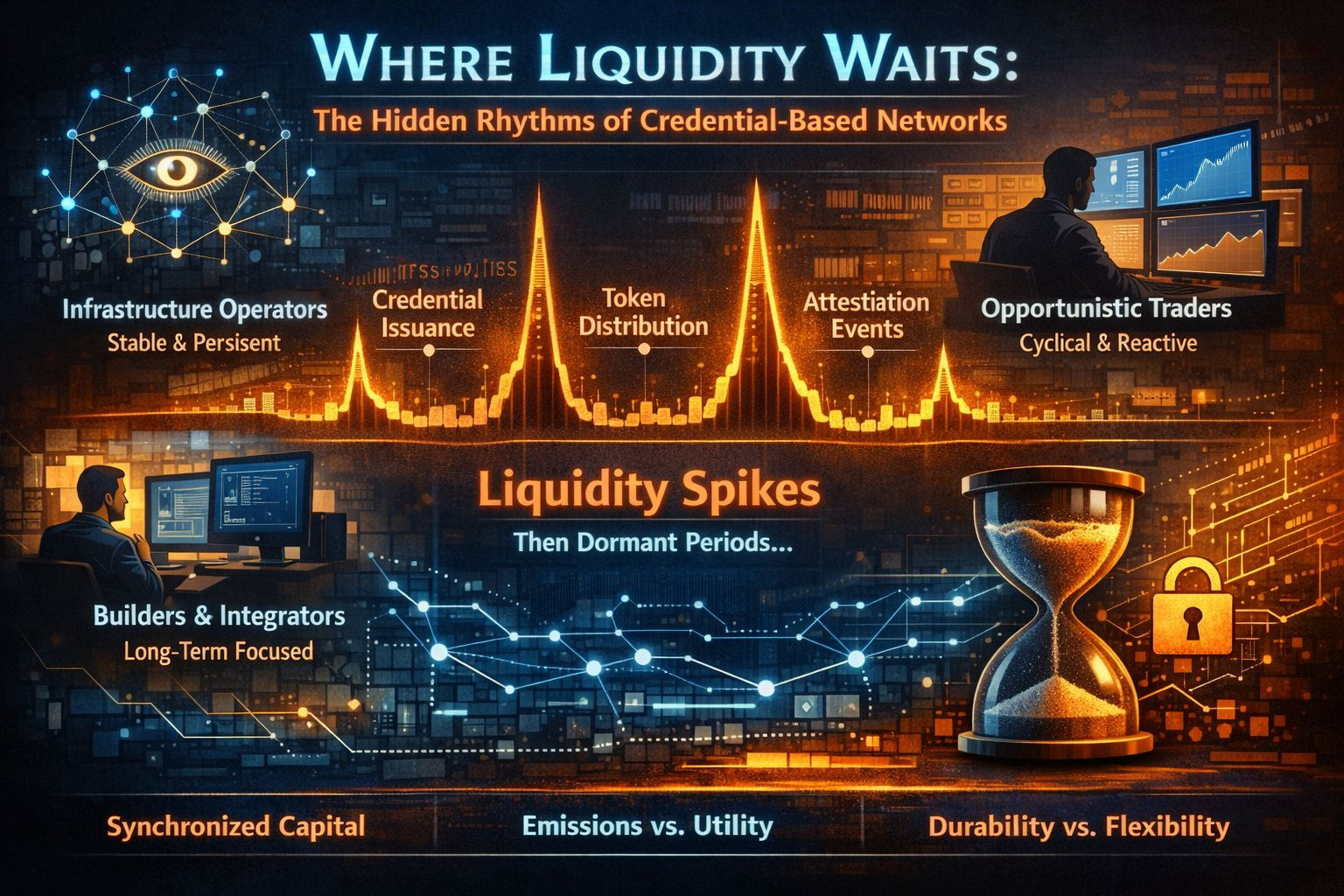
The first thing I noticed when I started tracking this emerging layer for credential verification and token distribution wasn’t transaction volumeit was timing. Activity doesn’t flow continuously the way it does on a typical DeFi venue. Instead, it arrives in pulses. You see tight clusters of transactions around issuance eventscredentials minted, attestations verified, tokens distributedand then long stretches where the chain feels almost dormant. That rhythm tells you immediately that this isn’t a liquidity-first system. It’s event-driven infrastructure.
Once you sit with the data for a while, the participant behavior starts to separate into distinct cohorts. There’s a class of actors behaving like infrastructure providersrunning nodes, verifying credentials, or maintaining data availability layers. Their capital is relatively sticky. They’re not reacting to short-term price volatility; they’re positioned around long-term participation rewards and network relevance.
Then there’s another layermore opportunistic, more fluid. These are participants rotating capital around issuance cycles. They show up when there’s a distribution event, optimize for whatever yield or token exposure is available, and then fade out once the immediate opportunity compresses. You can track them by wallet clustering: fresh inflows before distribution, rapid exits after.
And then there’s a third group that’s smaller but increasingly importantbuilders and integrators. These wallets don’t behave like traders at all. Their activity is tied to contract deployments, repeated interactions with verification primitives, and long-lived usage patterns. They’re not chasing emissions; they’re embedding the system into something larger.
What this mix reveals is that the network is balancing between two economic identities. On one side, it’s trying to function as infrastructuresomething persistent, embedded, and quietly compounding in relevance. On the other, it’s still reliant on token-driven coordination, which inevitably introduces cyclical, incentive-driven capital.
The incentive design is where this tension becomes most visible.
Verification isn’t free. Whether it’s cryptographic proofs, identity attestations, or off-chain data validation, there’s a real cost to computation and coordination. The protocol subsidizes that cost through token emissions and distribution mechanisms. But the way those emissions are structured creates very specific liquidity behavior.
Capital doesn’t sit idle here. It waits.
Participants position ahead of known issuance windowscredential drops, retroactive distributions, or staking reward cycles. Liquidity builds quietly, then releases all at once. You can see it in the on-chain data: wallet balances increase in anticipation, transaction counts spike during the event, and then everything thins out again.
This pacing matters. It tells you that capital isn’t deeply committedit’s synchronized.
The question then becomes: how much of that capital transitions from synchronized to durable?
Staking mechanics play a big role here. If participation requires locking tokens to verify or validate credentials, you start to see longer holding periods. But the effectiveness depends on how those locks are structured. Short-duration staking with high emissions tends to attract mercenary capitalparticipants who are willing to lock, but only as long as the yield justifies the opportunity cost.
Longer-duration commitments with non-linear rewards can shift behavior, but they also reduce flexibility, which many market participants resist unless they have high conviction in the system’s future utility.
Another subtle dynamic is the split between verification and execution costs. Verification is the core function, but executionactually using those credentials in downstream applications—is where real economic density should form. Right now, most of the value is still concentrated at the verification layer. That’s why activity spikes around issuance rather than usage.
From a market microstructure perspective, this creates predictable liquidity windows.
You don’t get constant order flow. You get bursts. Traders who understand the cadence position around those bursts rather than trying to trade continuous volatility. Liquidity providers adjust spreads accordinglytight during events, wide during inactivity. It’s not unlike older farming cycles, but with a more structured trigger tied to protocol-specific events rather than generic yield opportunities.
What’s interesting is how similar this feels to early-stage infrastructure plays in previous cycles. Not in terms of narrative, but in terms of capital behavior. There’s an initial phase where emissions drive attention, followed by a compression phase where only the participants with a real reason to stay actually remain.
The long-term question is whether this system can transition from emission-driven coordination to utility-driven persistence.
Right now, a meaningful portion of activity is still tied to distribution. That’s not inherently a problemit’s how networks bootstrap. But you can already see hints of what happens when incentives compress. The opportunistic layer becomes thinner. Liquidity windows shrink. What’s left is a smaller, more stable base of infrastructure operators and builders.
If the protocol succeeds, that base expands not because of emissions, but because credentials themselves become economically relevantused across applications, required for access, or embedded into other systems.
If it doesn’t, the network risks becoming episodic. Active during distribution cycles, quiet in between.
What I think the market is underestimating is how sensitive this system is to timing alignment. It’s not just about how much is emitted, but when and how predictably. Too predictable, and capital games it. Too random, and participation drops because coordination becomes difficult.
The real opportunity here isn’t in the token mechanics aloneit’s in whether the protocol can create a layer where verification activity becomes continuous because it’s needed, not because it’s incentivized.
Right now, we’re not fully there. But you can see the outlines forming in the data. And that’s usually where the more durable opportunities start to emergenot when the system is fully built, but when the behavior begins to shift in ways most participants haven’t yet priced in.
#SignDigitalSovereignInfra @SignOfficial $SIGN
