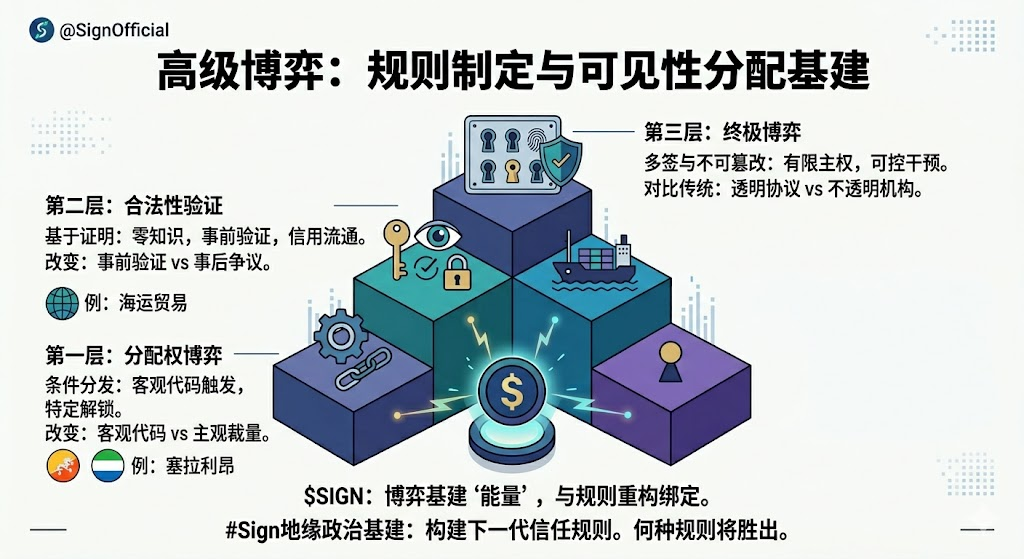
In the market's gambling game, people always think that the core of the game is guessing price fluctuations. But the truly advanced strategy is to see and participate in the formulation of rules and the distribution of information visibility. The rules of the traditional financial system are written in thick legal texts and the black boxes of centralized servers, while the @SignOfficial $SIGN ecosystem is writing the rules of the next global value game into immutable code, defining what should be visible and what must remain hidden. This is the true infrastructure of visibility in the game.
The first layer of the game that I observed is the struggle for the distribution of rights. Traditional welfare, subsidies, or project airdrops are essentially the unilateral interpretation and execution of who should receive these rules by centralized agencies. The rules are opaque, and execution can be tampered with, which gives rise to rent-seeking and witch hunts. The TokenTable engine in the $SIGN ecosystem introduces conditional vesting. It transforms the distribution rules from subjective discretion into objective code: assets will only unlock when specific on-chain identities (Targeting) are met, when within specific geographical fences, or after a specific time. This changes the payoff matrix of the game: the cost for attackers to forge identities rises sharply, while the expected returns for compliant participants become stable and predictable. When sovereign entities like Bhutan and Sierra Leone adopt this system to distribute key resources, they are not competing for short-term interests, but rather for the authority to establish trustworthy execution rules, which is the foundational capital for long-term stability.
The second layer of the game is the verification of the legitimacy of actions. In complex transactions or multinational collaborations, the biggest friction lies in how to prove to multiple parties that a certain prerequisite has been met. The traditional way relies on easily forgeable paper proofs or delayed centralized notarization. The Attestation-based Execution framework provided by Sign Protocol moves the game to the proof itself. You can use zero-knowledge proofs to confirm to smart contracts or collaborators that you have completed KYC, that you have specific qualifications, or that goods have been shipped, without disclosing any sensitive data. This means that the focus of the game shifts from post-dispute and claims to pre-verifiable commitments. On-chain proofs (Attestation) become tradable and composable 'credit atoms.' When trade financing in Gulf countries starts to rely on such verifiable proofs, the advantage of the game shifts to those who can generate trustworthy proofs instantly and at low cost.
The third layer, and also the most fundamental game, is the right to interpret and veto ultimate rules. Any system needs to upgrade and respond to extreme situations, but who triggers changes and in what manner? Traditional companies have board decisions, which pose a risk of single-point malfeasance. The architecture of SIGN designs a clever balance through multi-signatures and immutable logic (Multi-sig & Immutable Logic). The upgrades or emergency operations of key contracts are controlled by multiple signatures, dispersing power; while the core business logic (such as distribution rules, proof verification algorithms) becomes immutable once deployed. This creates a game environment of limited sovereignty: participants are confident that the foundational rules will not be arbitrarily changed (certainty), while also believing that in extreme cases, a multi-signature group composed of trusted entities can intervene as necessary (flexibility). This design is precisely what sovereign nations value most when seeking digital autonomy: it prevents external single-point interventions while retaining necessary internal governance levers. Therefore, investment$SIGN logic extends far beyond simply betting on a tool token. It is betting on a profound paradigm shift: the game rules of the value internet are transitioning from reliance on opaque authoritative institutions to reliance on transparent, verifiable cryptographic protocols. $SIGN, as the 'energy unit' driving the generation, verification, and TokenTable conditional distribution of Sign Protocol proofs, is deeply tied to the process of this rule reconstruction. The more geopolitical conflicts highlight the fragility of traditional trust channels, the more rigid this code-based, auditable game infrastructure becomes. This is not about which country will win, but about which set of trust-establishing rules will prevail in the next era.#Sign地缘政治基建 is precisely what is being constructed.