

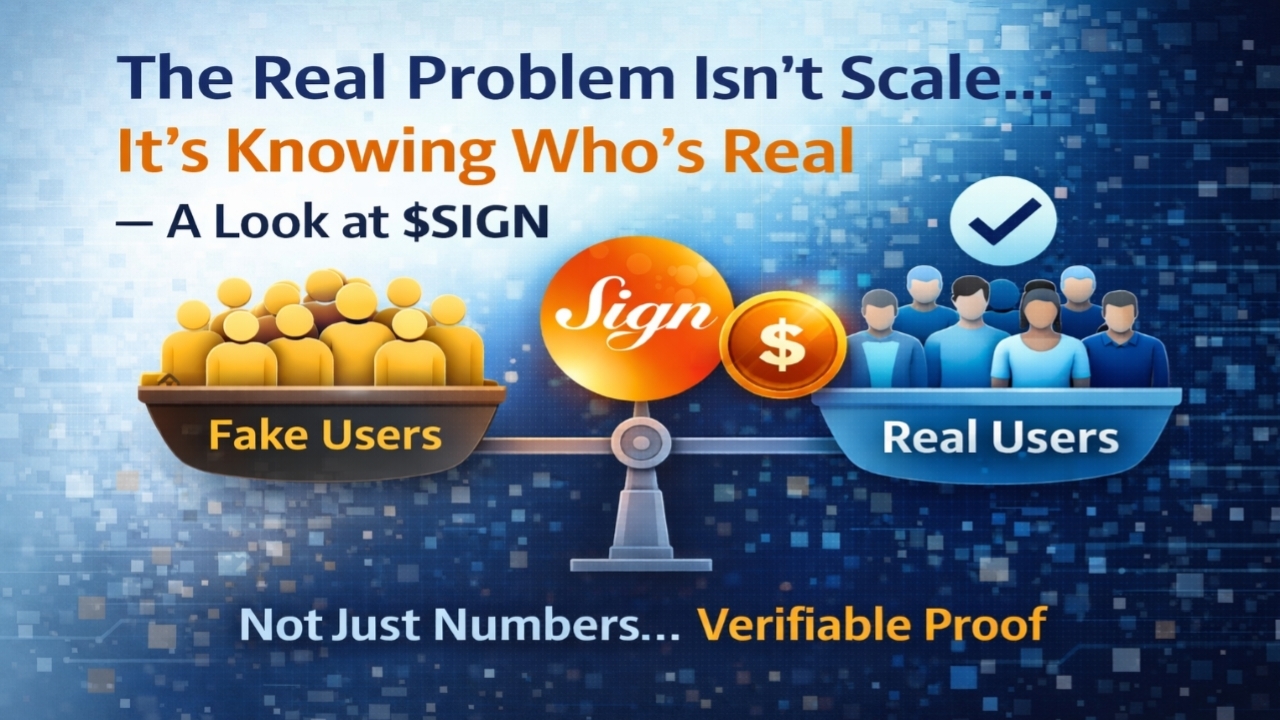
I was scrolling through a campaign the other day, and something felt off.
There were thousands of participants, but the engagement didn’t feel real. Same type of activity. Same patterns. It made me wonder… how many of these users are actually genuine?
And more importantly - do systems even know the difference?
That question stayed with me.
Because most digital platforms today focus on growth, not authenticity. They count numbers, but they don’t always verify the reality behind those numbers.
That’s where things start to break.
This is what led me to look deeper into @SignOfficial and $SIGN.
From what I understood, the idea isn’t just about building faster systems… it’s about building more honest systems.
With $SIGN, actions can be backed by something verifiable. Not just activity logs, but actual proof that something happened, under the right conditions.
And that changes how systems behave.
Because when actions are tied to verifiable records, fake participation becomes harder. Bots can mimic activity, but they can’t easily replicate trusted proof.
That’s where the gap starts to close.
What stood out to me is how this doesn’t try to block users… it simply raises the standard.
Instead of asking “how many users joined?”, the system can start asking “how many of them are real and verified?”
That shift feels important.
Especially in areas like airdrops, campaigns, public programs, or even financial systems, where fake activity can distort everything.
In my view, $SIGN is not just improving verification… it’s improving signal quality inside digital systems.
Less noise. More clarity.
And when systems become cleaner, decisions become better too.
Looking ahead, I feel like this will become more necessary than optional. Because as systems grow, the biggest challenge won’t be attracting users… it will be trusting them.
$SIGN seems to be solving that quietly - by making sure actions can be proven, not just performed.
@SignOfficial
#SignDigitalSovereignInfra
