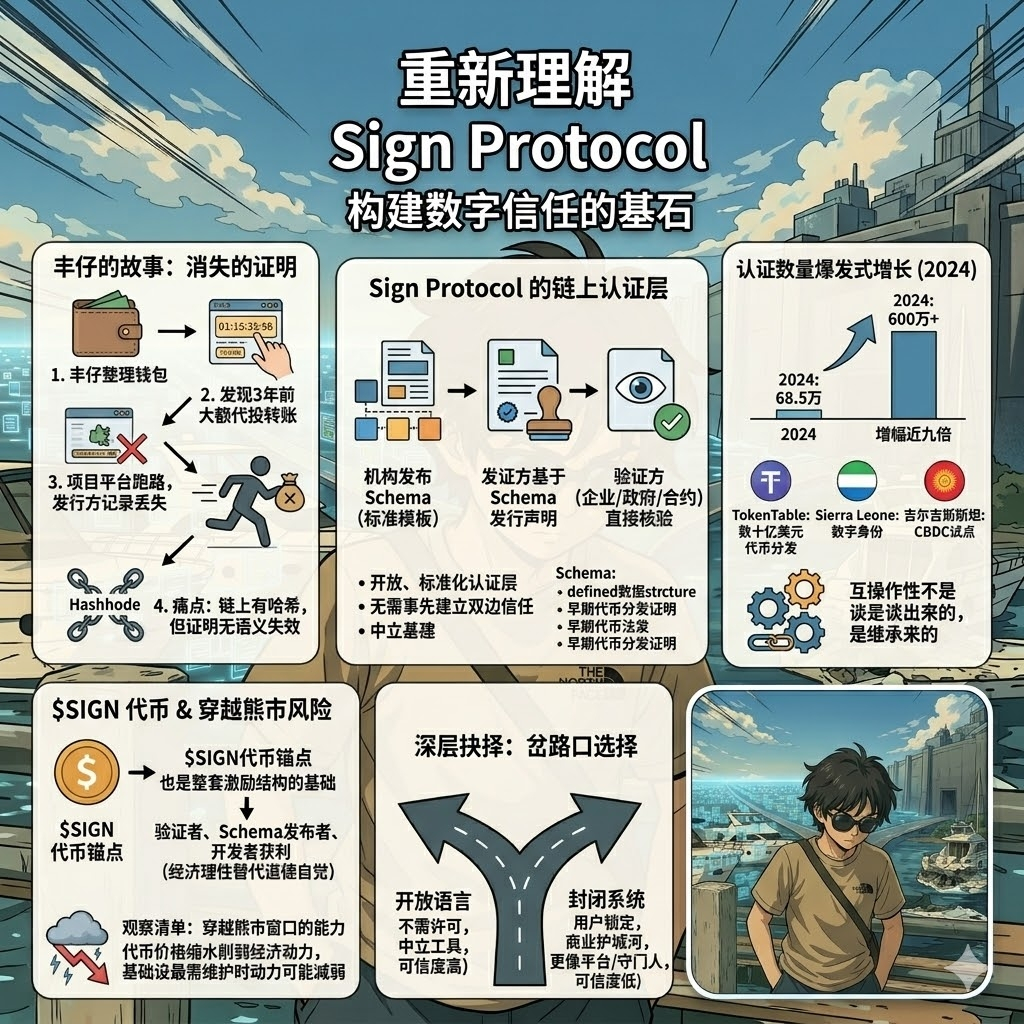
Taking advantage of Saturday, Fengzai organized his wallet and took a look at the historical transaction records, a large transfer record from three years ago caught his attention, and then Fengzai began to re-understand the Sign Protocol @SignOfficial
That large transfer was made to help a friend. In 2021, he participated in the early token distribution of a project; the platform later disappeared, and all records were lost. He asked me if there was any way to prove that he really participated back then and received that batch of tokens. We searched for a long time; the wallet history was there, but the issuer's certification records had completely vanished. There were transactions on-chain, but the proof of what that transaction "meant" died along with that centralized platform. This is why Fengzai began to seriously look at the Sign Protocol. Not because of its financing backing or because of government collaboration press releases, but because it attempts to solve precisely the kind of failures I have witnessed.
What the Sign Protocol does can be simply stated as follows: it builds an open certification layer on-chain, allowing any institution to publish schemas, which are standard templates defining "what a certain type of proof looks like"; any issuer can issue verifiable statements based on this template; any verifier, whether a business, government system, or smart contract, can verify directly without the need to establish a bilateral trust relationship with the issuing agency in advance.
Interoperability is not negotiated, it is inherited. This is evidenced in the data. In 2024, the number of certifications on the Sign Protocol grew from 685,000 to over 6 million, an increase of nearly nine times. TokenTable: the module responsible for token distribution in the Sign ecosystem has handled distributions amounting to over several billion dollars. Sierra Leone is using it for digital identity, and Kyrgyzstan is using it for a central bank digital currency pilot. These are not plans in a white paper but are deployments that are already operational.
But what Fengzai really wants to discuss is a deeper choice facing the Sign Protocol, a choice that Fengzai feels is not sufficiently discussed in the market at present.
Any project working on "trusted infrastructure" stands at an invisible fork in the road: one path is to let the protocol become an open language that anyone can use, without permission and without dependencies; the other path is to deepen the product, leading users deeper into it, ultimately becoming a closed system with a moat.
The second road looks better in the short term: high user stickiness, clear commercial monetization, and a smooth financing narrative. But the logic of trusted infrastructure is precisely the opposite: the more a certification protocol resembles a "platform", the lower its credibility as a "neutral infrastructure". People can perceive that when a system starts to shape outcomes instead of merely recording them, it transforms from a tool into a gatekeeper.
When I observed the actions of the Sign Protocol in the Middle East, I felt this tension. Abu Dhabi, regulatory framework, sovereign infrastructure: these words combined have great power and can easily be interpreted by the market as "government backing equals price increase". However, "real use" and "strong narrative" appear identical in the early stages, with the difference only becoming apparent two years later.

Currently, the price is still significantly distant from the historical high. The tokens serve not only governance functions within the protocol but also anchor the entire incentive structure: validators, schema publishers, and integration developers all gain value distribution through it. Fengzai believes this design logic is valid: using economic rationality to replace moral consciousness to maintain public infrastructure is more sustainable than relying on "community spirit".
However, there is a risk that Fengzai thinks needs to be on the observation list: this incentive alignment operates well when token prices are stable, but during a bear market cycle when token values plummet, the economic motivation of contributors will weaken accordingly, while the infrastructure precisely needs maintenance during that time. The ability to "navigate the bear market window" is the variable I currently want to validate most.
The records of my friend's missing tokens were ultimately not recovered. Not because the on-chain data was lost, but because there was no standardized certification layer back then to lock in "what this distribution meant".
If the Sign Protocol goes the right way, such situations will be much less common in the future.
Have you ever encountered a situation where "there are records on-chain, but they don't prove anything"? What was the scenario?