
I’ve spent a long time watching different systems claim they can “fix trust,” and over time that’s made me naturally skeptical. Human behavior rarely follows clean rules. People lie, forget things, exaggerate, panic, follow trends, and sometimes act irrationally even when incentives are clear. That mindset is what I bring when I look at SIGN. Interestingly, that’s also why the project feels more realistic to me than many others. Instead of assuming humans will behave like perfectly predictable nodes in a network, SIGN seems to acknowledge that trust is fluid and contextual while still trying to organize credibility in a structured way.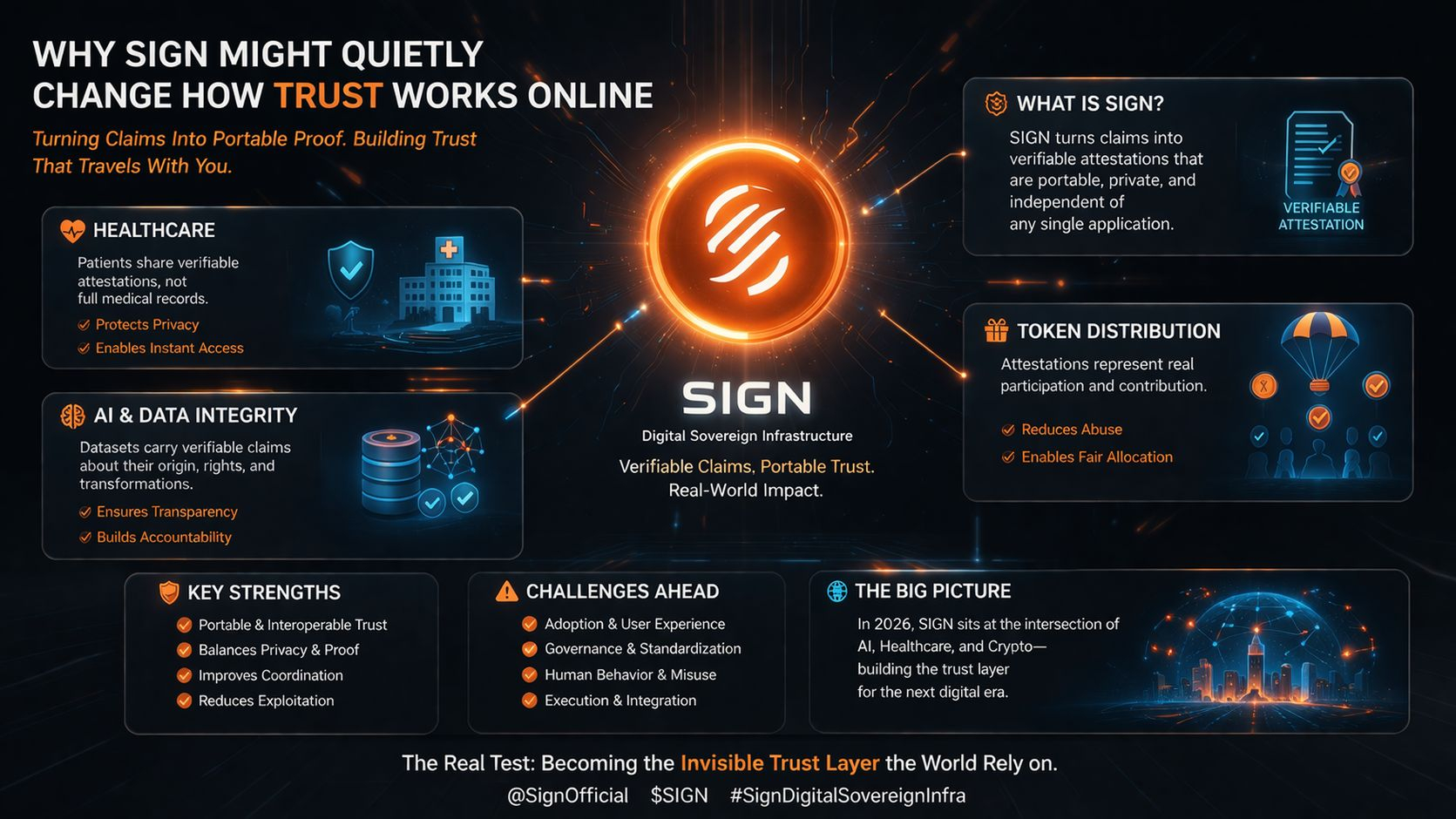
When I think about what SIGN is trying to do, the easiest way I describe it is turning claims into portable proof. Right now, most systems force us to repeatedly prove the same things about ourselves. Whether it’s logging into a new platform, verifying identity for financial services, or qualifying for token distributions, we constantly repeat similar verification steps. It’s inefficient, but more importantly it fragments trust. Each platform ends up acting like its own isolated verification island. SIGN attempts to change that by letting attestations — verifiable claims — exist independently from any single application. That simple shift could change how systems coordinate with each other.
I find the idea even more interesting when I imagine it outside the crypto space. Take healthcare, for example. Patient information is often scattered across hospitals, labs, and insurance systems that don’t communicate effectively. In a model similar to SIGN, a person wouldn’t need to reveal their full medical record every time. Instead, they could present verifiable attestations like “I have been diagnosed with this condition” or “I qualify for a specific treatment.” That creates a balance between privacy and proof, allowing action without unnecessary exposure of sensitive data.
The same concept could also be useful in AI development, which I’ve been paying more attention to recently. Questions around training data are becoming more serious: where the data came from, whether it was ethically sourced, and how it has been modified. Right now much of this relies on trust in institutions or incomplete documentation. If datasets carried verifiable attestations about their origin, usage rights, and transformations, systems could validate those claims cryptographically instead of relying on blind trust. SIGN seems naturally aligned with that kind of future where data carries a verifiable history with it.
Another area where this idea feels relevant is token distribution. I’ve seen countless airdrops and incentive systems get abused because they rely on weak indicators of participation. Bots farm rewards, users manipulate eligibility rules, and projects end up distributing value in ways that don’t reflect genuine contribution. If attestations can represent real participation or meaningful involvement, then distribution becomes more intentional. It shifts from something that feels like a lottery toward something that resembles structured allocation.
That said, I still see some obvious challenges. Adoption is probably the biggest one. Many technically strong systems fail simply because they never reach enough users or developers. For SIGN to become meaningful infrastructure, developers need to integrate it and users need to interact with it effortlessly. Most people don’t care about credential layers or attestations — they just want things to work smoothly. If the experience feels complicated, they’ll abandon it quickly. Ideally, the best version of this technology would be almost invisible, quietly working behind the scenes.
Governance is another question that stays in the back of my mind. Who ultimately decides what counts as a valid attestation? In theory, decentralization spreads that power across many participants. But historically, standards often end up being shaped by a small group of influential players. If credibility standards are defined by a limited set of actors, the system risks inheriting the same biases and gatekeeping problems that exist in traditional institutions. This isn’t a challenge unique to SIGN, but it’s something any trust infrastructure will have to confront.
Human behavior itself is another unpredictable layer. Even with strong verification mechanisms, people can still misuse systems. They can present information selectively, create misleading claims, or exploit edge cases in the rules. I’ve seen protocols fail not because the technical design was flawed, but because the human element wasn’t fully accounted for. What I find somewhat reassuring about SIGN is that it doesn’t seem to ignore this reality. By making attestations transparent and verifiable, it at least increases the chances that inconsistencies will be noticed early.
Looking at where we are in 2026, the timing feels interesting for something like this. Conversations around AI are shifting toward accountability and data transparency. Healthcare systems are under pressure to become more interoperable while still protecting privacy. And in the crypto world, there’s a gradual shift from pure speculation toward infrastructure that actually solves coordination problems. SIGN appears to sit right where these trends intersect, which gives it relevance beyond a single niche.
Still, I try not to get carried away with the narrative. I’ve watched too many promising ideas struggle to translate into real adoption. The gap between potential and execution is always larger than it first appears. In the end, what will matter most isn’t how elegant the idea is, but whether developers adopt it, whether partnerships form, and whether real-world systems start integrating it. The true test for SIGN isn’t just building a strong attestation system — it’s becoming a layer people rely on without even realizing it.
