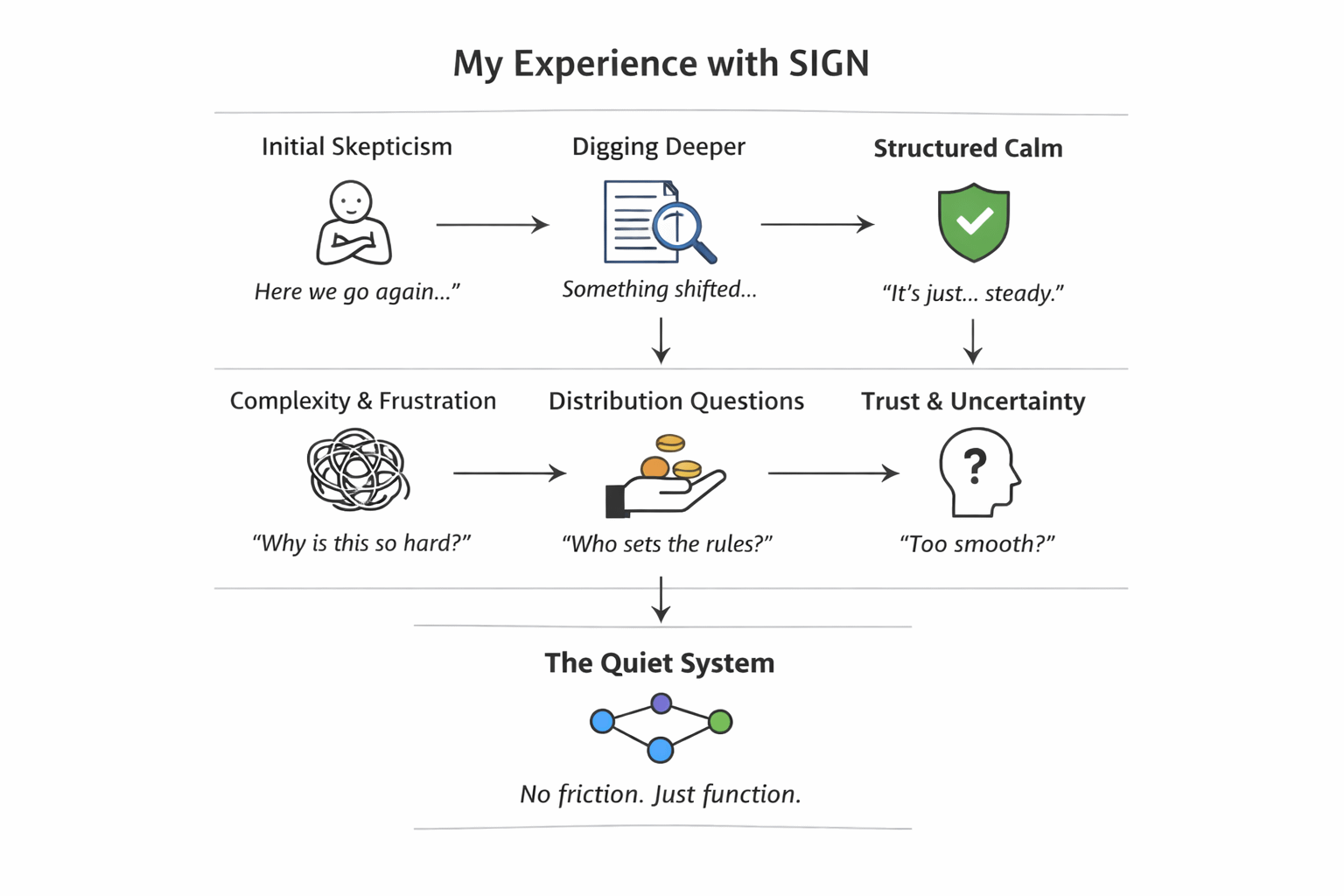
If I’m being honest, when I first opened SIGN’s documentation, my reaction wasn’t curiosity—it was skepticism. I remember leaning back in my chair, arms crossed, thinking, here we go again… another project trying to sound deeper than it actually is. That’s usually how it starts. But I stayed with it.
And somewhere along the way, something shifted.
I noted while going through the system—really trying to follow how everything connects—that it didn’t behave the way I expected. It didn’t try to impress me. It didn’t simplify things just to make them look elegant. If anything, it felt like it was asking me to slow down. Which, honestly, was a bit frustrating at first.
There was even a point where I got stuck.
I had been reading the same section over and over, trying to understand how verification, attestations, and distribution actually tie together in practice. And I’ll admit—it wasn’t clicking. Not in the way I wanted it to. I remember closing my laptop, walking around for a bit, and thinking, why is this harder to grasp than it should be? It felt like I was looking at a map of a city I’d lived in my whole life—but all the street names had been changed overnight. The layout was familiar. But I couldn’t find my way home.
When I came back, things started to settle. Not completely. But enough.
What actually struck me—after the third cup of tea and a bit of pacing—was that SIGN doesn’t try to “sell” you. In an industry built on noise and constant announcements, it feels… understated. It just sits there. Structured. Almost stubbornly calm. Like it’s waiting for you to catch up instead of chasing after you.
And honestly? That kind of confidence is either brilliant or a massive red flag.
I’m still trying to figure out which one it is.
At its core, SIGN is dealing with something we all experience but rarely question: the constant need to prove ourselves. Who we are. What we qualify for. Whether we belong somewhere. And while reading through its design, I kept thinking—why do we keep doing this over and over again?
It’s exhausting.
And if you zoom out a bit, it’s also kind of strange.
Think about everyday life. You show your ID at the entrance of a building. Then again at the reception. Then again for access inside. It’s like showing your ID to the bouncer at a club, then to the bartender, and then—for some reason—having to show it again just to leave. At some point, it stops feeling like security and starts feeling like a glitch in how we operate.
That’s the pattern SIGN is trying to challenge.
Instead of forcing systems to verify everything from scratch every time, it introduces attestations—structured claims that can persist. But here’s the important part: this isn’t just a digital stamp or a one-time signature. It’s more like a piece of living proof. Something that can move between systems, be referenced again, and still hold its meaning without being reissued every single time.
On paper, it’s one of those ideas that sounds so obvious you almost feel stupid for not thinking of it yourself.
But we know how “obvious” ideas behave in the real world.
They usually don’t work as cleanly as they should.
And that’s where my hesitation comes in.
Because while the design feels grounded—almost like it was built by people who were genuinely tired of broken systems—I keep wondering what happens when it meets reality. Not the ideal version of it. The messy version. The one full of exceptions, conflicting rules, and human behavior that doesn’t follow logic.
Will it hold up?
Or will it become another well-designed framework that looks perfect on paper but struggles to survive outside it?
I don’t know.
And that uncertainty hasn’t gone away.
The distribution side of SIGN makes things more interesting. This is where it starts to feel less theoretical. Allocating resources—money, access, benefits—is never simple. It’s always layered with questions of fairness, eligibility, and control.
SIGN approaches this by tying distribution to verifiable conditions.
Which sounds good.
But then again… who defines those conditions?
That’s the part that keeps bothering me a little.
Because no matter how clean the system is, the rules behind it are still human. Someone decides what qualifies. Someone decides what doesn’t. So even if everything is transparent, bias doesn’t disappear—it just becomes easier to trace.
And maybe that’s enough. Maybe that’s the goal.
As I sat with this longer, I started to see SIGN less as a solution and more as a shift in perspective. It doesn’t remove trust—it reorganizes it. Instead of constantly asking “can we trust this?”, it asks “has this already been verified in a way we can rely on?”
It’s a small shift.
But it changes everything.
At least in theory.
Because in practice, it introduces a new kind of dependency. A quiet one. Now we’re not just trusting institutions—we’re trusting the system that records and carries their claims forward.
And I’m still not fully comfortable with that.
There were moments where everything felt a bit too neat. Too clean. And that bothered me more than complexity ever could. Real systems are messy. They break. They contradict themselves. They evolve in ways no one predicts.
So I kept asking myself: where does this break?
I still don’t have a clear answer.
And that’s probably the most honest place to be.
What I can say is this: SIGN doesn’t feel like a product trying to win attention. It feels like an attempt to build something foundational. Something that, if it works, disappears into the background. Quietly handling verification. Quietly enabling distribution. No friction. No repetition.
Just… function.
And that’s the part that stays with me.
Because my personal view is that the real challenge here isn’t technical—it’s human. We complain about friction, but we also rely on it. Standing in line, handing over documents, watching the process unfold—it gives us a strange kind of reassurance. Like, okay, this is being done properly.
Take that away, and what are we left with?
A system that just… knows.
And that’s the scary part.
But what do you think? Are we actually tired of the friction, or is the friction the only thing that makes us feel secure? Are we ready for a world where our identity quietly moves through systems without us constantly proving it—or does that “too smooth” feeling make you uneasy too? I’m honestly still not sold either way.