That news from Reuters last month gave me chills.
The outflow risk of deposits in Gulf countries has soared to 307 billion USD; what does that mean? It is more than Qatar's entire annual GDP. Money is fleeing, but fleeing is not the problem—transferring USDT is simple; the real issue is: once this money has left, who still recognizes it as "clean"? Who will provide you with a certificate stating that "this money is fine" when crossing borders?
This is precisely the most magical aspect of the Middle East right now. The banking system in the UAE is crazily promoting digital identities, practically throwing away paper signatures into the Persian Gulf, while large funds are sitting in the Dubai Free Trade Zone, holding tens of millions of USDT, yet they dare not move.
It's not that they dare not move; it's that they don't know how to prove themselves "clean."
In the past two weeks, I have thoroughly examined the documents of @SignOfficial and found that this project is not at all a "plugin that issues certificates"; it targets the most painful point in global asset flows: when traditional trust channels are cut off by geopolitical conflicts, who will redefine the effective referee?
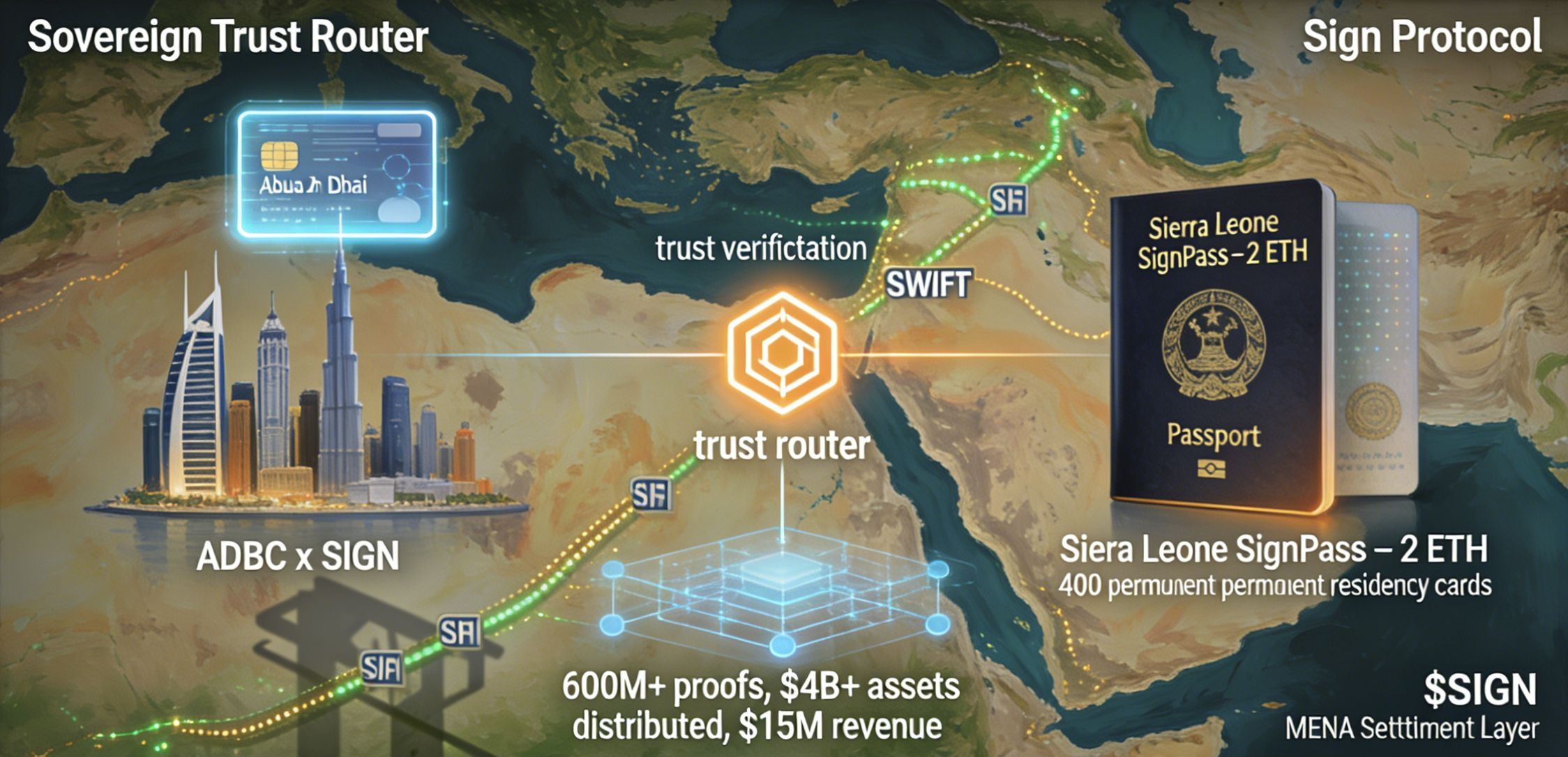
Let's look at some hard data, so no one says I'm exaggerating. SIGN processed over 6 million on-chain proofs in 2024, distributing more than 4 billion USD in token assets, covering over 40 million wallets. This is not some "testnet data"; it's real money coming out. What's even more impressive is that it generated 15 million USD in revenue last year—in an industry where most projects cannot even formulate a reasonable income model, SIGN has already made money by selling "trust infrastructure."
But the real reason I put SIGN on my core observation list is the line in Abu Dhabi.
ADBC is directly collaborating with SIGN to make Abu Dhabi a testing ground for the entire Middle East and North Africa region. Consider the logic of this matter: do Middle Eastern tycoons lack money? No, they do not. What they lack is a low-friction trust channel that is not controlled by a single Western system. Traditional cross-border settlements either go through SWIFT under scrutiny or through traditional intermediaries that are as slow as camels, often charging you a fee.
SIGN's Sovereign Chain and Sign Protocol combination directly targets e-Visa, import and export permits, and border verification—all sovereign necessities. Once it operates smoothly in the Middle East, it will become the "trust router"—funds, identities, trade permits; want to cross borders? You must pass my checkpoint first.
Of course, seasoned investors cannot just listen to stories without looking at the facts.
The biggest uncertainty for SIGN right now, I am closely watching two points. The first is token empowerment. The narrative sounds grand, but if institutional clients all "free ride" the technology framework with permissioned deployment, and all settlements are done with fiat and stablecoins, then the SIGN token is just a nominal mascot. The second is the pressure of circulation; currently, the circulation rate is only about 12%, so the unlocking pace needs to be monitored.
So why do I dare to exchange the profits from trading for SIGN spot now? Because the situation in Sierra Leone has shown me a different signal.
SIGN has already collaborated with the Sierra Leone immigration department to develop SignPass, allowing global citizens to apply for permanent residency for 2 ETH, having sold 400 slots and actually issued PR cards. This is not what a crypto project is supposed to do; this is using blockchain as sovereign infrastructure.
A project capable of running through sovereign-level cooperation, generating 15 million USD in revenue in a year, holding a distribution volume of 4 billion USD, is being treated by the market as a regular L2 concept—either I am crazy, or the market has not yet understood.
The more chaotic the world becomes, the more we need bottom-level infrastructure that does not rely on rhetoric but on efficient processes. SIGN is focused on the track of "self-certification of funds" and "mutual recognition of sovereign identities"; the rights to charge on this track are much more valuable than selling low-end products.
As for $SIGN how much is it worth? I am too lazy to draw a line. I only care about when that collaboration in Abu Dhabi will transition from pilot to full deployment, and whether those new institutional flows are truly leveraging the technology or genuinely integrating SIGN into the settlement loop.
Once either of these two indicators is achieved, the valuation logic of SIGN will no longer adhere to the "token issuance project" model.
Buy your life-saving positions first, and for the rest, let time run its course.