Sisters, happy weekend! I have been staring at that Reuters report for a long time this morning. Everyone is talking about how cross-border transfers have become cheaper, or watching the data showing a 5-fold increase in #USD1 supply on Solana.
But to be honest, if we only look at the rates, this matter is too competitive. The big financial companies of Web2 can also lower the fees with some effort.
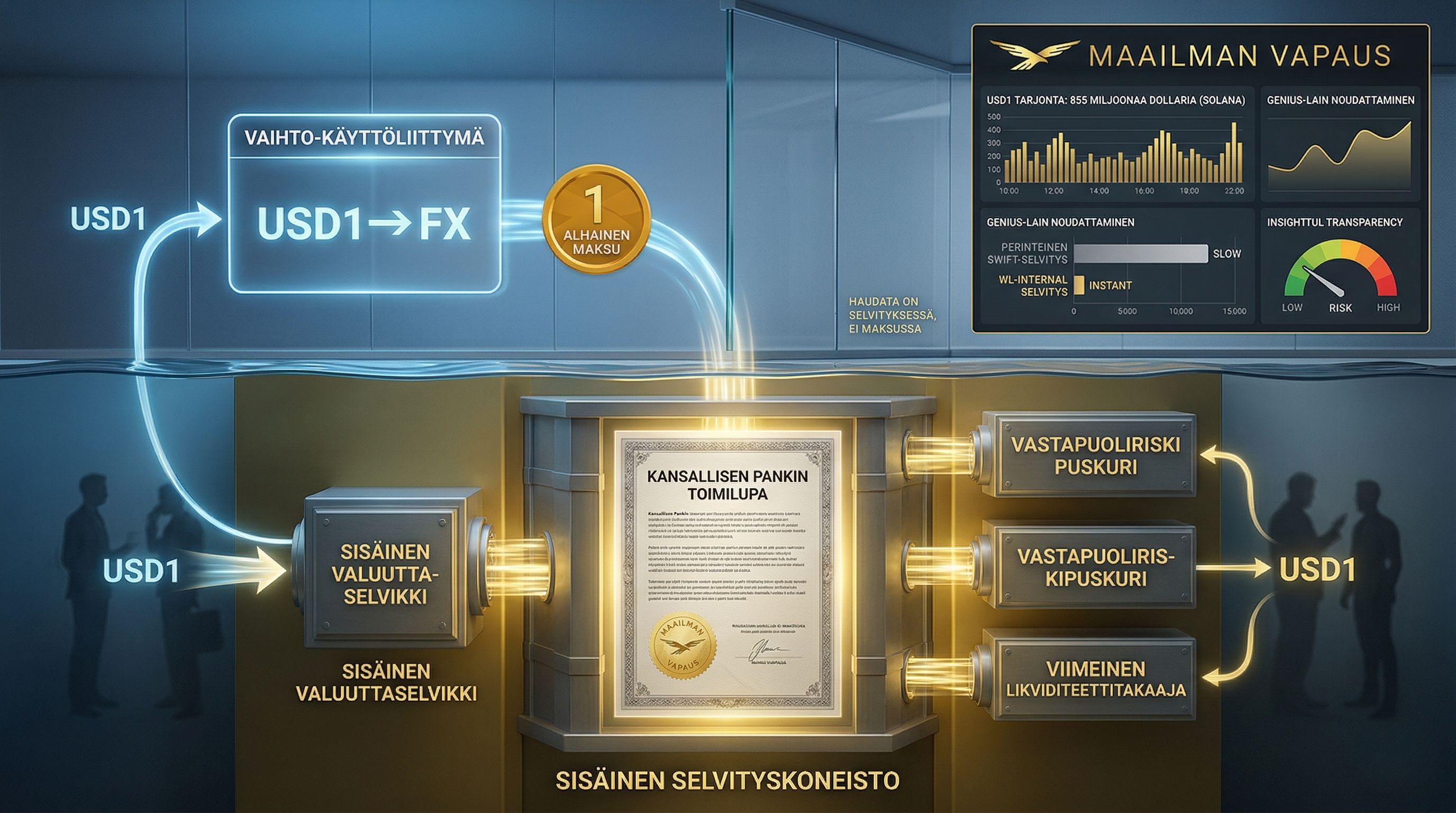
What I really care about is the issue that no one has mentioned, and even the officials haven't elaborated on, but which determines life and death: "The unspoken moat of World Swap, who will actually back the foreign exchange counterparty settlement?"
1. The rate is just superficial; the real value is in the settlement.
Many people think that World Swap's competitor is traditional wire transfers, believing that as long as they are faster than banks and have lower fees, they will win this game.
Wrong.
The hardest part is not the smooth one-click currency exchange button in the front end, but the liquidity gap that appears in that one second when you convert USD1 into fiat money and transfer it to a global bank account.
Foreign exchange (FX) is a huge counterparty game.
Without a top-notch final clearing party backing it up, this kind of cross-border business is like walking a tightrope in extreme market conditions.
2. That banking license is not just for show.
Did you notice World Liberty Trust's application for a national banking license in the U.S. in January?
This is definitely not just for compliance.
Once there is a license, @worldlibertyfi is no longer just a DeFi protocol.
It has become a financial entity with its own clearing capacity. In the past, stablecoin exchanges had to find a bunch of market makers to hedge risks. But if $WLFI follows the path of internal clearing + bank ledger...
What it grabs is not the transfer fee, but the juiciest part of traditional banks—the foreign exchange clearing premium.
3. USD1 transforms from trading chips into a settlement base.
Let's see through the hard logic behind this. The project side is not in a hurry to publicly explain the clearing logic, probably because this is the most core trump card.
#BitGo has secured the reserve safety at the issuance level.
#GENIUS legislation has resolved the legal red lines.
What #WorldSwap needs to solve is to turn USD1 into a global settlement conduit like blood.
When clearing capacity exceeds trading capacity, USD1 is no longer a high-yield financial product. It is a digital currency that resembles money more than a bank account.
4. A little rambling.
Since we want to be top-notch, I instead suggest that the authorities can moderately disclose some strategies regarding the risk compensation mechanism in the future.
Not only must there be PoR, but also transparency in counterparty risk hedging. When institutions see that every cross-border clearing has an unbreakable clearing logic behind it, rather than just relying on liquidity pools... only then can the awareness of WLFI users be truly maximized.
5. Finally.
The end of finance is not about who runs faster, but who stands firm in the face of risk.
1 dollar is just the beginning.
That last push depends on how World Swap reconstructs that foreign exchange jungle, which hasn't changed for decades, using clearing rights in the backend.
Stop just staring at that Swap button.
The truth is often hidden in those unspoken moats.
#WLFI #USD1 #WorldSwap #DeFi #stablecoin
This article only represents personal views and does not constitute any investment advice, DYOR!