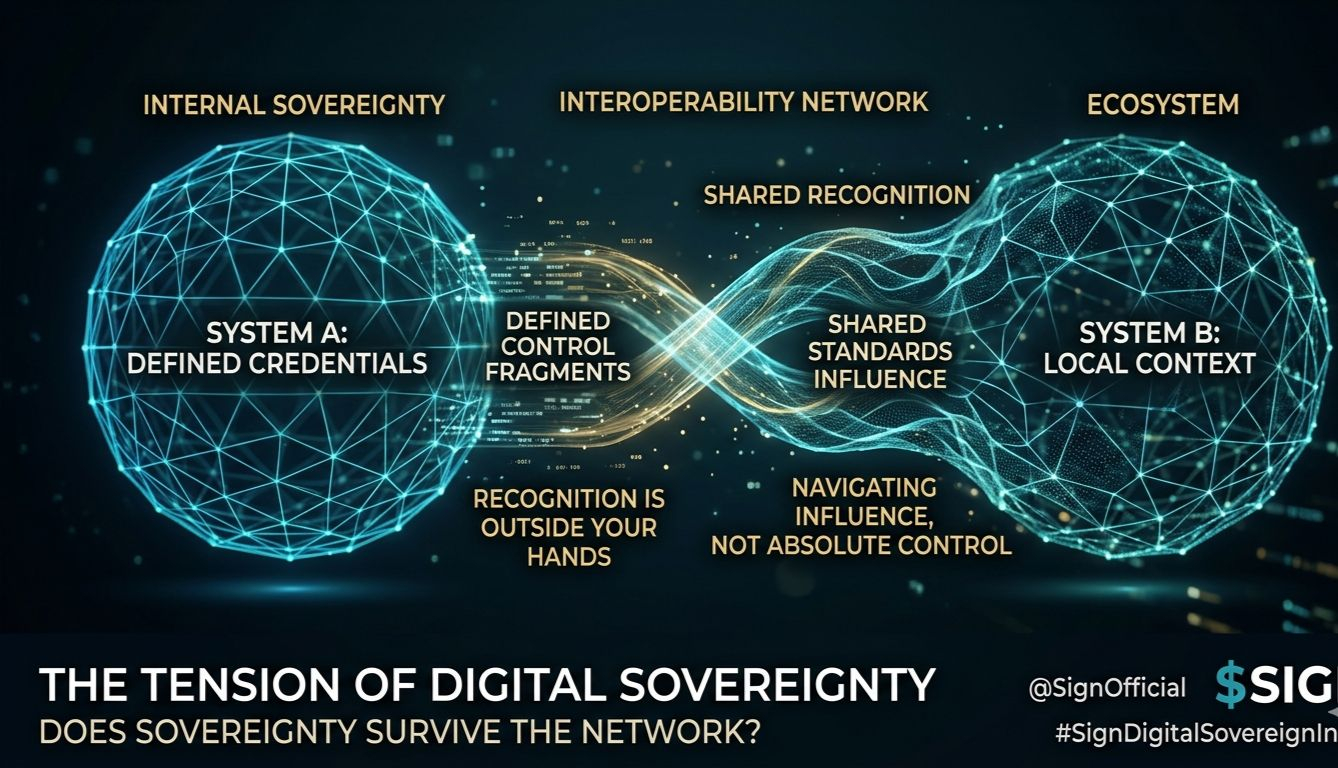
I’ve been sitting with this question for a while now, and the more I think about it, the less straightforward it becomes.
On paper, sovereignty in digital systems sounds clean. Each government, each institution defines its own rules, issues its own credentials, and enforces its own policies. That’s the promise behind @SignOfficial and $SIGN control stays where it originates. No central override. No external authority stepping in.
But reality starts to shift the moment these systems stop operating in isolation.
Because sovereignty doesn’t end at issuance it gets tested at recognition.
You can create the most precise, well-defined credential inside your own system, but the moment it crosses into another system, something subtle happens. Control fragments. Interpretation takes over. Another network decides what your credential means, how much trust it deserves, or whether it matters at all.
And that decision? It’s completely out of your hands.
That’s where the illusion starts to crack.
Interoperability makes everything more useful no doubt about it. Systems need shared formats, shared logic, shared expectations just to function together. But standards aren’t neutral. They evolve through influence. Through adoption. Through whoever has the weight to shape them over time.
No one forces alignment, but the pressure is always there.
Drift too far, and your credentials become less usable. Stay too rigid, and you risk becoming irrelevant in a network that rewards compatibility. So even without direct control being taken away, something quieter happens sovereignty begins to bend.
Not break. Not disappear. Just adjust.
That’s the tension I keep coming back to.
$SIGN introduces a model where systems can connect without collapsing into one another. That’s powerful. It avoids the extremes of full centralization and total fragmentation. But it also introduces a new dynamic one where participation itself becomes a form of influence.
Because the more valuable the network becomes, the harder it is to stand completely apart from it.
So the real question isn’t whether sovereignty exists inside the system.
It’s whether it survives the network.
Do you truly control your system if its value depends on how others perceive it?
Or does control slowly migrate outward from what you define internally to what the broader ecosystem agrees to accept?
That’s not a flaw in the model.
It’s the reality of shared infrastructure.
And maybe the future of sovereignty isn’t about absolute control anymore but about navigating influence without losing identity.