
 I’ve been thinking about Sign Protocol, and the more I sit with it, the clearer it becomes.
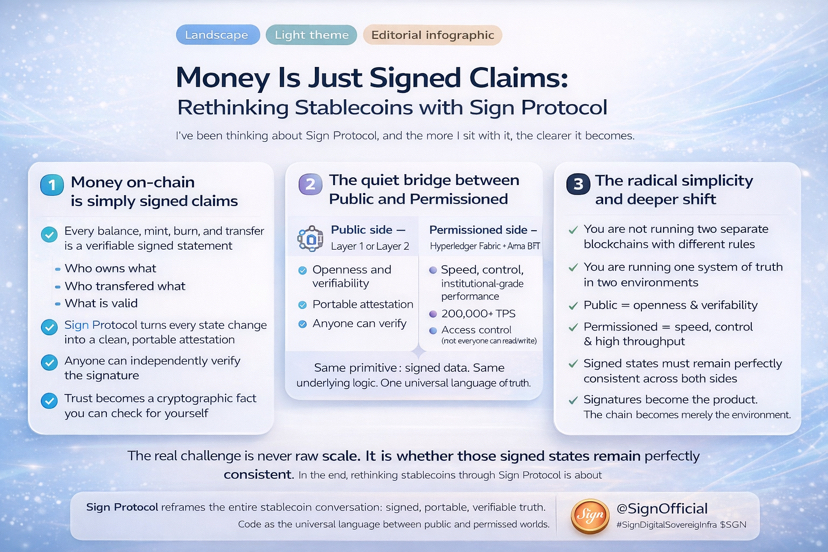
At its core, money on-chain has never really been “money” in the traditional sense. It is a continuous stream of signed claims: who owns what, who transferred what, what is valid, and what is not. Every balance, every mint, every burn is simply a verifiable statement.
Sign Protocol reframes the entire stablecoin conversation through this lens.@SignOfficial
On the public side — whether you’re running a Layer 2 or deploying directly on a Layer 1 — Sign turns every state change into a clean, portable attestation. Anyone can independently verify the signature. Trust is no longer a belief; it becomes a cryptographic fact you can check for yourself.
What makes it truly powerful, however, is how seamlessly it bridges to the permissioned world.
Running on Hyperledger Fabric with Arma BFT, the permissioned side still operates on the exact same primitive: signed data. The only real difference on the permissioned side is access control — not everyone can read or write. But the underlying logic stays exactly the same. A balance update is still a signed statement. A transfer is still a signed statement. Sign Protocol becomes the universal language that makes both environments speak the same truth.
This is the quiet elegance most people miss.
You are not running two separate blockchains with different rules. You are running one system of truth expressed in two different environments: public for openness and verifiability, permissioned for speed, control, and institutional-grade performance (200,000+ TPS). The high throughput claim only makes sense when you stop treating transactions as heavy on-chain computation and start treating them as signed attestations that can be validated and ordered efficiently.
The real challenge — and the true test — is never raw scale. It is whether those signed states remain perfectly consistent across both sides. If the public view and the permissioned view ever drift, the entire system of trust collapses.
What I respect most about this approach is its radical simplicity. Sign does not try to reinvent money or force everything onto a single chain. It simply structures everything around the one thing that actually matters: signed, portable, verifiable truth. Signatures become the product. The chain becomes merely the environment.
In the end, rethinking stablecoins through Sign Protocol isn’t about faster transactions or higher TPS. It is about building a single, coherent system of truth that can live anywhere — public or permissioned — without ever breaking its own logic.
That is a much deeper and more lasting shift than most people realize.
#SignDigitalSovereignInfra $SIGN
