
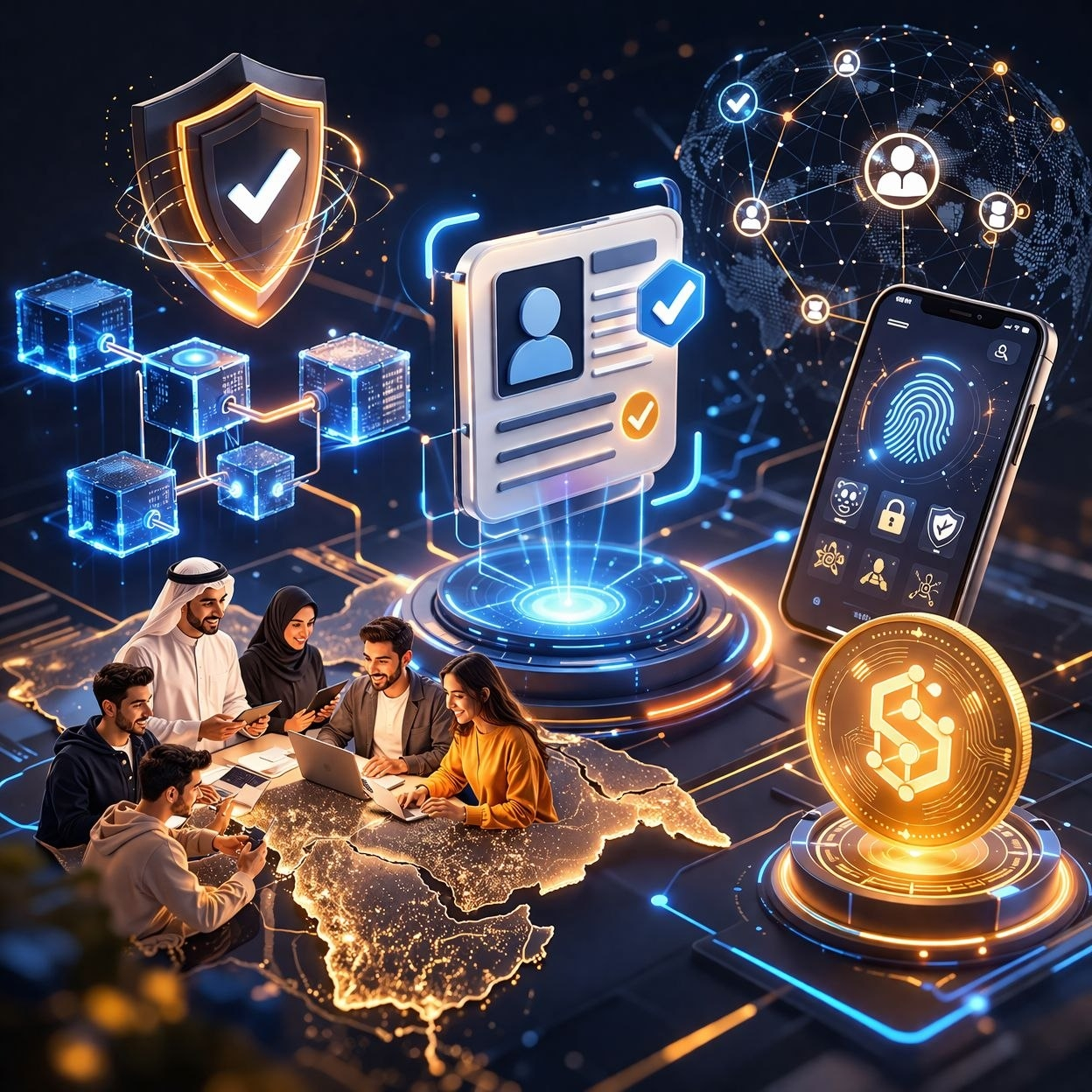
A question I had never asked myself before.
I used to think that owning my accounts, my data, and my interactions... meant that I owned my identity.
But over time, I started to notice something uncomfortable:
I do not own my identity...
I am just borrowing it from the platforms.
Every login, every authentication, every 'verification'...
was done on the terms of another party, not on my own terms.
Until I came across a project that did not offer me a new advantage...
But changed the question completely:
Sign Protocol
Did not tell me how to better document my data...
But made me ask for the first time:
What if I could own the “proof” itself... and not just the data?
The real shift in understanding
At first, I dealt with it as an ordinary technical protocol:
Documentation... verification... data.
But as I delved deeper, I realized that the idea is much deeper:
The matter is not “proving who you are”...
But “who has the ability to prove that?”
And this is where everything changed.
⚙️ How it works... without complication
The idea is brilliant in its simplicity:
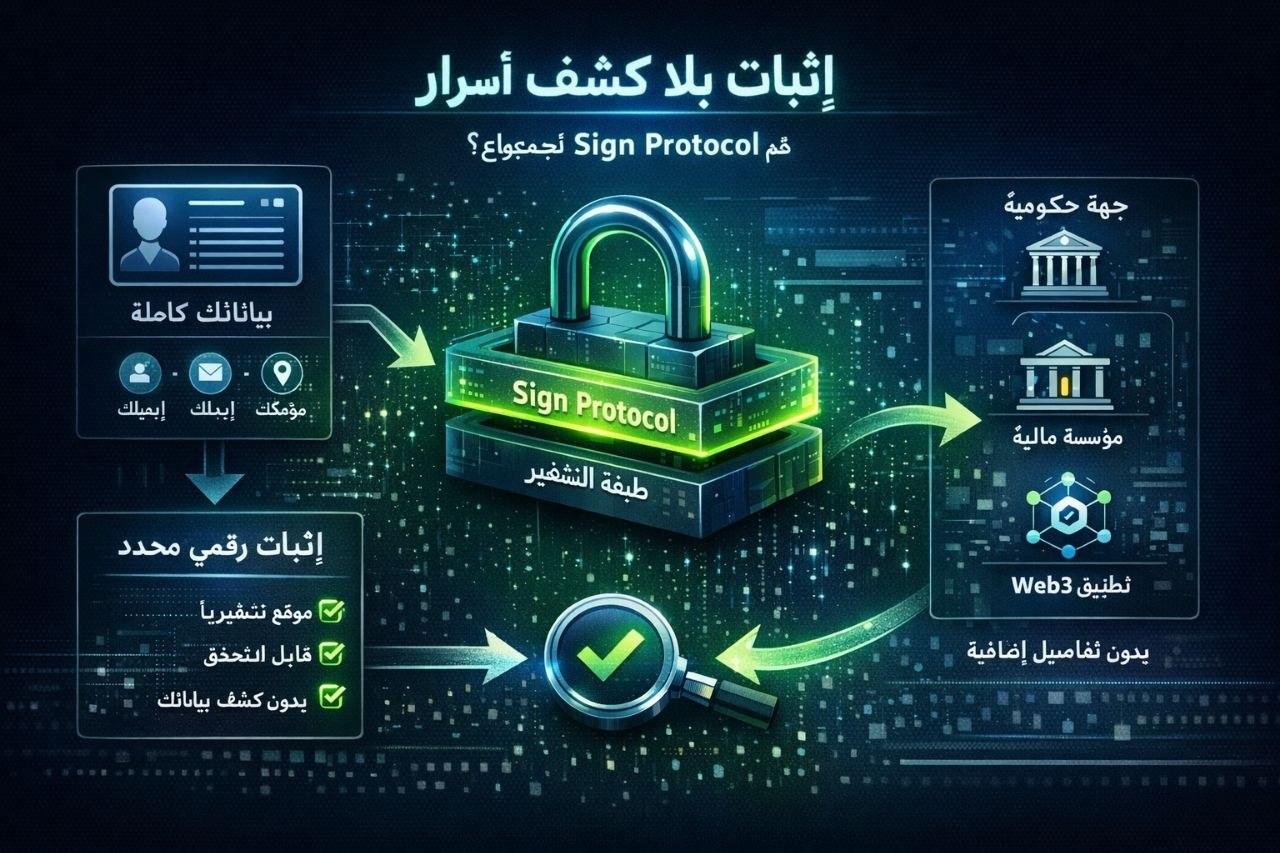
Instead of giving every entity all your data,
You can issue just one “proof”:
✔ Proves a specific piece of information
✔ Cryptographically signed
✔ Instantly verifiable
✔ Without revealing any additional details
🔐 For the first time, I felt that:
The control is no longer at the platform... but with me
🏗 Why is this project different?
Because it doesn't try to break current systems...
But builds on top of them.
It connects between:
• governments
• institutions
• Web3 applications
Through a single layer:
“Trust Layer”
And this is what makes it realistic... and applicable.
👨💻 From a developer's perspective (and here's the surprise)
The most surprising thing to me was not the idea... but the ease of building on it.
The system is based on 3 smart layers:
Encryption layer (complex... but hidden)
Protocol and SDK layer (this is where the developer works)
Application layer (user interface)
As a developer, you do not need to be an encryption expert.
You just specify “what you want to prove”... and the protocol takes care of the rest.
And this is rare in infrastructure projects.
🌉 The real power: interoperability
One of the most important strengths:
The project does not impose a single system.
But supports working across multiple networks (Cross-chain),
Which makes it suitable for environments like the Middle East
Where systems differ from one entity to another.
🤝 Partnerships... are not marketing but evidence
Over time, I realized that the project does not move randomly...
But builds itself through thoughtful partnerships.
And this is important because:
✔ Partnerships = actual usage
✔ Usage = trust
✔ Trust = real value
🌍 Why do I see a big opportunity?
Because the world—especially our region—is heading towards:
• Digital transformation
• Sovereignty over data
• Building trustworthy systems
In this context,
Sign Protocol does not offer a feature...
But provides an infrastructure that can be built upon
👈 The conclusion I reached
After this experience, my thinking changed completely:
I no longer see “verification” as a step...
But as an asset I own.
And I realized that the future will not belong to those who own the data...
But to those who own the proof
Sign Protocol is not just a crypto project...
But a new direction in thinking.
Project:
• Practical
• Scalable
• Built on a real need
• And progresses through clear steps
📌 And in the end, the question changed for me:
I no longer ask:
“Does this platform trust me?”
But I started asking:
“Do I own the proof... that allows me to enter any system with confidence?”
#SignDigitalSovereignInfra @SignOfficial $SIGN