Most people think that the hardest part of trading is judgment.
Actually, it isn't.
The hardest part of trading has never been whether to go long or short,
nor whether to find a buying point or a selling point,
but rather—
Clearly knowing that now is not the time to take action, you can still hold back.
This is the hardest part.
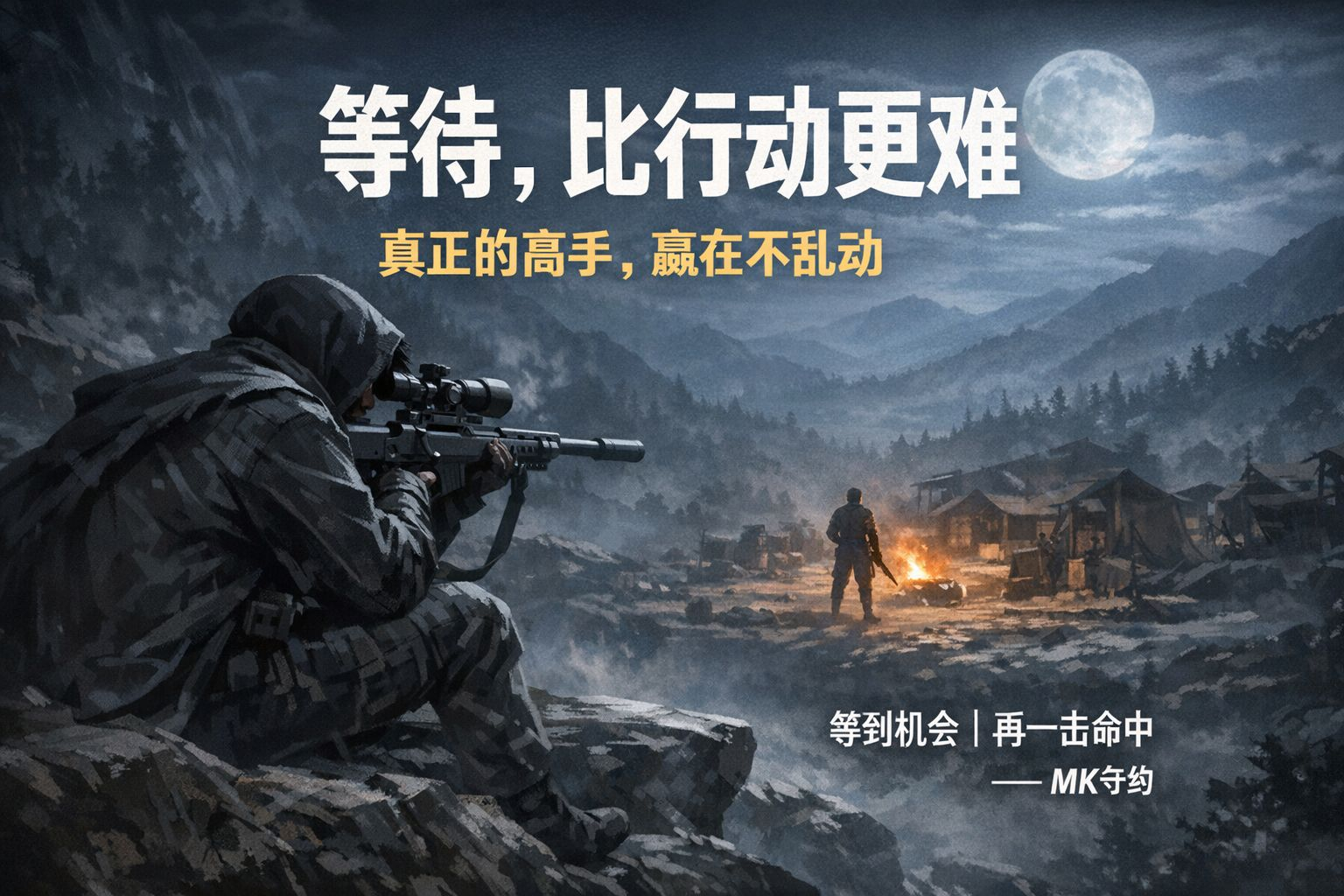
Many people lose money not because they lack skills.
But rather because they can't wait.
The chart hasn't formed yet, but I went in first.
The signal hasn't been confirmed yet, but I took a gamble.
The position isn't comfortable enough yet, but I rushed in.
The market hasn't given an answer yet, but people are already anxious.
In the end, it's not the market that forces you to trade,
it's you who can't stand the blank of doing 'nothing'.
If you stare at the stock chart for too long, your hands will start to itch.
You get anxious when you see others making money.
If you don't get any orders for several days in a row, you'll start to wonder if you've missed out on something.
When you feel anxious, you want to do something to prove that you're still in the right state of mind.
Therefore, trading is no longer about "waiting for opportunities".
Instead, it became about "relieving emotions".
This is the most discreet way many people die:
It wasn't because of a misjudgment that they died.
Instead, they died because they couldn't wait any longer.
The real bad deals are often not because you completely misread them.
It's because you could have waited longer.
But they took action a step ahead of time.
You think that if you get in earlier, you can reap more profits.
As a result, most of the time, the one who gets in early...
What's being eaten up isn't profit.
It's your stop-loss range, your mindset, and your subsequent rhythm.
Many losses are not due to a wrong direction.
The problem is the rhythm.
A wrong rhythm is often more fatal than a wrong direction.
Why is waiting so difficult?
Because waiting is essentially a struggle against human nature.
Humans are naturally inclined to "do something".
When faced with uncertainty, the first reaction should not be observation.
Rather, it's about control.
The most ironic thing about trading is this:
The more you try to control the market, the easier it is to lose control.
The more you want to get involved immediately, the more likely you are to get involved in mistakes.
The reason why waiting is difficult is
It's not because it requires technology,
It's not because it requires you to let go of the urge to "do something right now".
It forces you to admit:
There's some money you shouldn't be earning right now.
There are some positions that are not right for you right now.
Sometimes, even if you see the market trend, you have to be patient.
This is against human nature.
But all stable people eventually have to learn this lesson.
Ordinary traders are most afraid of being out of the market.
Because when you're not actively working, you feel like you're not doing anything.
Without participation, there is no value.
Without orders, it's like having no status.
Inaction is like falling behind others.
But the real experts are the opposite.
Experts know that being out of the market is not a sign of emptiness.
Holding no positions is a screening tactic.
It's about preventing yourself from being wasted on worthless opportunities.
It's about saving bullets for when it's truly worth firing.
In trading, it's not about who presses the button first and wins.
But who can distinguish them better:
When should we go?
When must you endure?
Many people interpret "waiting" as negative.
That's completely wrong.
True waiting is never about being in a daze.
It's not about lying flat either.
It's not about fantasizing that prices will move in the direction you want.
True waiting is waiting with standards in mind.
Go while we wait, with discipline in mind.
Wait with the boundaries in mind.
You're not refusing to do it because you're afraid.
Rather, it's because you know:
The current position is not worth your effort.
This is a proactive approach.
Moreover, it is a more advanced form of initiative than simply placing an order.
Because many times,
"Hold it still"
It takes more strength than simply "taking immediate action".
In the system of keeping promises, waiting is not a support skill.
The act of waiting itself is a core competency.
Because whether you make money or not
Often it doesn't depend on whether you can do it or not.
It depends on whether you do less.
The market is constantly changing.
But it's not worth it to do it every day.
You need to understand a cruel but true fact:
Most of these transactions should actually be avoided.
The vast majority of them suffered losses.
Neither of them stemmed from "big opportunities".
Instead, it's those small, bad, or half-baked opportunities that you could have avoided.
You didn't lose to the market.
You lost because of your own "restlessness".
The more experienced a trader is, the less they are in a hurry to prove themselves.
Because he knew,
Trading is not a performance.
It's not about showing others that you're busy.
It's not about making yourself feel like "I participated today".
There is only one thing that matters in trading:
When it comes to making a move, is it worth it?
If it's not worth it,
The best course of action is to remain still.
This sounds simple.
But very few people can actually do it.
Because most people would rather make mistakes.
They also didn't want to do nothing.
They felt, "I made a mistake, but at least I did something."
But the market doesn't care whether you've tried or not.
It only cares whether your result is correct or not.
If you move around even once,
It might take ten more chances to make up for it.
You made an impulsive order,
This could completely disrupt what was originally a stable rhythm.
So we waited, and it seemed like nothing was happening.
In fact, it preserved many things:
The position was preserved.
He managed to maintain his composure.
Discipline was maintained.
It also preserves your sharpness for the next time you really need to make a move.
In the philosophy of contract-based trading, there is a very important statement:
Waiting is not inaction.
Waiting is for the purpose of only taking actions that are certain to be taken.
You believe that only action brings power?
In fact, many times,
Restraint is true strength.
You think that frequent participation constitutes trading?
In fact, when a transaction eventually comes to an end,
It's not about who can make the better move.
It's not about who's more likely to hold back.
So why is it said that waiting is harder than taking action?
Because all it takes to take action is an impulse.
Waiting requires discipline, boundaries, patience, and clarity.
Taking action can easily make you feel like you're amazing.
Waiting often makes you look like you've done nothing.
But those who can truly go far...
I've never been the most active one.
But it is the one who is most patient.
Because in the transaction,
A lot of money isn't earned through "doing" it.
They survived by "not doing anything reckless".
💎Conclusion of the 53rd article in the Trading Philosophy of Keeping Promises:
A true expert isn't someone who's better at placing orders than you.
They are more patient than you, waiting until it's time to place an order.
— MK Shouyue