
The first time I really noticed friction wasn’t in crypto.
It was in something simple.
I was trying to verify something basic. A small process that should have taken minutes. Instead, it turned into a chain of steps. Upload this. Wait for that. Confirm again. Retry because something failed.
Nothing complicated.
Just… slow.
And the more I thought about it, the more I realized something.
Friction is not a bug.
It’s a tradeoff.
Systems add friction to stay secure. To verify properly. To reduce errors. But the moment you try to scale, that same friction becomes a bottleneck.
That’s where things start breaking.
And that’s exactly where SIGN started to make more sense to me.
Because most systems today are stuck between two bad choices.
Add more checks → increase friction
Reduce checks → increase risk
Neither scales well.
That’s the real problem.
The more users you have, the harder it becomes to maintain both speed and accuracy. And most systems eventually compromise one for the other.
That’s why you see:
slow verification processes
inconsistent eligibility decisions
messy onboarding
delayed outcomes
It’s not because systems are broken.
It’s because they’re stretched.
The more I looked into Sign Protocol, the more I saw it as an attempt to reduce that tension.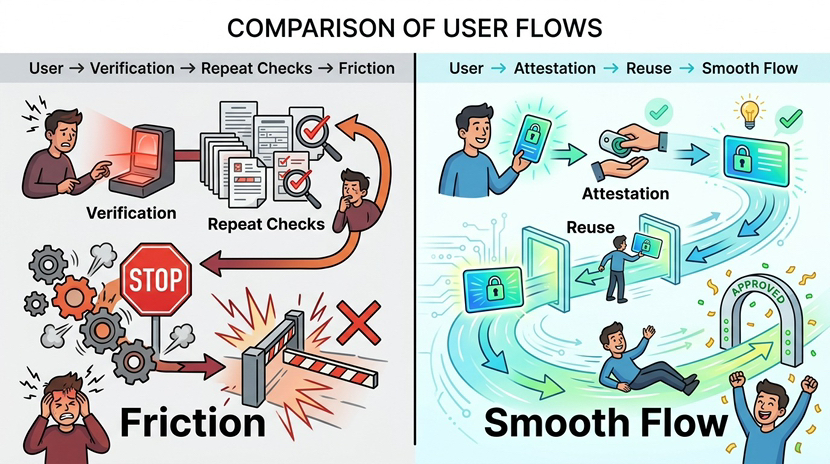
Not by removing verification.
But by making it smarter.
Through attestations, systems don’t need to repeat the same checks over and over. They can rely on verified claims. Reusable proof. Structured data that has already been validated.
That changes the dynamic.
Because now verification becomes lighter.
Not weaker.
And that’s a key distinction.
If you can verify once and reuse that proof across systems, friction drops naturally. You don’t need to ask users for the same information repeatedly. You don’t need to rebuild trust every time a new interaction happens.
That’s how systems scale.
Not by removing checks.
By making checks more efficient.
The more I think about it, the more I realize this is one of the biggest barriers to real adoption.
People don’t leave systems because they don’t work.
They leave because they’re exhausting.
Too many steps. Too much repetition. Too much friction.
And once that feeling sets in, growth slows.
That’s why infrastructure like $SIGN matters more than it looks.
It doesn’t just improve verification.
It improves experience.
And experience is what determines whether systems scale or stall.
I’m not saying this solves everything overnight. There are still challenges. Integration takes time. Systems need to adopt new standards. And not every use case will benefit equally.
But the direction feels right.
Because eventually, every system runs into the same limit.
It can’t grow if every new user adds more friction.
And that’s when better infrastructure becomes necessary.
Not optional.
The more I research SIGN, the more I see it as a way to reduce friction without sacrificing trust.
And that’s a rare combination.
Because most systems today can only pick one.
@SignOfficial #SignDigitalSovereignInfra $SIGN
