
I keep coming back to one thought about SIGN that I honestly do not see enough people talking about: what if its real value is not only verification, but memory?
Most crypto systems are good at recording transactions, but not always good at preserving meaning. A wallet can show what moved, when it moved, and where it went. But that still does not tell the full story. It does not explain why someone was eligible, what role they played, what they contributed, what they proved, or what trusted context existed behind that action. That gap matters more than people think.
This is the angle that keeps pulling me toward SIGN.
To me, SIGN looks increasingly like a system designed to give crypto better memory. Not memory in a casual sense, but structured memory. The kind of memory that lets ecosystems remember who did what, under what conditions, and with what proof attached. That changes the way I think about value. Because when a network cannot remember meaningful actions properly, it keeps treating every new interaction like it started from zero. And when everything starts from zero, trust stays weak, coordination stays expensive, and good users often get mixed in with noise.
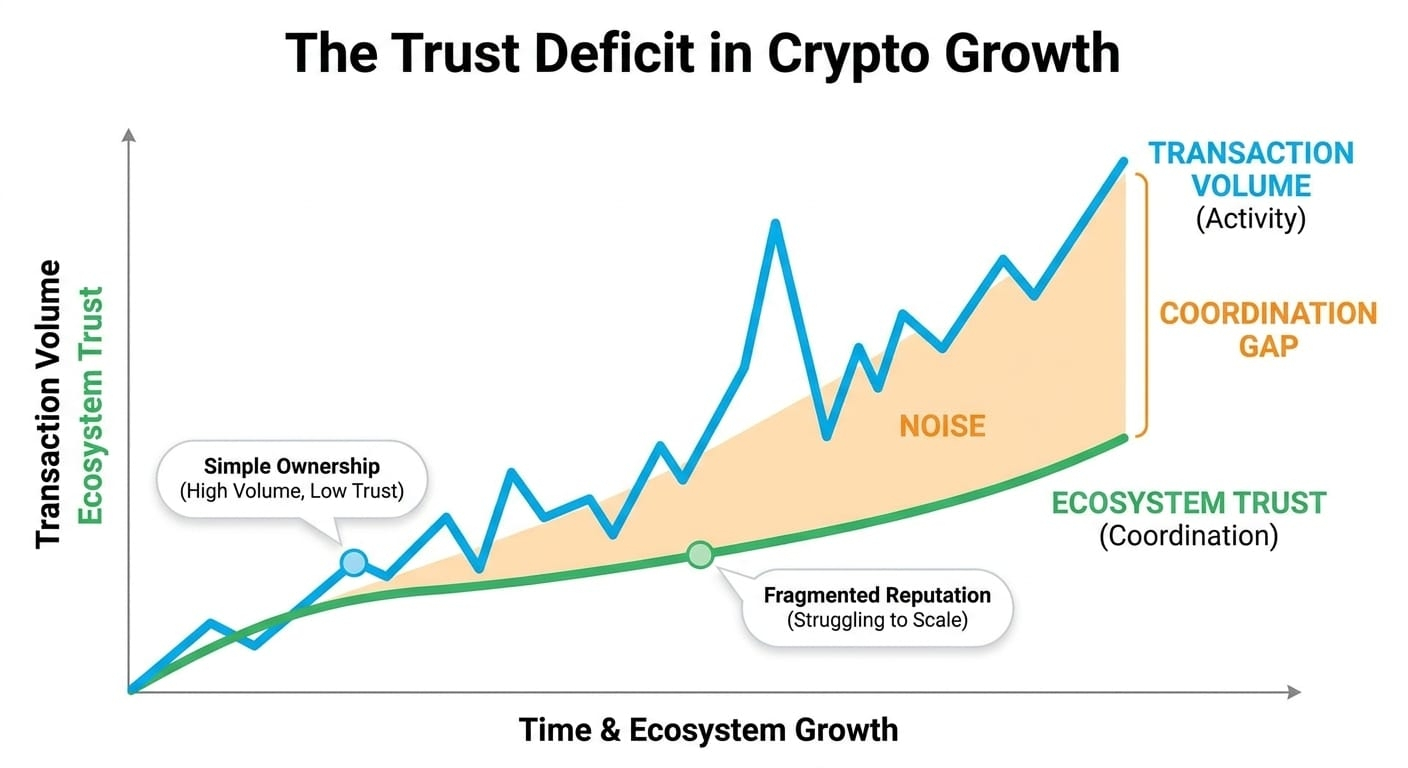
That is a real problem in crypto.
I have seen how often strong participation gets reduced to shallow signals. A wallet appears active, so people assume it matters. A user arrives early, so people assume they are loyal. A community member posts often, so people assume they are valuable. But activity is not always contribution, and visibility is not always credibility. This is where I think SIGN becomes much more important than people realize. It creates a way for ecosystems to remember actions with more depth. Not just that something happened, but that it happened within a verifiable structure.
That makes the whole environment smarter.
The more I think about it, the more I feel that crypto is entering a stage where simple ownership is no longer enough. The next layer is context. Who earned access? Who completed something meaningful? Who has a real history with a project? Who can carry trusted proof from one environment into another? These are powerful questions because they move value away from surface-level signals and closer to evidence. And once evidence starts traveling properly, the internet begins to function differently.
This is why I do not see SIGN as just another infrastructure project. I see it as something that could help turn fragmented digital activity into reusable trust. That matters because crypto is full of repeated effort. Users keep proving themselves again and again. Communities keep rebuilding credibility from scratch. Projects keep struggling to separate real alignment from temporary farming behavior. If SIGN helps solve that, then it is not only improving efficiency. It is improving memory across the ecosystem.
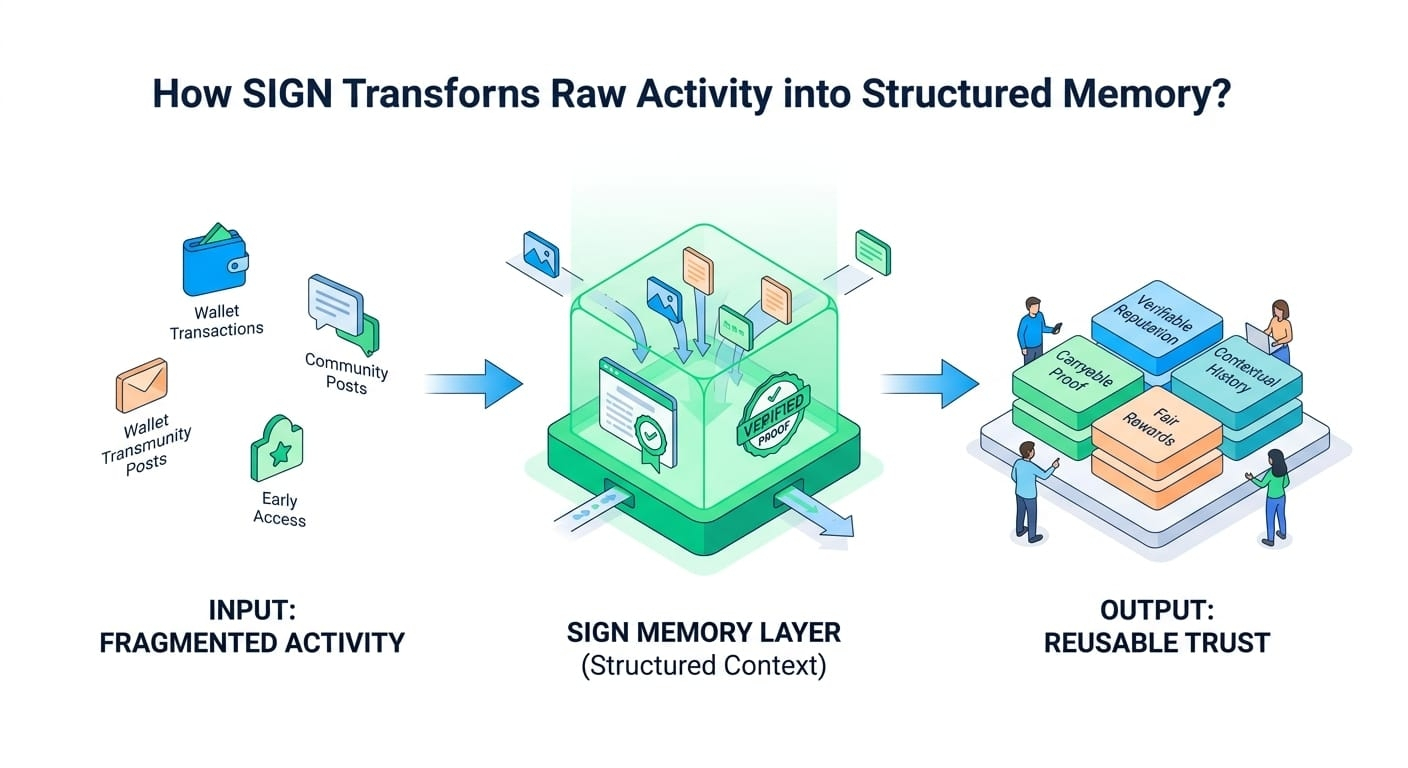
And better memory creates better coordination.
A system that remembers well can reward more fairly, filter more intelligently, and scale more smoothly. It can reduce wasted effort. It can make reputations more portable. It can help ecosystems stop relying so heavily on noise and start relying more on structured proof. To me, that is where the long-term strength of SIGN may really sit. Not only in verification as a feature, but in memory as infrastructure.
That feels like a much bigger story.
Because in the long run, the strongest ecosystems will not just be the ones that move fast. They will be the ones that remember well. They will know how to preserve trust, carry proof forward, and let meaningful actions keep their value over time. If that future starts taking shape, then SIGN may end up mattering far beyond what most people currently price in.
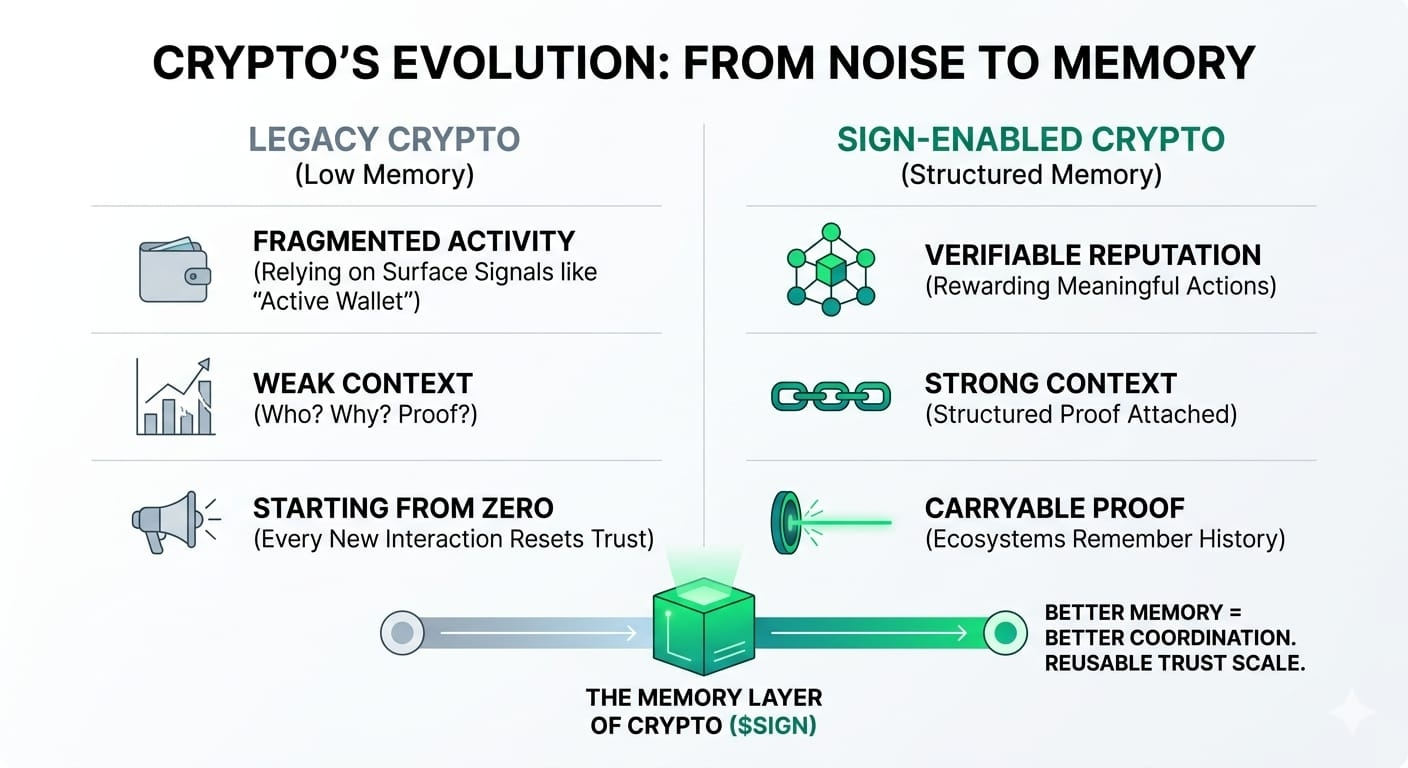
That is why I keep watching it closely. I do not think SIGN is only helping crypto verify truth. I think it may be helping crypto remember it.