You ever notice how most public systems still feel stuck in a loop? You submit the same documents again and again, verify your identity multiple times, and still end up waiting days or even weeks for something that should’ve taken minutes. It’s not always because the system is broken. It’s because the way trust is handled hasn’t really evolved. That’s the part Sign Protocol is quietly trying to change, and the more I look into it, the more it feels like this isn’t just another crypto narrative. It’s a deeper shift in how verification itself works. Right now, most government and institutional systems operate in silos. Every department, every platform, every country even, maintains its own version of truth. So even if your identity has already been verified somewhere else, it doesn’t carry forward. You start again. Same forms, same checks, same friction. What Sign Protocol does differently is introduce the idea of attestations, which are essentially verifiable credentials that can be issued once and reused across multiple services. But what makes this powerful is not just reuse. It’s the structure behind it. These credentials are tied to schemas, meaning they follow a defined format, and they’re cryptographically signed, meaning they can be independently verified without needing to trust the issuer directly. That alone changes the dynamic. Services no longer need to rely on each other. They only need to verify the proof. When you go deeper into the architecture, things get even more interesting. Sign doesn’t force everything onto the blockchain. That would be inefficient and impractical. Instead, it uses a hybrid model where sensitive or heavy data can live off-chain, while the blockchain acts as a source of truth for integrity. Think of it like this. The actual data might sit elsewhere, but its fingerprint is anchored on-chain, ensuring it hasn’t been tampered with. This balance between on-chain verification and off-chain storage is what makes the system scalable in real-world environments. At the same time, it introduces a subtle complexity. Once you depend on multiple layers interacting perfectly, maintaining consistency becomes a real challenge. That’s where the strength of the design will be tested over time. Another layer that stands out is TokenTable and its unlocker system. At first glance, it looks like a simple token distribution tool, but it’s actually much more than that. It turns distribution into programmable logic. Instead of manually releasing funds or relying on centralized control, tokens can be unlocked based on predefined conditions like time schedules, milestones, or specific triggers. This creates a system where outcomes are not decided by people in the moment, but by rules set in advance. In a public infrastructure context, that could mean subsidies, grants, or incentives being distributed automatically based on verified conditions. No delays, no discretion, no ambiguity. Just execution. What really ties all of this together is the idea of making trust portable. Not just proving something once, but allowing that proof to move with you across systems, platforms, and even borders. That’s a big deal. Because right now, trust is static. It exists in one place and loses meaning the moment you step outside of it. Sign Protocol is trying to turn trust into something dynamic, something that flows. And if that works, the implications go far beyond crypto. It touches identity, governance, finance, and how institutions interact with individuals on a daily basis. But here’s where it gets a bit deeper. When systems become more efficient, they also become more powerful. If governments and institutions start relying on programmable verification layers like this, we’re not just improving speed or reducing friction. We’re redefining how control is structured. Decisions become automated. Processes become standardized. And while that brings clarity and efficiency, it also raises questions about flexibility, oversight, and who defines the rules that everything runs on. That’s why I don’t see Sign Protocol as just infrastructure. It feels more like a foundation being laid quietly under systems we already use. You don’t really notice it at first. But once you understand what it’s doing, you start to see the bigger picture. It’s not just about faster services or smoother onboarding. It’s about changing how trust is created, verified, and shared across the digital world. And if that shift continues, the way governments deliver services might not just improve. It might become something completely different from what we’re used to today.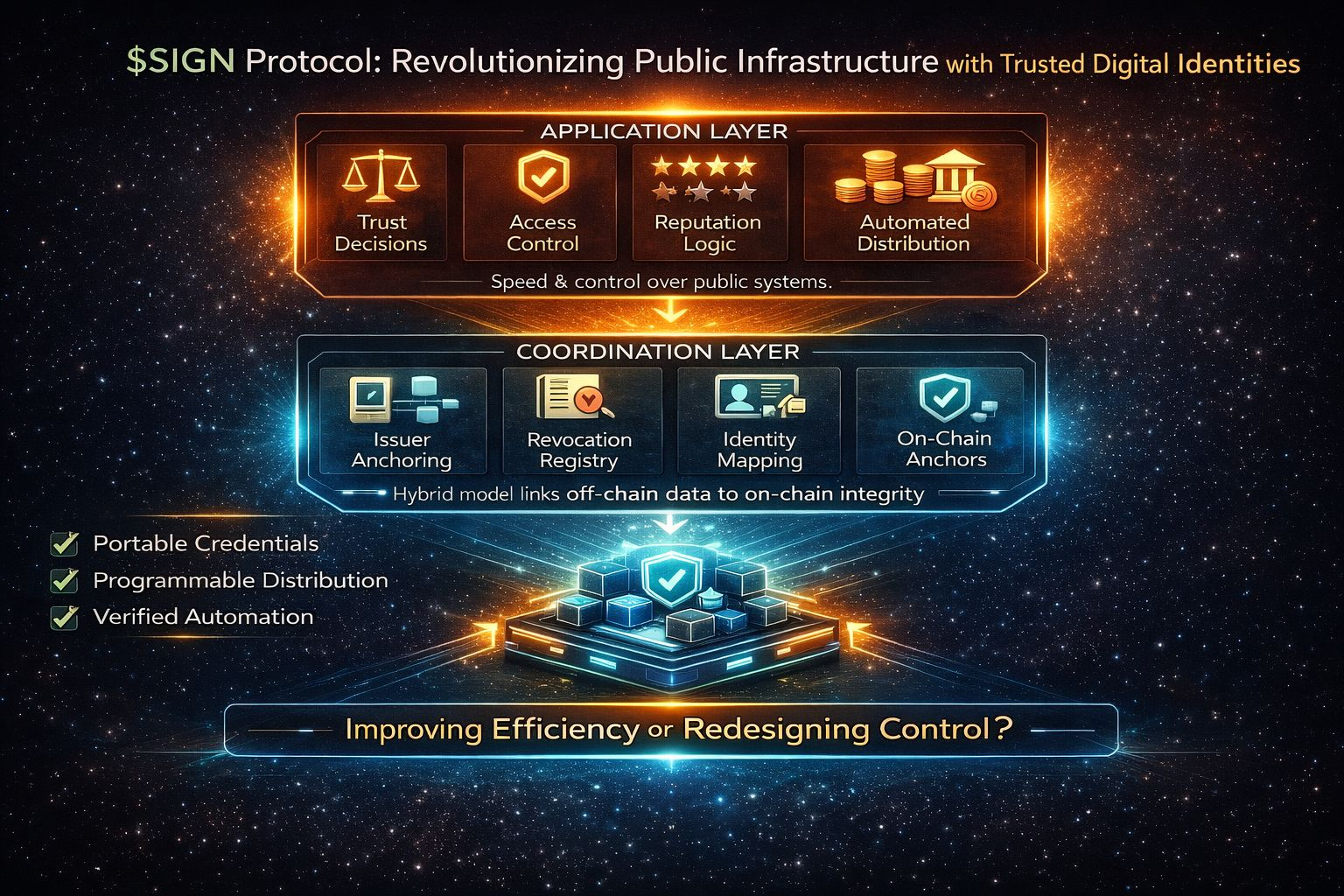

Article
The Silent Shift in Public Systems: How $SIGN Is Redefining Trust, Identity, and Service Delivery
Disclaimer: Includes third-party opinions. No financial advice. May include sponsored content. See T&Cs.
0
15
205
Explore the latest crypto news
⚡️ Be a part of the latests discussions in crypto
💬 Interact with your favorite creators
👍 Enjoy content that interests you
Email / Phone number