
A few days ago, I stayed up late and went through the documentation of $SIGN again. To be honest, I really don’t want to simply treat it as a 'chain on attestation tool for grabbing benefits' anymore.

The most exciting part of this project is not about creating some new concept, but rather that they have already clearly stated in the official documentation: they are directly targeting the three sovereign-level digital infrastructures of Money, ID, and Capital. How does it work? New Money corresponds to CBDC and compliant stablecoins, New ID deals with verifiable identities and privacy protection, and New Capital focuses on compliant fund distribution and subsidies.
And what about the Sign Protocol?
It firmly sits beneath these systems as a shared evidence layer. Simply put: who has the final say, how the evidence is stored, how others can verify it, while not revealing all the cards to outsiders, all depend on it. Once this positioning is established, its competitors are not those ordinary airdrop protocols, but rather the 'middleware of rules' in the digital age, folks.
So why am I bringing it up again at this time? Just take a look at the recent troubles in the Middle East. This is not just about catching a whiff of gunpowder in the news; it has genuinely driven the 'friction cost of cross-border collaboration' sky-high.
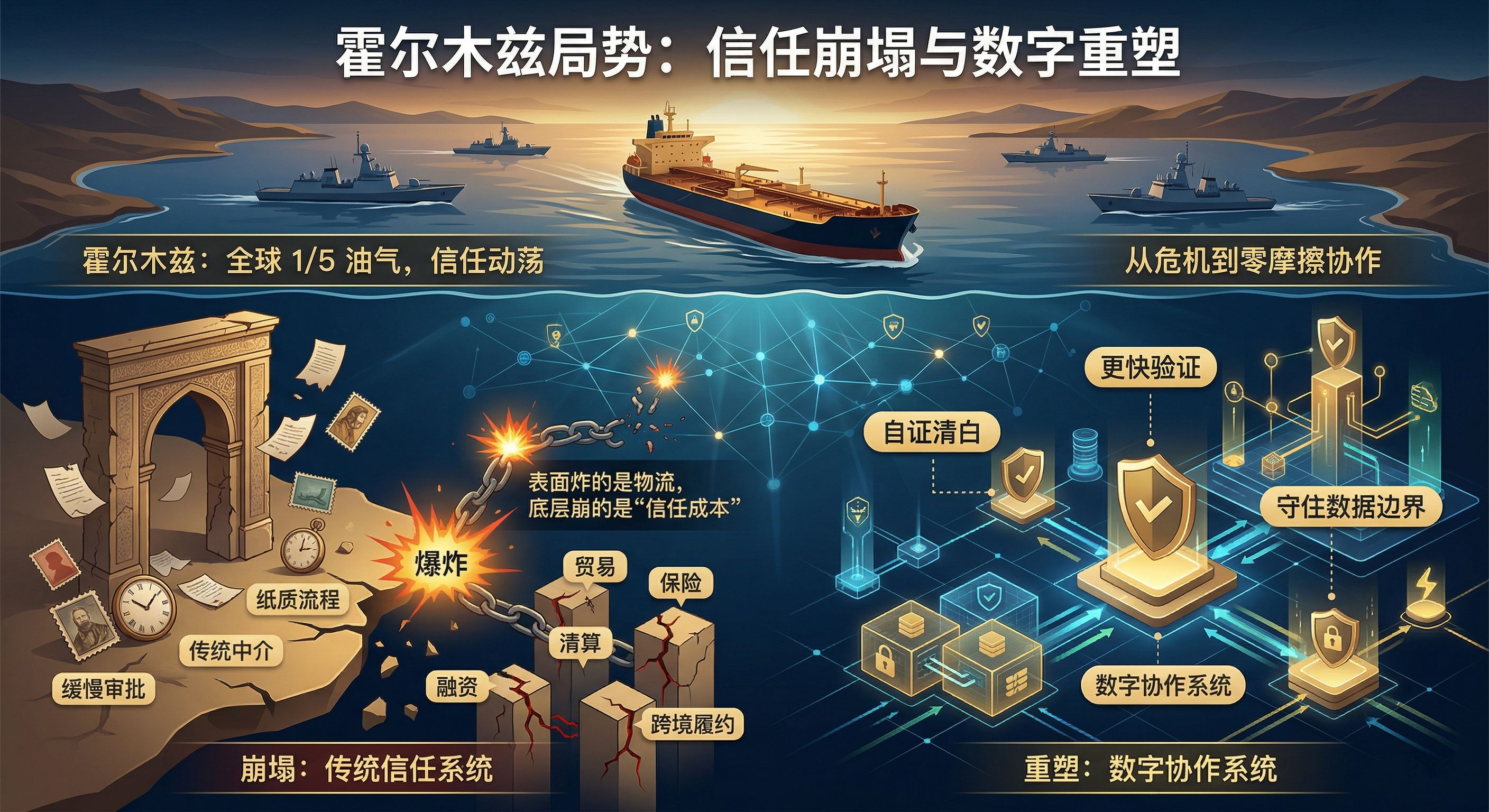
Reuters recently reported extensively on how the Gulf conflict is disrupting transportation and energy markets. Maersk has halted operations at the Salalah Port in Oman, and with tensions in the Strait of Hormuz, the fragility of the global supply chain is heightened.
You need to understand that the Strait of Hormuz handles one-fifth of global oil and gas transportation. When the security expectations in this area fluctuate, the impact is not just on oil prices but on the entire chain of trade, insurance, clearing, financing, and cross-border performance. On the surface, logistics may explode, but the underlying collapse is the 'cost of trust.' In the past, we could rely on traditional intermediaries, go through paper processes, and wait for cross-border approvals. Now? Don't mess around. Everyone is desperately searching for a digital collaboration system that is faster, can self-verify, and ideally can protect their data boundaries.
This is why I think discussing $SIGN in the context of the Middle East should definitely avoid that kind of cheap 'chaos coin speculation' logic; it's too low. What really needs to be focused on is that those rich folks in the Middle East are racing down this path.
The intuition of seasoned investors tells me: the big shots in the Gulf are not just speculating on concepts; they are crazily preparing for the 'next-generation financial and asset registration foundation.' Currently, the underlying protocols that can protect privacy while solving trust verification are the real, essential needs.
Applying this macro environment to SIGN, you'll find it's not a forced match. The Sign white paper itself is aimed at top-level use cases, such as regulatory records, border control, encrypted identities, and the ability to 'verify in real-time without sharing sensitive data.' This direction perfectly fits the needs of the Gulf region: they crave the ultra-high efficiency of digitization while absolutely not wanting to relinquish the sovereignty of core data; they require inter-agency collaboration while strictly forbidding sensitive data like resident information and business contracts from running naked outside.
The approach of Sign, which 'can verify but only shows you the minimum necessary information,' is valuable precisely because of this! It doesn't force you to disclose everything but allows you to prove to others that 'this business is legal, valid, and traceable.' In peaceful times, this function seems like an add-on.
But in the high-pressure cooker of the Middle East, where policies, capital, and cross-border trade are repeatedly fricting, this changes from 'sounds pretty cool' to 'it's really not feasible without it.'
So now, I analyze SIGN's Eastern dynamics, and I'm used to breaking it down into three layers:
Digital currency layer: in the future, as compliant stablecoins become widespread, on-chain settlement will not just ask 'can it be transferred,' but rather 'who qualifies to transfer, under what conditions, and what audit records are kept.' At this point, the value of the evidence layer will skyrocket.
Digital identity layer: top-level KYC, visas, corporate qualifications cannot simply be faked with a screenshot on-chain; they require a proof system that is called upon frequently.
Digital capital layer: whether it's real estate RWA or compliant fundraising, in the end, what matters is not whose PPT is the loudest but rather who can firmly write the rules into the system, turning verification and accountability into an ultra-low-friction assembly line.
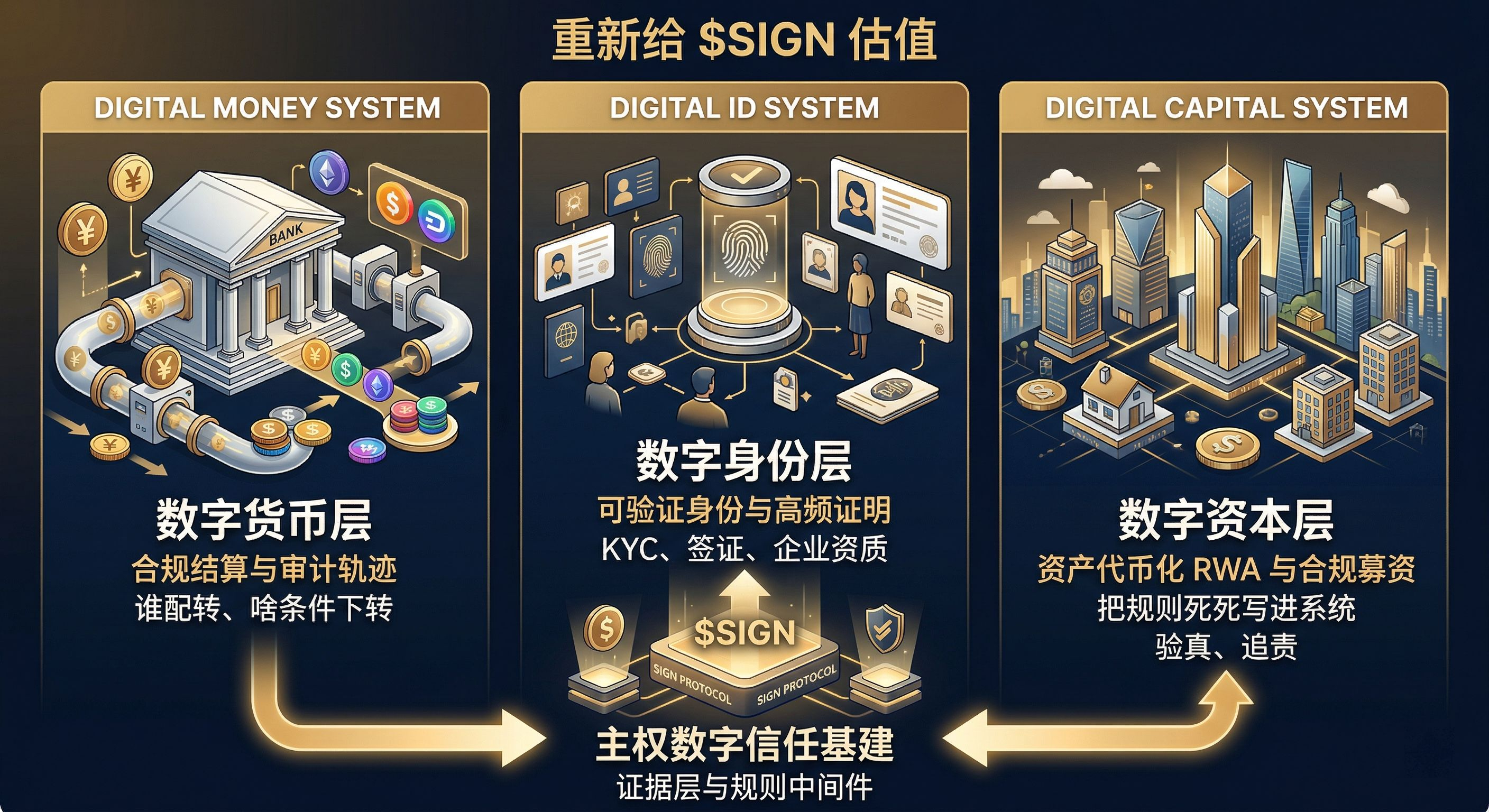
The more chaotic the situation in the Middle East, the more the market needs to reprice these three layers of demand. And the strength of SIGN is not merely as a standalone tool, but whether it can smoothly integrate into these three layers, becoming the default 'proof interface.'
Alright, after all this, I must pour a bucket of cold water to cool things down, or else it will really become mindless hype 😅.
Reviewing the official MiCA white paper, it clearly states that SIGN is currently a utility token primarily focused on on-chain attestation, verification, and governance. What does this mean? While the narrative of the track is grand, it does not mean the token can mindlessly capture all value.
What if in the future, those big institutions in the Gulf really use a framework similar to @SignOfficial , but they settle in fiat currency, and the fees are based on offline corporate contracts, without involving SIGN in the staking and clearing process? That would be awkward, a typical case of 'the project eats meat, the token drinks soup.' Conversely, what truly matters for SIGN is not issuing a couple of collaborative PR articles, but whether it has been embedded in real business flows!
For example: Do institutions really burn SIGN when invoking? Do node runners need to stake? If this economic model loop is not resolved, it is at best a powerful software stack; only when this is figured out can it become a network that prints money.
It is precisely for this reason that now focusing on SIGN, the most valuable aspect is not the FOMO sentiment, but rather this window period of 'the direction is right, but the price has not fully reflected it yet.'
At least from the public information I have uncovered so far: Sign has already elevated its tone to the level of sovereign architecture, and indeed the rich folks in the Middle East are seriously investing real money into digital payments and asset tokenization upgrades.
Let's not exaggerate that it has achieved absolute monopoly; a more objective judgment is: it definitely has the potential to position itself in the 'digital upgrade' wave in this region. In the crypto space, what is the biggest fear? It's the fear that you have a good project, but you're telling an old story from the previous cycle. SIGN has hit upon a very hardcore reality: when regional frictions overturn the traditional trust system, whoever can provide low-friction, auditable, and locally deployable digital proof layers will ascend from being workers to partners.
Without further ado, let's get to the conclusion:
The essence of SIGN does not lie in whether it will be manipulated into a meme coin in the short term, but whether it can firmly occupy the 'evidence layer' C position in the grand narrative of 'digital currency reconstruction + asset tokenization + increasing cross-border friction' in the Middle East. If it retreats and continues to remain a tool for distribution in the small circle of Web3, then sorry, the upper limit is visibly low. But once it truly bites into the structural dividend of financial upgrades in the Gulf, the market's perception will absolutely switch from 'on-chain small tools' to 'early chips in top-level digital trust infrastructure' at lightning speed.
To be honest, for someone like me who has experienced several rounds of bull and bear markets, the sexiest aspect of such a target has never been the few points that jump in today's account, but whether it has the fate to survive until the next grand narrative erupts and still firmly holds the main seat at the table.#Sign地缘政治基建