

@SignOfficial #SignDigitalSovereignInfra $SIGN
i don’t think the strange part is that something gets verified somewhere. that part… fine, systems do that all the time, nothing new there. what keeps messing with me is arriving after that, inside Sign, and realizing i’m already too late to see how it happened. like the important moment already passed somewhere else, and now i’m just dealing with the result as if that’s the only thing that ever mattered.
and somehow that’s enough.
Sign keeps putting me in that position, not loudly, not in a way that forces you to notice. it’s quieter than that. you open something, you query something, SignScan shows you something clean, structured, signed, tied to a schema, and everything about it feels settled. almost too settled, like whatever uncertainty existed before this point has already been shaved off.
and i keep thinking… when did this become real?
because it didn’t happen here. not where i’m looking at it, not where it’s being used. it happened somewhere earlier, under conditions i didn’t see, inside an origin-side attestation flow that doesn’t travel with the result. and now inside Sign it just exists, already shaped into something usable, already reduced into an attestation under schema that another chain or another app can accept without hesitation.
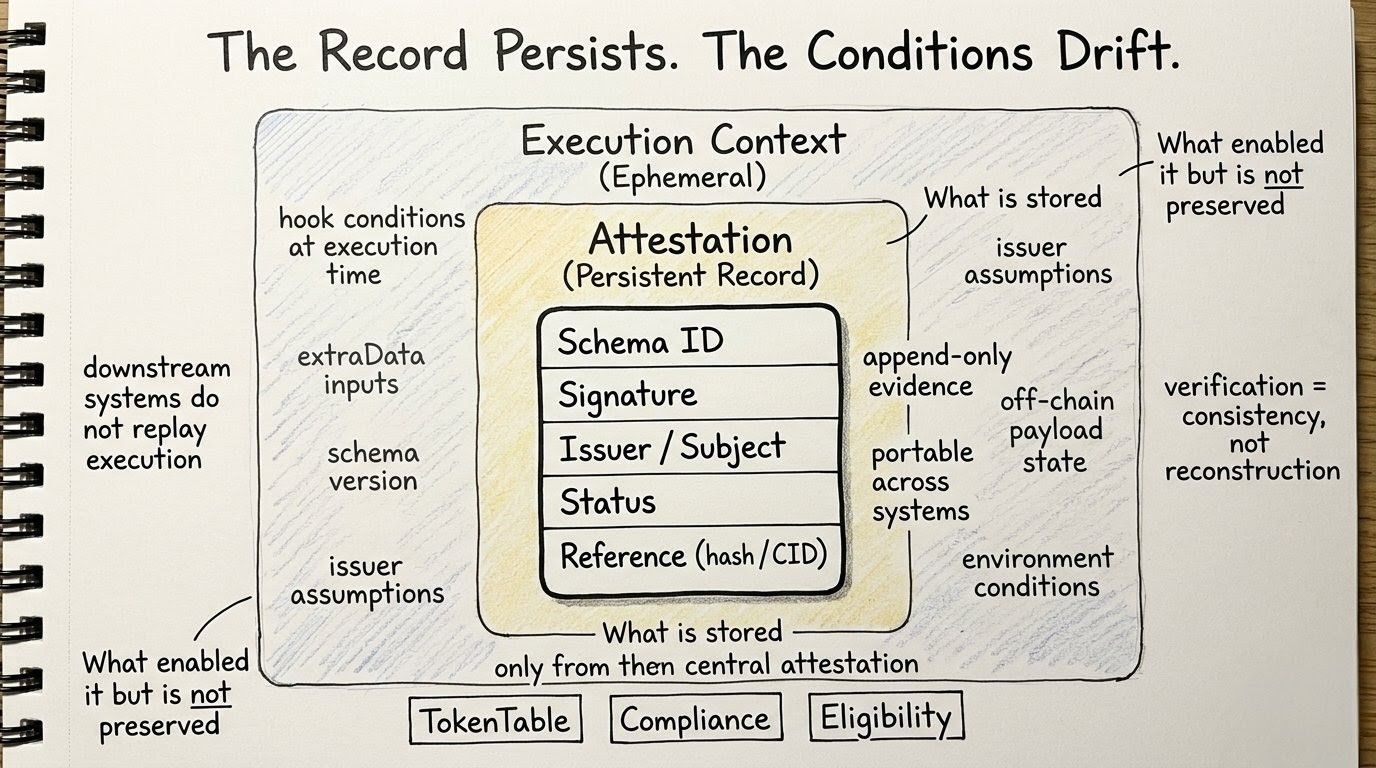
“you don’t witness the decision, you inherit it”
and that line keeps sitting there longer than it should.
because if you actually follow how something moves through Sign, it doesn’t carry its full story with it. it carries just enough to be accepted again. an issuer signed it under a schema, some logic ran before it was allowed to exist, maybe a hook filtered it, maybe a threshold passed, maybe something inside extraData aligned just right. maybe the whole thing passed through a cross-chain schema path where the hook emitted the event that started everything else. but none of that travels in full.
what travels is the attestation, and the fact that it survived.
and inside Sign, that survival becomes the only visible truth. not how close it was to failing, not what almost stopped it, not what got cut before it appeared. just the version that made it through. the version clean enough to be indexed, clean enough to be queried, clean enough to be reused somewhere else as a cross-chain attestation result.
and then it does move.
another chain, another application, another context. and Sign doesn’t ask the new place to re-live the old decision. it doesn’t ask it to reopen origin-side schema logic or replay hook checks. it hands over an attestation result already shaped enough to be used, already compressed into a form that can travel, already backed by a cross-chain verification surface the destination side is willing to accept. not the whole origin-side path, just the attestation result Sign can carry across.
that part feels efficient, i get that.
but also… a little off.
because the place using it didn’t see anything happen. it didn’t see the input, didn’t see where the schema boundary cut things down into acceptable form, didn’t see the logic that decided what survives. it didn’t see the event the schema hook emitted, didn’t see Lit or the TEE side compare the target data, didn’t see the delegated attestation signature come back. it just sees that Sign says this attestation exists under a schema, and that’s enough to proceed.
TokenTable doesn’t hesitate either. it doesn’t go back to the origin and ask “why.” it doesn’t try to reconstruct anything. it checks whether the attestation exists under the schema it expects, and if it’s there, it moves. eligibility resolves, distribution flows, access opens. the application layer consumes the attestation result, not the whole path that produced it.
so the movement isn’t tied to understanding anymore.
it’s tied to attestation presence.
and that shift feels small at first, almost harmless. until you sit with it long enough and realize what actually got removed to make that possible.
“presence replaces process”
because once something becomes an attestation inside Sign, it stops being local. it becomes portable. not the full claim, not the messy context, just the version of it that survived compression. and portability means the next system doesn’t need to know how it was made, only that it was made, emitted, and accepted through the cross-chain result Sign carries forward.
but what exactly does that mean?
what exactly am i trusting here?
am i trusting the issuer who signed it, the schema that defined its shape, the hook logic i never saw, the origin chain it came from, the cross-chain schema that framed the verification, the TEE or threshold-backed result that carried it across… or just Sign itself as a surface that says “this passed somewhere”?
and is that enough… or just enough most of the time?
because everything downstream behaves like it is enough. capital moves, access opens, eligibility resolves, all based on something that arrived already decided. and nobody really stops to ask where that decision actually lived, because inside Sign that location disappears.
it gets folded into the attestation.
“the origin becomes invisible once the result is portable”
and that’s the part that keeps scratching at me. because it means the moment where something could have gone either way, the actual tension point, doesn’t travel. it stays behind. and everything after that is just consequence playing out in environments that never saw the uncertainty.
never saw the edge cases, never saw the almost-failures, never saw the part where the system could have said no.
just the final shape.
clean enough for SignScan, clean enough for any system plugged into Sign to consume without friction. and yeah, that’s the whole point. you don’t want every chain to redo everything, you don’t want every app to replay every condition, you don’t want every destination side to reconstruct an origin-side attestation path from scratch. you don’t want every consumer to re-run the schema hook, inspect the event trail, compare the origin-side data, and ask Lit or the TEE layer to prove it all over again. nothing would scale if it worked like that.
so Sign chooses something else.
it chooses to make outcomes portable, not processes.
and that choice quietly shifts what trust even means inside it. it’s not “i checked this myself,” it becomes “i accept this attestation because the origin side already checked it, the delegated result came back through the cross-chain path, and that’s enough for me to consume it here.” those feel similar when everything works. close enough to pass unnoticed.
until they’re not.
because if something goes wrong, where do you even go back to? the destination chain can’t replay it, the application layer never saw it, the attestation doesn’t carry the full path, and the cross-chain result only carries the conclusion forward. so you’re pointing back at something that already finished, already compressed, already turned into a surface-level truth inside Sign.
and everything else has already moved on.
so responsibility doesn’t disappear, but it stops sitting in one place. it stretches across issuer, schema design, hidden logic, origin chain, cross-chain schema, event-triggered verification, threshold-backed result, and the system that consumed the attestation without reopening anything. and none of them fully hold the whole story anymore, which is why everything looks so clean.
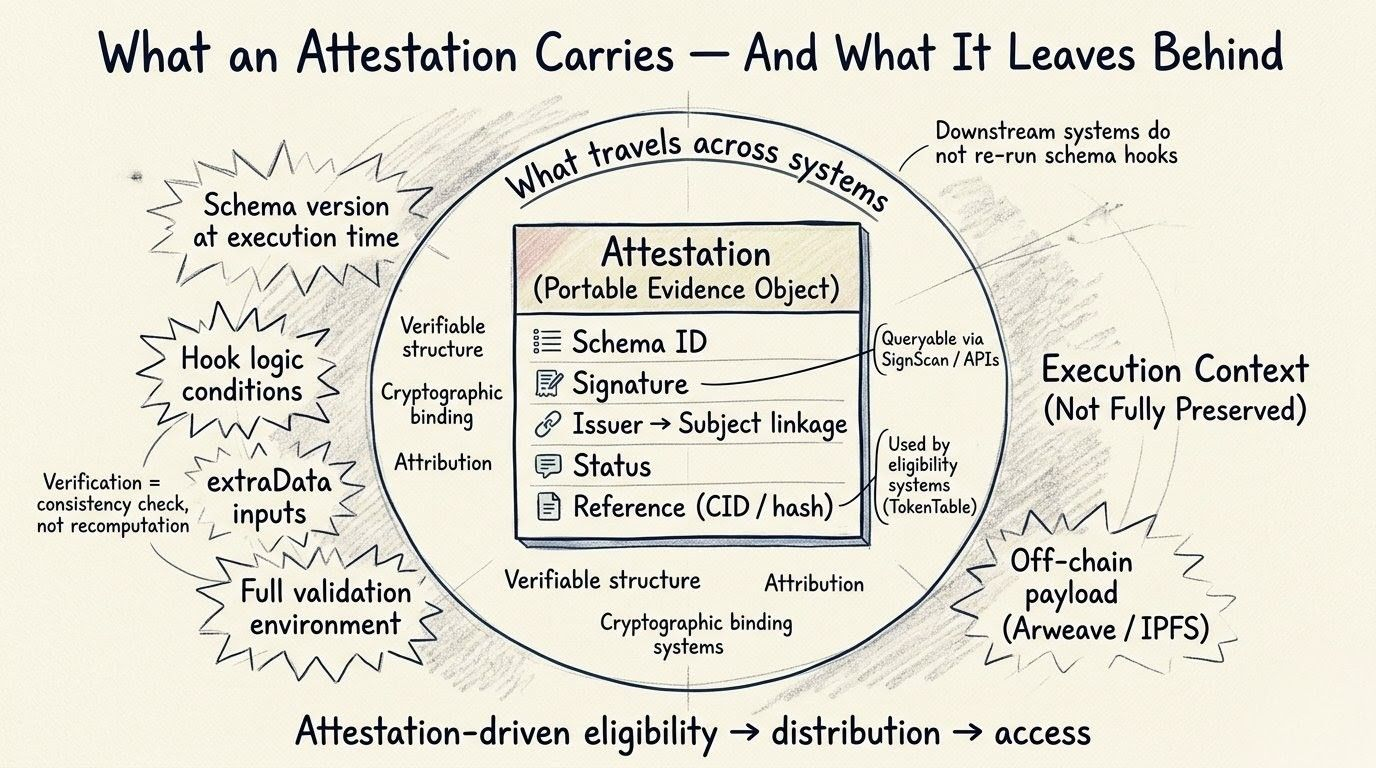
because no single place holds the mess.
Sign shows you what survived. not what struggled to get there, not what got filtered out, not what never made it. and maybe that’s necessary, maybe that’s the only way this kind of system can exist without collapsing under its own weight.
but it also means something i can’t really ignore anymore.
that the place where truth actually forms is not where truth gets used. it’s somewhere behind it, already done, already sealed into an attestation, already turned into something other systems can trust without seeing, already carried forward as a Sign cross-chain result.
and now i’m just interacting with that surface inside Sign like it was always complete, like nothing complicated ever happened before it.
and i keep coming back to this one thing, not cleanly, not resolved,
if i can trust something without ever seeing where it was processed, then what exactly am i trusting?
the claim?
the attestation under schema?
the cross-chain result?
or just the fact that something, somewhere, already decided… and Sign made sure i never had to see how messy that decision actually was?