
@SignOfficial $SIGN #SignDigitalSovereignInfra
i thought the attestation was the decision. that’s how it looks from the outside anyway. something gets verified, signed, timestamped, stored, done. clean. it feels like Sign decided something there.
but the more i keep following one flow all the way through, the less that holds.
because by the time the attestation exists, the schema-hook outcome is already over.
so where did it actually happen?
i keep ending up in the same place. not the attestation layer. not storage. not SignScan. not even what the application layer reads later. it’s earlier than that, inside the schema hook, and that part is weirdly quiet for something that important. quiet almost in the wrong way. like the loudest moment in the whole flow is happening in a place that refuses to look loud.
an institution prepares something messy. always messy. documents, exceptions, someone approving late, someone skipping a step, something not fully matching the template but still going through because reality doesn’t follow clean schemas. that whole thing arrives at Sign and it doesn’t get stored first.
it gets tested first.
and maybe that should have been the first clue.
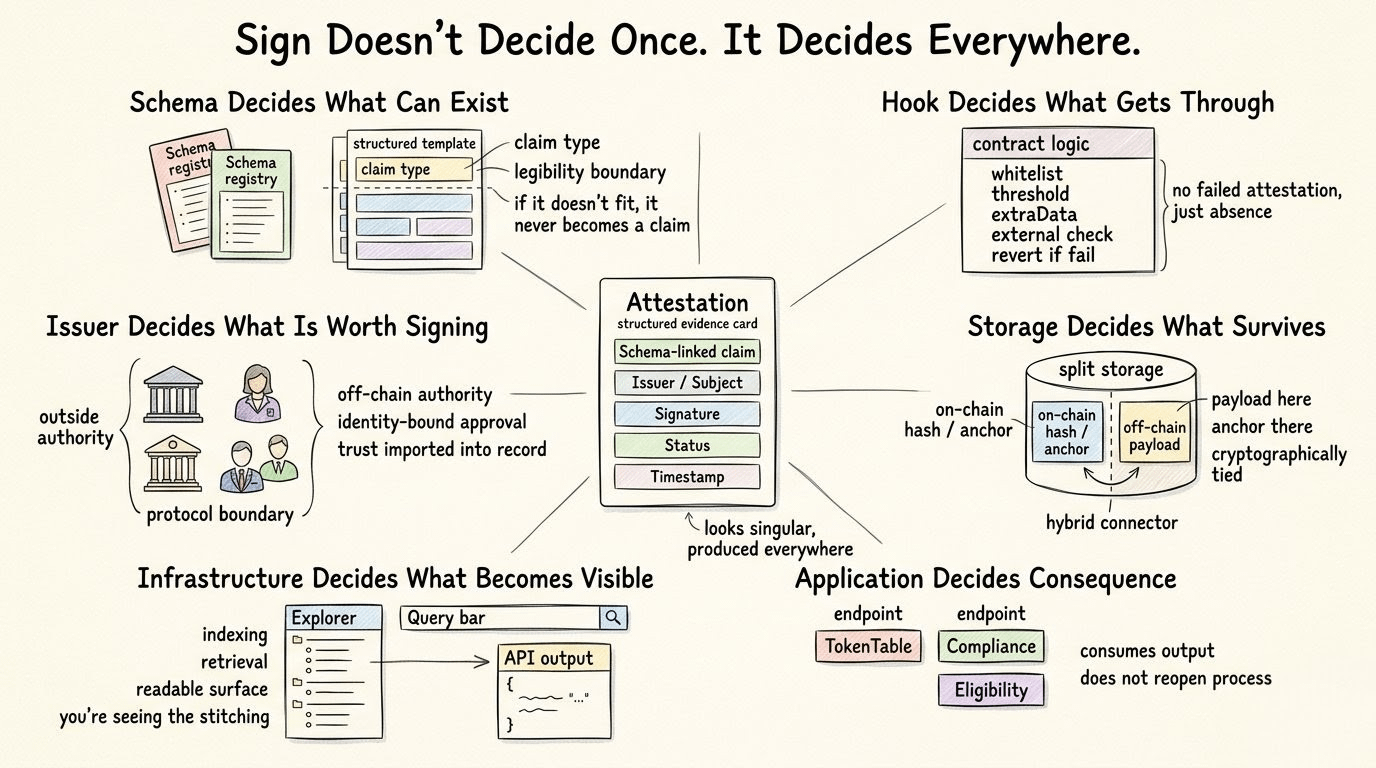
the schema registry shapes it before anything else. cuts it into something that can even be understood here. fields, types, order, encoding, all of that already decides what version of the situation is allowed to exist inside the attestation flow. but that still doesn’t feel like the actual decision to me. not yet anyway.
that feels more like making the thing readable enough for schema-hook execution to happen at all.
and even that is already a kind of cut, isn’t it? not rejection exactly. not approval either. more like… if this can’t be spoken here, nothing later even gets a chance.
the real moment is the hook. that’s where everything tightens. conditions get checked, permissions enforced, thresholds evaluated, maybe a zk proof gets verified, maybe execution-time extraData matters in a way nobody will ever see again.
and for a brief moment, everything is still alive.
it can still fail.
it can still be rejected.
it can still not make it.
and then it either passes or disappears.
that’s it. no half-state. no almost. no failed attestation object entering the evidence layer. no SignScan surface for refusal. no retrievable record saying this was attempted. no query result for failure. no application-layer object for “almost passed.”
nothing.
so what actually happened there? did a decision happen, or just a filter? and does that distinction even matter if the effect is the same? that’s the part i keep tripping over, because the effect is obviously a decision. something was allowed through or not. but Sign behaves like only the successful hook-pass deserves memory.
“If it doesn’t pass, it never existed here.”
that line keeps coming back in a way i don’t like, because it means the protocol doesn’t remember the schema-hook moment that actually mattered. only the attestation outcome.
only the survivor.
and once it passes, it becomes an attestation. clean, structured, signed, timestamped. everything about it feels stable. but it’s also late, like arriving after something already happened. after the tension. after the actual risk. after the only moment where things could still go another way.
so what are we really looking at then?
the decision, or the residue of it?
because all the tension was earlier, inside that schema-hook call, inside that one execution moment, inside hook-time conditions that no longer exist once it’s done. and none of that travels forward into the evidence layer, into SignScan, or into retrievable application-layer state.
“The protocol remembers what survived, not what was decided.”
and i keep getting stuck on that because in real life, decisions are not just outcomes. they’re process, hesitation, context, edge cases, things that almost went the other way. but here none of that is visible. maybe that’s intentional. maybe it has to be like this, because if Sign had to carry all that forward, every attempt, every failure, every hook branch that didn’t pass, it would explode under its own memory.
so it compresses.
not just data.
decision-state too.
and now i’m thinking, how many decisions are happening inside schema hooks that the protocol refuses to remember? how many times did something almost pass? how many times did something fail because of one small hook-time condition that nobody will ever see again?
does that matter?
or does it only matter that it passed once?
because downstream nothing cares. TokenTable doesn’t. EthSign doesn’t. whatever app is reading the attestation doesn’t. they don’t ask what almost happened. they ask what exists. what entered the evidence layer. what SignScan can surface. what can be retrieved. what can be executed on.
and that’s enough for the system to move.
but is it enough for understanding?
or is “enough” the whole design here?
“history begins at success.”
that feels wrong in a quiet way. not broken. just incomplete.
and then there’s another layer to it, timing. because that schema-hook moment is not just invisible, it’s also isolated. it happens once, under specific execution-time state, specific conditions, specific extraData, and then it’s gone.
gone how, exactly?
not erased from the chain maybe. erased from legibility. erased from what the rest of the stack can carry forward.
so even if you wanted to reconstruct it later, you can’t really.
because the exact state that made it pass might not even exist anymore.
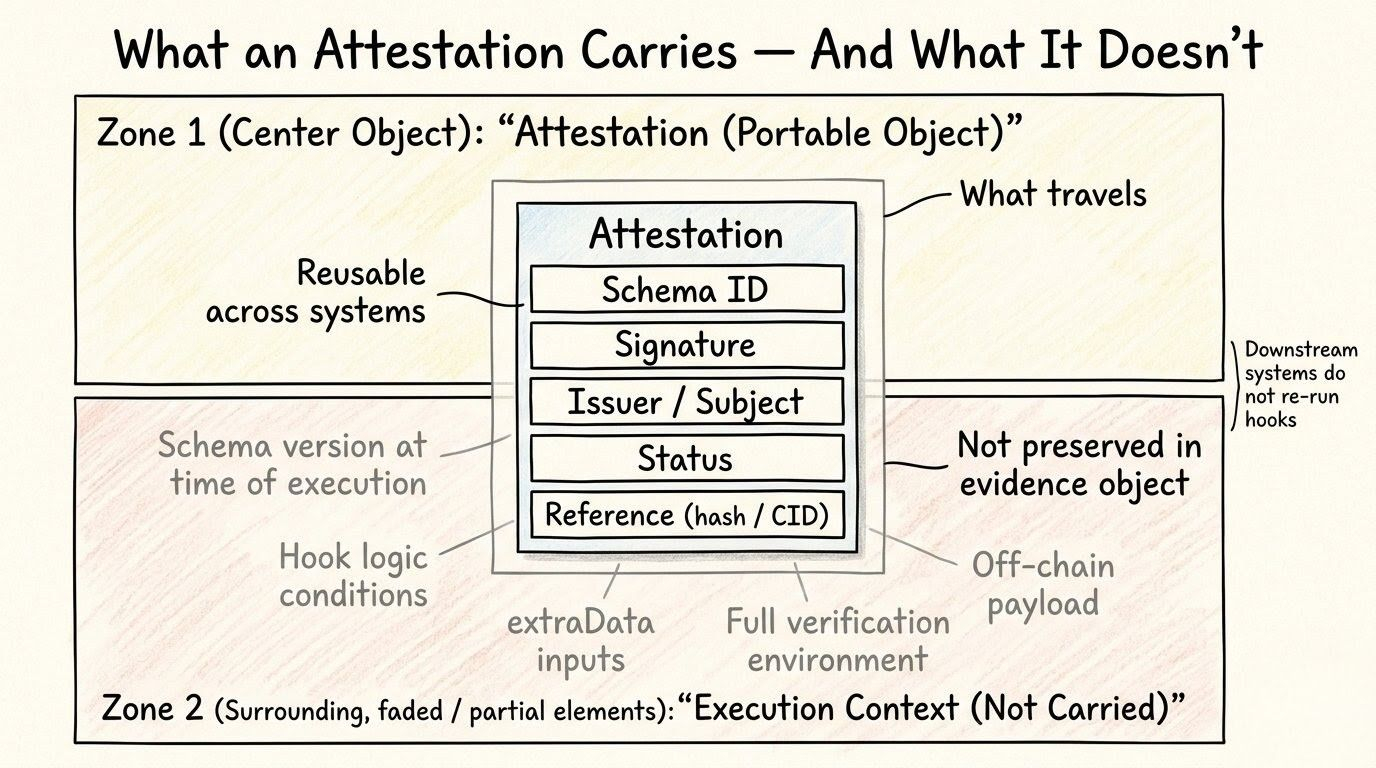
so what exactly are we trusting when we look at an attestation? that the claim is true? or that at one specific moment, under one specific hook configuration, the schema hook did not reject it? those are not the same thing, and i keep circling that because it changes how the whole system feels. less like a permanent truth layer, more like a protocol that captures moments of non-rejection and then turns them into usable evidence.
“valid means it survived, not that it was fully understood.”
and yeah, that works. it scales. it lets systems coordinate. it avoids infinite re-checking.
but it also means something quiet is happening underneath.
decisions are being made in a place that leaves no memory.
or maybe more precisely… leaves no memory that later layers are allowed to read.
i don’t know if people fully sit with that, because we keep looking at the attestation like it’s the important thing. but it’s not. it’s just what made it out.
the real thing happened earlier.
and disappeared.
or half-disappeared. hidden behind the clean object that came later. maybe that’s closer.
so what are we actually building here? a system of verification, or a system that forgets everything except what passed? maybe that’s the only way this works. maybe remembering everything would break it. maybe forgetting is the cost of scale.
but still, it leaves this gap that i can’t unsee now, between the moment something was decided and the thing that proves it later. and that gap is empty. completely empty. no trace. no memory. no explanation.
just an attestation.
sitting there like it was always obvious, like nothing else ever happened before it.
and maybe that’s the cleanest illusion inside Sign. that what you see is the whole story, when really it’s just the part that survived the schema hook, entered the evidence layer, became retrievable state, surfaced through SignScan or the query layer, and avoided being forgotten.
which maybe means the strangest part is not that Sign makes decisions.
it’s that Sign makes the decision vanish, then hands you the survivor like that was the only thing that ever mattered.