

I learned the hard way that crypto metrics can look clean while the real story stays messy. A token can show decent volume, active chatter, even a respectable market cap, and still leave you with no clear answer about what the system actually does or whether anyone will keep using it once incentives cool off. That is the lens I bring to SIGN now. What got my attention was not the ticker first. It was the realization that Sign is trying to build structure around trust itself, through schemas, attestations, and queryable records, while also tying that stack to capital distribution through TokenTable. In Sign’s own documentation, Sign Protocol is presented as the evidence layer of the SIGN. stack, and TokenTable is described as the allocation, vesting, and large scale distribution component.
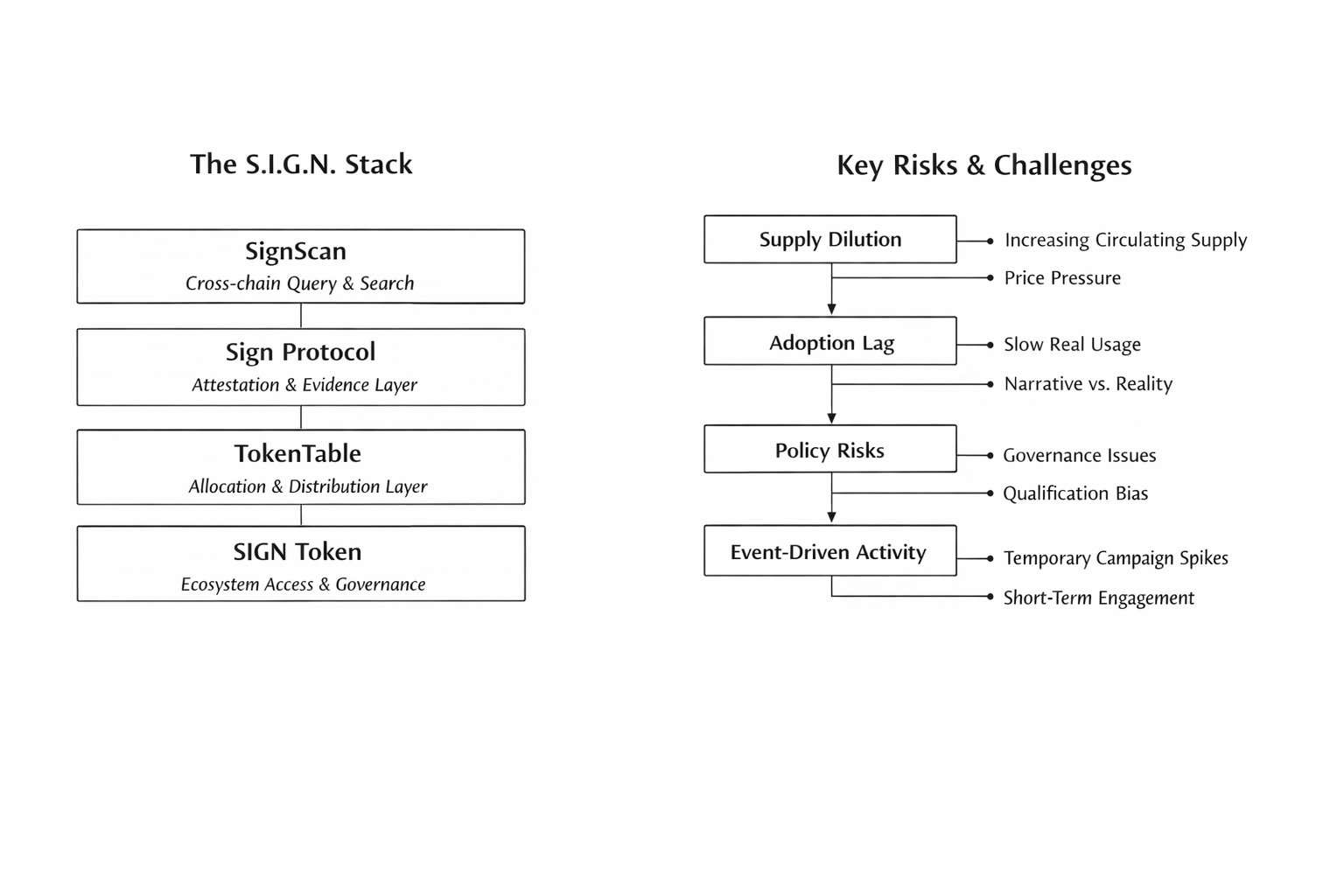 That matters because SIGN is not just selling a vague “trust” narrative. The protocol defines schemas for how facts are represented, then creates attestations as signed, verifiable records that can be public, private, hybrid, or even ZK based depending on the use case. The docs also make clear that SignScan is meant to query those records across chains, storage layers, and execution environments through REST and GraphQL. In plain language, the project is trying to make claims more inspectable and easier to verify later, instead of forcing every app or institution to rebuild the same trust logic from scratch. From an investor’s angle, that gives SIGN a more serious profile than many tokens that only exist to circulate around speculation. Binance’s listing announcement set total and max supply at 10 billion SIGN, with 1.2 billion circulating at listing in April 2025. Current market trackers now show roughly 1.6 billion circulating, which tells you dilution is not theoretical here, it is ongoing. CoinGecko currently shows SIGN around $0.032 with a market cap near $52.7 million and about $29.7 million in 24 hour volume, while Binance’s price page still describes the token’s role as ecosystem access, incentives, and governance support. This is where the retention problem becomes the real issue for me. A system for credential verification and token distribution can sound important on paper, but tokens do not hold value just because the architecture is elegant. They hold value if usage becomes durable. Will institutions, builders, or programs keep issuing attestations because the workflow is better, or will activity spike around campaigns, listings, and distributions, then fade? That is the difference between infrastructure demand and event driven demand. I am watching whether Sign becomes a repeat tool for real verification and distribution flows, not just a smart framework people praise once and forget. What could go wrong is pretty obvious. More circulating supply can pressure price. Real adoption can lag behind narrative. And even if the evidence layer works, policy decisions still sit above the protocol. A clean attestation system does not automatically mean fair qualification logic or good governance. What would change my mind in a stronger direction is simple: repeated evidence that Sign’s stack is becoming operational infrastructure, not occasional campaign machinery. If you are watching SIGN, do not stop at price and volume. Follow whether the trust layer is actually being retained, because in crypto, the systems that survive are usually the ones people still need after the rewards stop.