

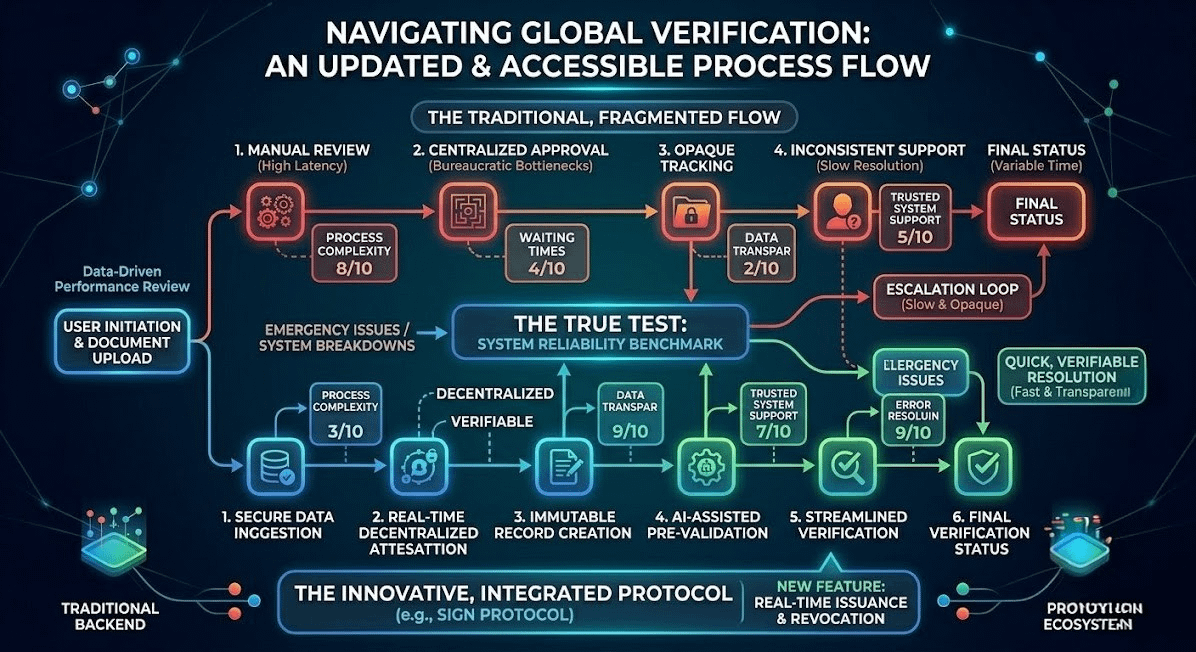
 I’ve learned this the hard way after one too many trips: travel systems always look effortless until the exact second you actually need them to work. You know how it goes. That crisp website pops up, the upload box looks so clean and friendly, the little progress bar smiles at you like everything’s under control. Then bam—one document decides to choke, a payment glitches, or the whole page just freezes. Suddenly you’re not dealing with a fancy app anymore. You’re sitting there refreshing like a maniac, talking to the screen, and wondering why something that’s supposed to make life easier feels so brittle.
That’s exactly why Sign Protocol caught my eye. Not in some shiny-tech, wow-factor way, but because it feels like the kind of practical fix people have been quietly hoping for.
If it can actually make e-visa stuff more structured and transparent—less about waiting in endless lines, dealing with cranky staff, or those awkward manual hand-offs—that’s not just an upgrade. It’s real relief. Fewer heart-in-your-throat waits. Less second-guessing. Less crossing your fingers that the right person shows up to stamp, check, or explain anything.
Traditional visa systems aren’t just slow; they’re the kind of exhausting that sneaks up on you. The worst part isn’t usually the rules themselves. It’s the total fog. Did my upload actually go through? Has anyone even looked at it yet? Is this delay normal, or did I mess something up? You basically hand over the story of your life in documents and pray the system on the other end is paying attention.
So when something like Sign comes along promising a cleaner, more digital way through all that, it honestly feels long overdue.
But I’m also realistic about it. Governments and big institutions don’t flip the switch overnight like some startup would. They move at their own pace—careful, deliberate, sometimes downright stubborn. Even a solid idea has to sit around and prove itself before anyone fully trusts it.
Sign might look amazing in the demo videos. It might feel smooth in everyday use too. But the moment that really matters isn’t the easy, polished version. It’s that random stressful Tuesday when your application has a tight deadline, your papers are perfect, and the system suddenly decides to throw a fit anyway.
These aren’t just casual apps we’re talking about. People are trying to catch flights, start new jobs, visit family, hit school deadlines, or cross borders for reasons that actually matter. This is real-life pressure. So the platform can’t only be great when everything’s going right. It has to hold up when things start falling apart.
That’s where trust actually gets earned—in the messy breakdowns.
What happens when the upload fails?
When the site freezes right after you hit submit?
When the portal says one thing but your payment record says something totally different?
When you did everything right and the system still turns it into chaos—who actually steps in to help?
A sleek design is nice and all. But real, human support when it cracks? That’s what separates a tool from something you can actually rely on.
A lot of digital stuff looks perfect while you don’t need anything out of the ordinary. Form loads. Button works. Status updates. Great. But the second something slips, the illusion shatters. Now you’re staring at a generic “try again later” message that feels like it’s mocking you, and you just want a real person to talk to.
Sign Protocol stands out to me for a specific reason. It could cut through one of the most draining parts of the whole visa nightmare: that helpless feeling that the system is this giant, unreadable machine way bigger than you. It could make the journey feel more yours—trackable, understandable, less like detective work on your own life.
Even so, I’m not handing over blind faith here. Caution isn’t the same as fear; it’s just experience talking. High-stakes stuff like this earns trust slowly. Save your screenshots. Keep copies of everything. Double-check every step. A prettier front end doesn’t automatically mean the back-end support got the same glow-up. Sometimes the shiny new portal still quietly leads you back to the same old creaky help desk.
So when I think about Sign in the e-visa world, I don’t really wonder if it can make the process look better. It probably can.
The question I keep coming back to is whether it stays solid when urgency, confusion, and a random glitch all hit at the same time. Whether it can do more than just smooth out the easy days. Whether it can actually catch you—fast, clearly, and helpfully—when the smooth ride ends and you suddenly need real speed, real answers, and something (or someone) that actually responds.
Because that’s the moment it stops being just a cool idea.
And becomes something worth trusting with the parts of your life that really matter.
Please, create, related,original, professional, engagable,reachable and updated bar chatPlease, create, related,original, professional, engagable,reachable and updated bar chart image please
@SignOfficial #SignDigitalSovereignInfra
