I’ll be honest the first time I really dug into S.I.G.N.’s architecture, it felt like way too much.
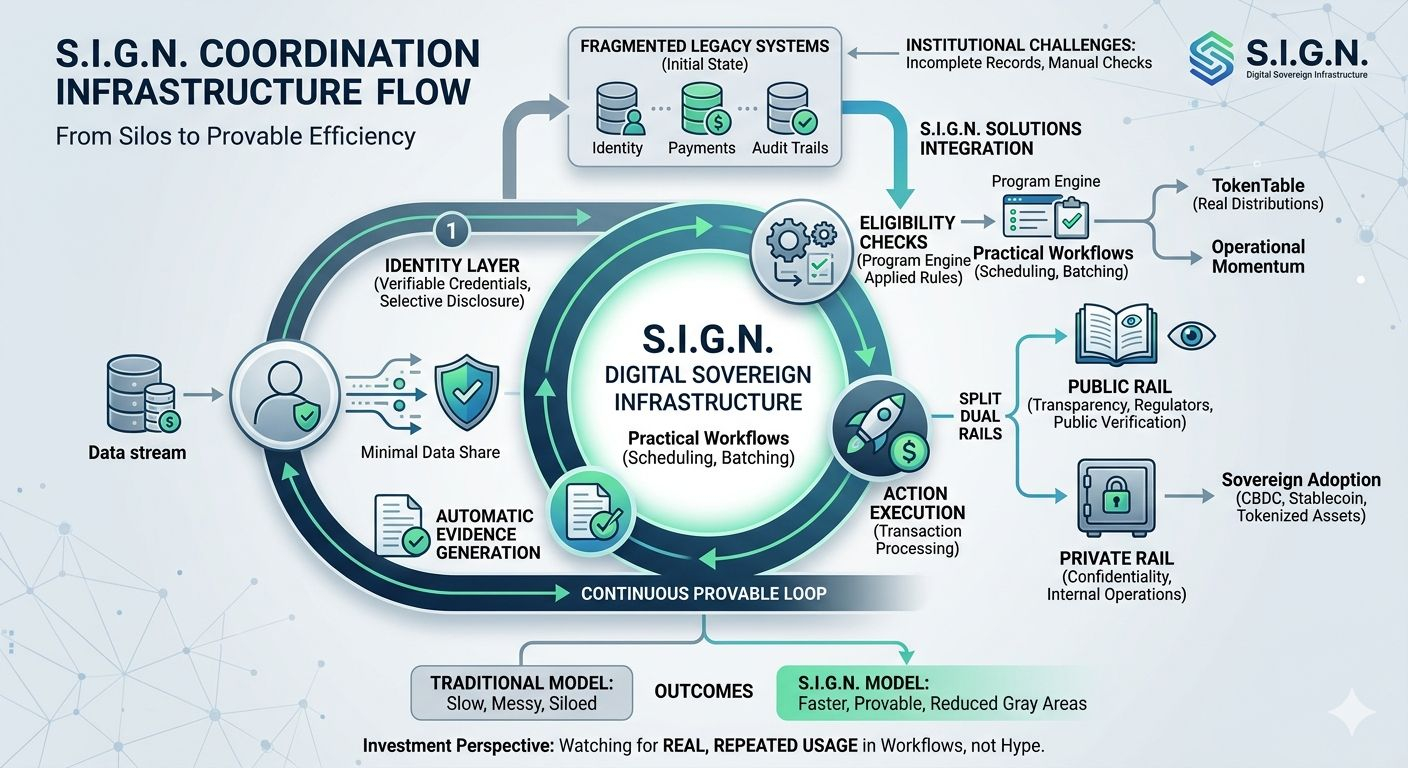
All those layers stacked on top of each other: identity, the dual rails, automatic evidence generation, that program engine… it looked like someone was trying to fix every problem in one go. In crypto, that’s usually my cue to step back. Most projects that aim for everything end up delivering nothing particularly well.
But the more time I spent with it, the more I started seeing it differently.
This isn’t some overambitious “everything chain” trying to reinvent the wheel. It feels more like an honest attempt to get the wheels we already have to actually work together especially in places where they’ve been stubbornly siloed for years.
Think about how government and institutional systems operate today. Identity data sits in one place, payments in another, and audit trails are scattered across departments with their own formats and timelines. When something goes wrong, you don’t get a clear picture. You get a slow, messy process full of manual checks and incomplete records.
That’s what made me reframe the whole thing. Instead of seeing S.I.G.N. as flashy blockchain tech, I started viewing it as coordination infrastructure the quiet glue that helps these fragmented pieces stop fighting each other.
The split between public and private rails is a perfect example. At first it just looked like a technical choice, but it’s really about respecting reality. Some information needs to be open and verifiable by regulators or the public, while other parts genuinely require privacy. Most systems break because they try to shove everything into the same box and end up losing either transparency or confidentiality. Here, the rails are separate but connected in a smart way, and I think that connection is where a lot of the actual value lives.
What kept drawing me back in was the identity layer. Honestly, most projects treat solid identity as an annoying afterthought. S.I.G.N. puts it right at the center with verifiable credentials and selective disclosure. Instead of dumping raw personal data everywhere and crossing your fingers, people can just prove exactly what’s needed nothing more.
It sounds so straightforward when you say it out loud, but almost no real-world system works like that. They usually over-collect because building proper minimal disclosure is hard. This feels like fixing something that’s been broken for a long time.
The part that really clicked for me is how everything flows together: you prove eligibility, the rules get applied, the action executes, and the evidence is generated automatically all in one tight loop. No more handing things off between separate systems with different timelines. It’s not just faster; it changes the whole model of trust.
The program engine goes beyond typical smart contracts too. It’s not about wild flexibility for its own sake. It’s designed for the practical, sometimes boring stuff that actually matters at scale scheduling, batch processing, eligibility checks, reconciliation. That’s exactly the kind of reliable plumbing governments need, even if it doesn’t make for flashy headlines.
Seeing TokenTable already up and running in real distributions gave me pause too. Once something becomes part of actual day-to-day workflows, it stops being theoretical. It turns into operational habit, and swapping it out later becomes risky. That means even modest adoption has a chance to build momentum quietly.
Of course, all that structure comes with trade-offs. Every action ties back to who approved it, under what authority, and using which exact rules. It forces a level of discipline that removes a lot of the gray areas institutions have quietly relied on for flexibility or control. I’m not sure every organization is ready or even wants to work in that kind of clear light.
From an investment perspective, it puts me in a strange spot. On paper, the design makes a lot of sense for solving real coordination headaches. But whether it succeeds will depend on something much harder to predict: do institutions actually want systems where everything is provable by default, or do they prefer the familiar comfort of inefficiency that allows some wiggle room?
That’s why I’ve stopped paying as much attention to hype or price moves. I’m watching for something simpler real, repeated usage in actual workflows, not just pilots or announcements.
If those flows start compounding naturally (eligibility turning into distributions turning into clean audits, smooth CBDC-to-stablecoin paths, tokenized asset updates), then the clever architecture will matter less than the fact that the system is simply… working day after day.
For now, S.I.G.N. sits in an interesting middle ground for me. It’s too thoughtfully put together to brush off, but too tied to slow, uneven sovereign adoption to get fully excited about without seeing more proof.
I’m staying curious though. True infrastructure rarely shows up with fireworks. It tends to sneak in quietly until one day you realize everything depends on it.