
At first, Sign might look like another blockchain DocuSign. Sign a file, store it on-chain, call it innovation. Nothing that stands out.
But this is different.
Sign is building digital infrastructure that governments can actually use. With S.I.G.N. (Sovereign Infrastructure for Global Nations), it is not about experiments or apps. It is about real systems that manage identity, currency, and payments at a national level.
Imagine a secure digital vault for citizen data and national currencies that connects directly to global financial networks. That connection is the key.
Governments today are stuck between slow legacy systems and fast-moving crypto networks they cannot control. Sign provides the bridge between the two.
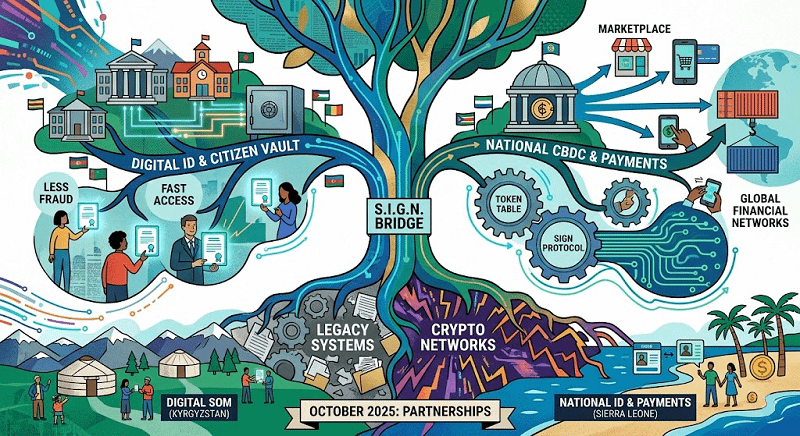
Here is what they are enabling.
Digital Identity is verifiable, reusable, and secure. It reduces fraud, cuts paperwork, and allows citizens to access services faster.
National Digital Currencies are CBDCs designed to work with stablecoins and global networks. This makes transactions faster, cheaper, and borderless.
This is not theoretical. In October 2025, Sign partnered with the National Bank of Kyrgyzstan to launch the Digital Som, serving over 7 million citizens. Weeks later, they helped Sierra Leone implement a national digital ID and stablecoin payment system. Real systems. Real people.
Sign has built a complete tech stack. Sign Protocol handles identity, TokenTable manages scaled payments, and a hybrid network balances control and transparency. These systems can pay thousands instantly and verify identities without paper.
The project has strong momentum with a 2025 token launch, over $25 million raised, and a community of hundreds of thousands.
Scaling governments is complex and politics can slow progress. Yet while much of the crypto market chases hype, Sign is quietly building the digital backbone that powers nations.