
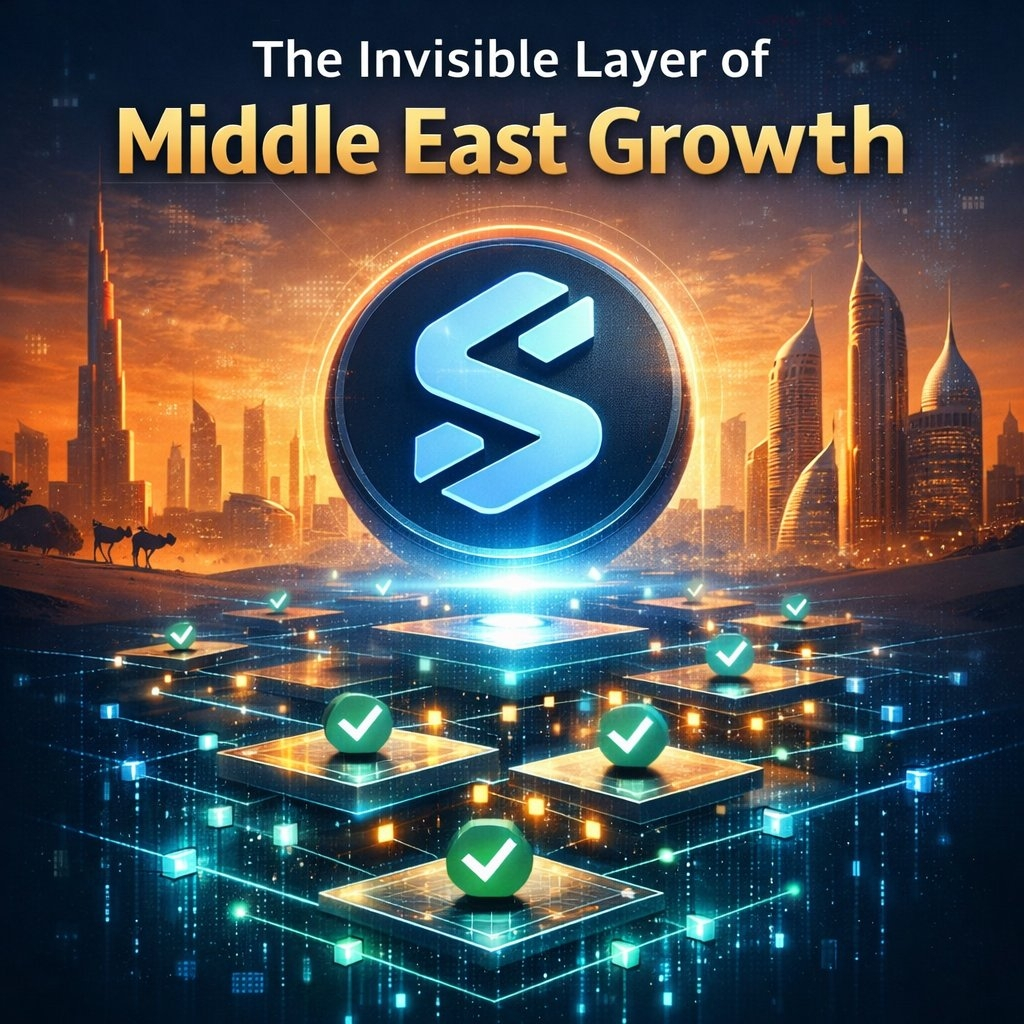
Across the shifting terrain of global digital infrastructure, a new narrative is emerging—one that moves beyond mere decentralization and toward something more foundational: digital sovereignty. In the Middle East, where state ambition, capital formation, and technological experimentation increasingly intersect, this concept is not abstract theory but active design. Within this context, Sign and its native asset, $SIGN, are positioning themselves as a connective tissue—a protocol layer that seeks to federate identity, trust, and economic coordination across fragmented systems.
To describe Sign as just another blockchain project would be to misunderstand its ambition. It is better understood as a blueprint for a new kind of infrastructure—one that attempts to reconcile state-grade compliance with decentralized programmability. If successful, it could form part of a broader “internet of value,” where sovereign entities, institutions, and individuals interact through cryptographic guarantees rather than intermediated trust.
Yet the path to such a system is neither linear nor assured.
The Context: Why Digital Sovereignty Now?
The resurgence of digital sovereignty is not accidental. It is a response to the asymmetries embedded in the current internet stack. For decades, data, identity, and economic coordination have been mediated by centralized platforms, many of them headquartered far from the regions they serve. This has created a structural imbalance: nations participate in digital economies but do not fully control the infrastructure that underpins them.
In the Middle East, this imbalance is particularly salient. Governments are investing heavily in digital transformation, smart cities, and financial innovation, yet they remain wary of dependency on external technological frameworks. The result is a dual imperative: embrace innovation while retaining control.
This is where protocols like Sign enter the conversation—not as replacements for state systems, but as modular layers that can interoperate with them. The goal is not to dissolve sovereignty into decentralization, but to encode sovereignty into decentralized systems.
Sign as Infrastructure: A Layer for Trust
At its core, Sign attempts to solve a deceptively simple problem: how to make trust portable, verifiable, and programmable across domains.
Traditional systems anchor trust in institutions—banks, governments, registries. Blockchain systems, by contrast, anchor trust in code and consensus. Sign operates at the intersection of these paradigms. It provides a framework for attestations—cryptographic statements about identity, ownership, or status—that can be issued, verified, and composed across a mesh of chains.
In practical terms, this means that a government-issued credential, a financial record, or a compliance verification could be represented as a verifiable on-chain object. These objects are not isolated; they can interact, forming a layered graph of trust relationships.
The metaphor here is less a single chain and more a federation—a network of interoperable systems that maintain local autonomy while participating in a shared protocol layer. Sign does not seek to replace existing institutions; it seeks to give them a common language.
The Role of $SIGN: Coordination and Incentives
No infrastructure layer can function without a mechanism for coordination. This is where $SIGN becomes critical.
Rather than serving purely as a speculative asset, $SIGN is designed to act as an economic primitive within the network. It incentivizes validators, secures attestations, and potentially governs protocol evolution. In this sense, it operates as both fuel and glue—aligning incentives across participants who may not otherwise trust one another.
The challenge, however, lies in balancing utility with stability. Tokens that underpin infrastructure must avoid the volatility that characterizes many crypto assets. If $SIGN is to serve as a reliable coordination layer for sovereign systems, it must evolve beyond market cycles and anchor itself in real usage.
This tension—between financialization and functionality—is not unique to Sign, but it is particularly acute in its case. Infrastructure tokens must behave less like venture bets and more like public goods.
Regional Dynamics: The Middle East as a Testbed
The Middle East offers a uniquely fertile environment for experiments in digital sovereignty. Sovereign wealth funds, regulatory sandboxes, and ambitious national visions create a landscape where large-scale infrastructure can be deployed with relative speed.
Countries in the region are not merely adopting blockchain technologies; they are attempting to integrate them into state-level systems. Digital identity programs, cross-border payment networks, and tokenized assets are all part of this broader shift.
Sign’s value proposition aligns closely with these initiatives. By providing a standardized layer for attestations and verification, it could enable interoperability between national systems that would otherwise remain siloed. In effect, it could help weave a regional mesh of chains—a network where data and value move fluidly while respecting jurisdictional boundaries.
Yet this alignment also introduces complexity. State actors have different priorities than decentralized communities. They require compliance, auditability, and control. The question is whether a protocol like Sign can satisfy these requirements without compromising its decentralized ethos.
The Optimistic Case: A New Social Contract for the Internet
From an optimistic perspective, Sign represents a step toward a more balanced digital ecosystem. It offers a way to embed trust directly into infrastructure, reducing reliance on intermediaries while preserving institutional roles.
In this vision, individuals gain greater control over their data and identity. Institutions gain more efficient mechanisms for verification and coordination. States retain sovereignty while participating in a global network.
The result is a layered system where trust is not assumed but proven—where economic interactions are mediated by cryptographic guarantees rather than opaque processes. This could unlock new forms of collaboration, from cross-border trade to decentralized finance integrated with real-world assets.
Sign, in this sense, is not just a protocol; it is a proposal for a new social contract—one where trust is both decentralized and accountable.
The Skeptical View: Complexity, Fragmentation, and Power
Skepticism, however, is not only warranted but necessary.
The first concern is complexity. Systems that attempt to bridge institutional and decentralized paradigms often become unwieldy. The integration of attestations, identity frameworks, and multi-chain interoperability introduces layers of abstraction that can be difficult to manage and secure.
Second, there is the risk of fragmentation. While Sign aims to create a unified layer, the reality of blockchain ecosystems is often one of competing standards. Without broad adoption, any single protocol risks becoming just another silo.
Third, and perhaps most critically, is the question of power. Digital sovereignty can be a double-edged sword. While it empowers states, it can also reinforce centralized control. If not carefully designed, systems built in the name of sovereignty could limit individual autonomy rather than enhance it.
In this light, Sign’s challenge is not merely technical but philosophical. It must navigate the tension between decentralization and control, between openness and regulation.
The Broader Implication: Toward an Internet of Value
What makes Sign particularly interesting is how it fits into a larger trajectory. The internet is evolving from a network of information to a network of value. This transition requires new infrastructure—systems that can handle identity, ownership, and trust at scale.
Sign’s approach—federating attestations across a mesh of chains—offers one possible path. It suggests that the future internet will not be dominated by a single protocol or platform, but by interconnected layers that enable different systems to interoperate.
In this model, sovereignty is not isolated but composable. Nations, institutions, and individuals can participate in a shared network while maintaining their distinct identities. The result is a more pluralistic architecture—one that reflects the diversity of the real world.
@SignOfficial $SIGN #SighDigitalSovereignIfra