
On paper, everything sounds simple: data are facts, and facts are truth. But in reality, everything turns out to be a bit more complicated. Because data in themselves mean nothing until they are placed in a specific structure. And here comes the main player, which is rarely mentioned — the schema.
The schema is not just a technical shell. It is a framework that determines which data is permissible, which fields are mandatory, and which do not exist at all. At this moment, an invisible but powerful form of governance arises: the one who designs the schema essentially defines the boundaries of reality. Not directly, not through censorship — but through architecture.
Imagine: if there is no field for “context” in the system, then context is not taken into account. If there is no way to capture doubt, then doubt does not exist. The schema not only stores data but also directs its interpretation. In this sense, “truth” becomes not an absolute category, but a function of design.
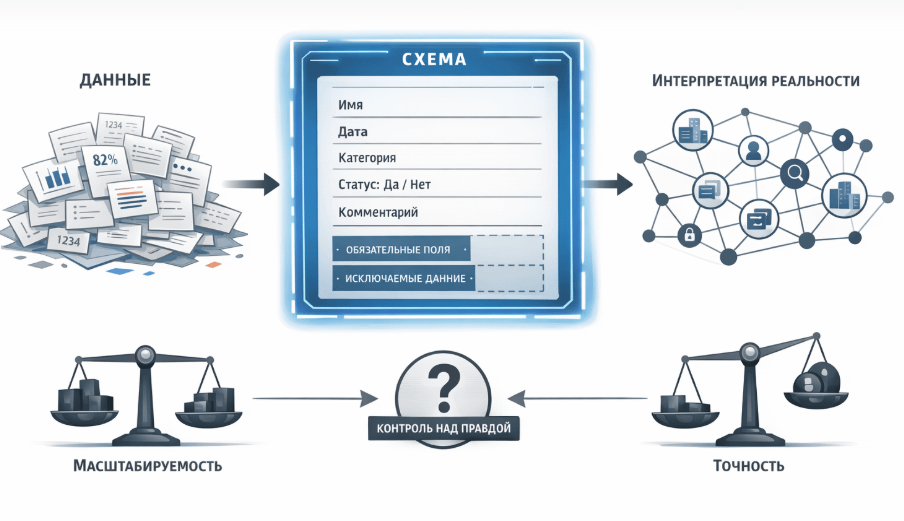
This is especially noticeable in on-chain systems, where schemas are often perceived as a neutral layer. But there is no neutrality here. Every decision — which attributes to include, which standards to use, how to validate information — already carries a certain philosophy. And users rarely realize this.
On the other hand, standardization provides scalability. Common schemas simplify interaction, make data compatible, and allow for the construction of ecosystems. Without this, it is impossible to create a global infrastructure of trust. But the price for this is the loss of nuance.
Flexibility provides space for a more accurate reflection of reality. It allows for consideration of context, non-standard cases, and local peculiarities. But the more flexibility there is, the harder it is to reach a consensus. The system begins to fragment into pieces, where each “truth” exists in its own version of the schema.
And here arises the key tension: between convenience and accuracy, between scale and depth. Schema-driven truth is not just a matter of data format. It is a question of power over how we describe the world.
In projects like Sign, this becomes particularly important. If trust is built through attestations and data structures, then schema design is no longer a technical task but a social contract. The question is not what data we collect, but what forms of reality we consider permissible.
Ultimately, control over truth shifts. Not to those who own the data, but to those who determine how this data can exist. And this changes the very logic of trust: it becomes a question not only of content but also of form.