
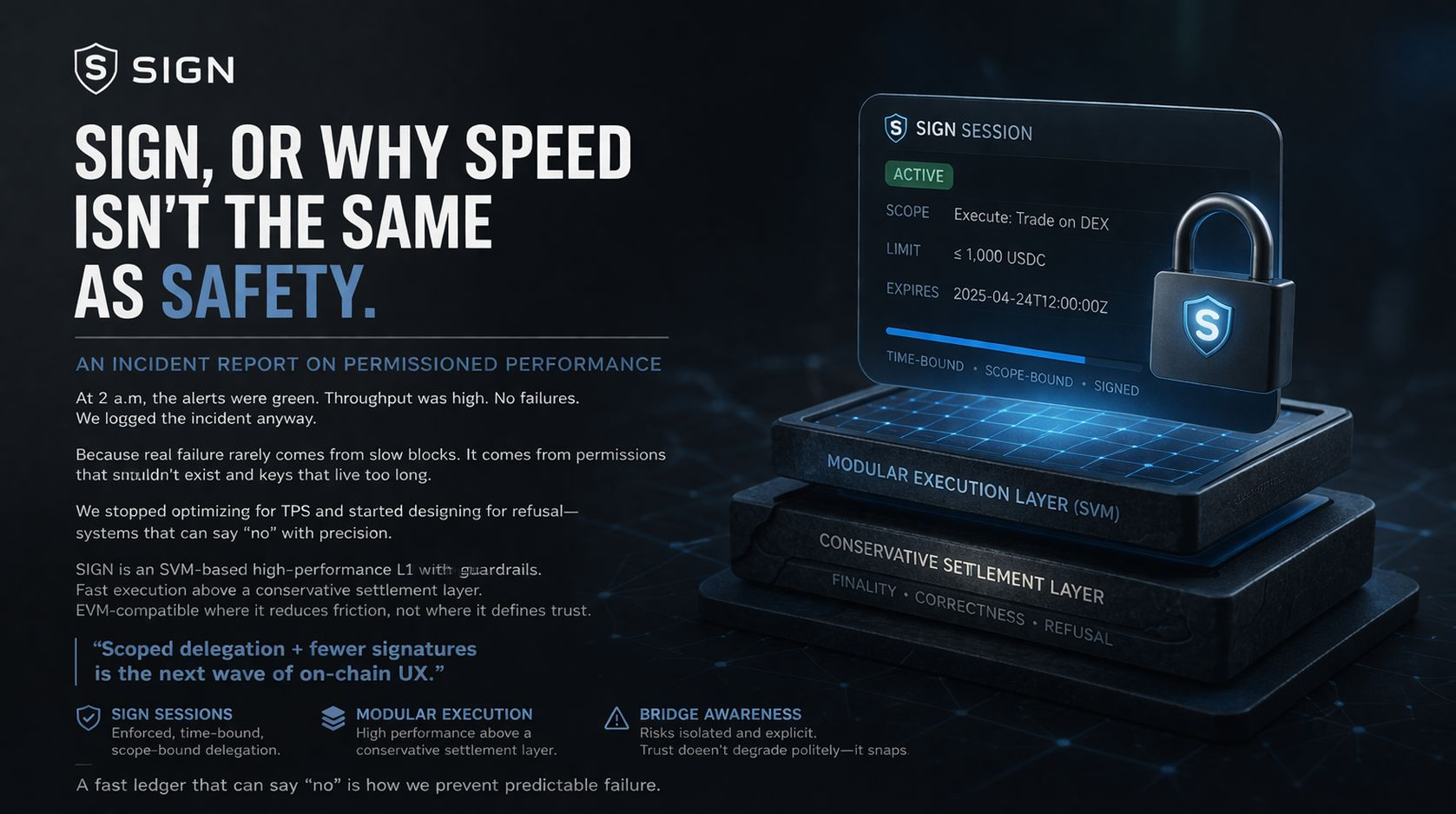
i logged the alert at 02:13. Not because something had broken, but because nothing had — and that, lately, had become the more suspicious condition. The dashboards were green, latency within tolerance, throughput high enough to satisfy anyone still measuring competence in transactions per second. But the risk committee had learned, slowly and expensively, that speed rarely announces failure. It conceals it.
The incident report began the same way they all do: timestamps, signatures, approvals. A trail of intent. Who authorized what, when, and under which assumptions. The problem is never the block time. It is the permission that should not have existed, the key that stayed valid longer than it deserved, the silent agreement between convenience and exposure.
This is where SIGN enters the room, not as a solution claiming perfection, but as a system that accepts where failure actually lives. It is an SVM-based high-performance L1, yes, but that descriptor is almost a distraction. The performance is there, measurable, defensible. What matters more are the guardrails — the constraints that refuse to optimize away caution.
We learned to stop asking how fast a system can execute and instead ask how precisely it can refuse.
SIGN Sessions became the focal point of that shift. Not a feature, but a discipline. Enforced, time-bound, scope-bound delegation. Permissions that expire not out of politeness, but design. Authority that shrinks to fit its purpose and disappears when it is no longer justified. The debates around wallet approvals used to stretch for hours — how many signatures, how much friction, how much trust to extend to a user before it becomes negligence. Sessions reduced the argument to something more honest.
“Scoped delegation + fewer signatures is the next wave of on-chain UX.”
It sounds like a usability improvement. It is not. It is a containment strategy. Fewer signatures mean fewer opportunities for compromise. Scoped delegation means that even if something leaks, it leaks into a confined space.
The architecture follows the same philosophy. Execution is modular, allowed to move quickly, adapt, and scale above a settlement layer that remains intentionally conservative. The base layer does not chase speed; it preserves correctness. It settles disputes, finalizes state, and refuses ambiguity. Above it, execution environments can iterate, optimize, and even fail — but without corrupting the foundation beneath them.
There were discussions about compatibility, of course. EVM support was included, but not celebrated. It reduces tooling friction, nothing more. Familiarity lowers onboarding costs, but it does not define the system’s integrity. That is determined elsewhere, in how permissions are structured and enforced.
We documented bridge risks with the same blunt language we had started to adopt elsewhere. No euphemisms, no softened conclusions.
“Trust doesn’t degrade politely—it snaps.”
Every cross-chain interaction is an assumption stretched across systems that do not share the same guarantees. When it breaks, it does not warn you gradually. It collapses entirely, taking its dependencies with it. SIGN does not eliminate that risk. It acknowledges it, isolates it, and forces it into explicit boundaries.
The token itself appears in the report only once, as it should. Not as an asset to be promoted, but as security fuel. Staking is framed not as yield, but as responsibility — participation in maintaining the system’s constraints, its refusals, its discipline.
By the time the report concludes, the tone has shifted without announcing it. Less technical, more reflective. The early sections read like monitoring logs; the later ones read like lessons we are trying not to forget.
Speed, we note, is rarely the cause of failure. It is the mask that allows fragile assumptions to scale before anyone notices. A system that moves quickly but cannot restrict itself will eventually authorize its own compromise.
SIGN is not built to be the fastest system in isolation. It is built to ensure that speed does not outrun control. That execution does not outpace accountability. That permissions are granted with an expiration date already attached.
Because in the end, the most valuable property of a ledger is not how quickly it can say “yes.”
It is how reliably, and how often, it can say “no.”. Use 'i'
#SignDigitalSovereignInfra $SIGN
