

The Great Delusion: Why "Digitization" Failed Us
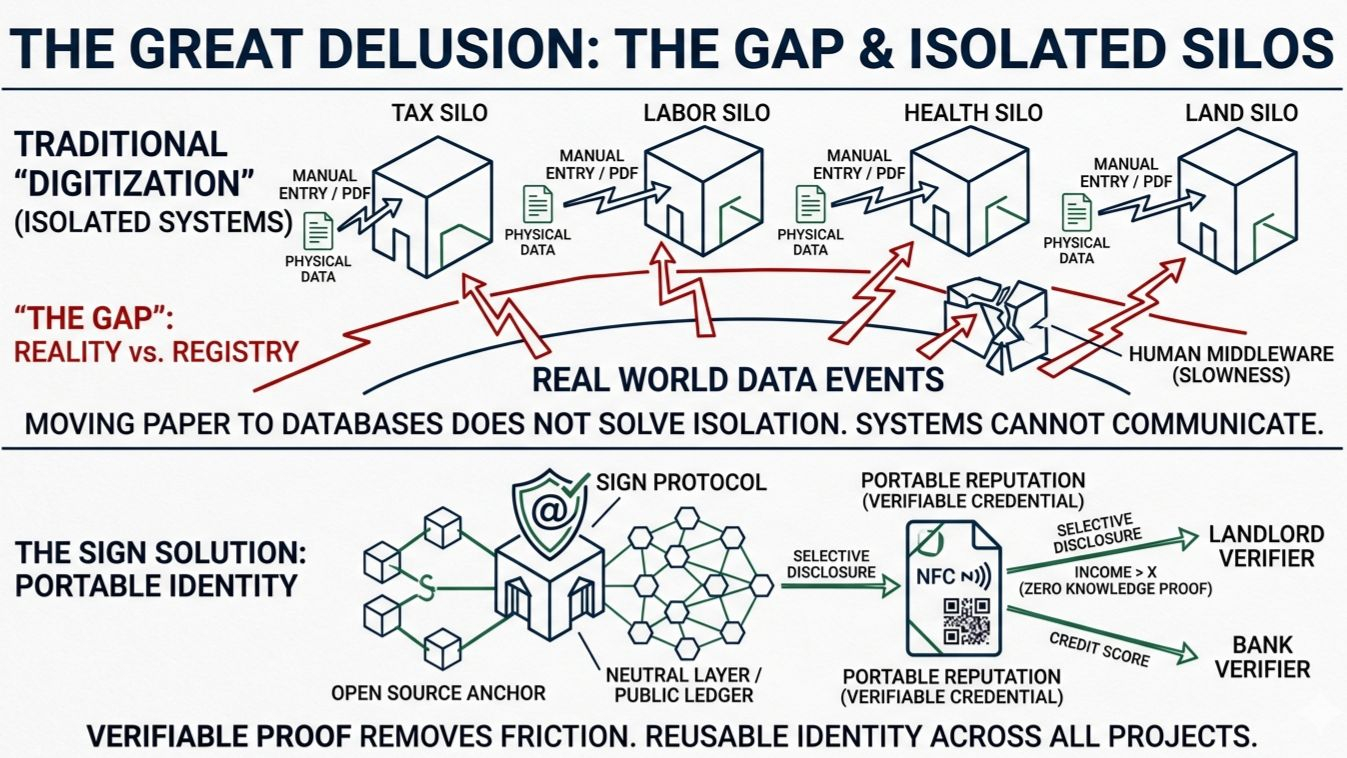
I’ve always been bothered by a specific lie: the idea that putting a paper form into a computer solves the problem. It doesn’t. We’ve spent thirty years moving from physical folders to digital silos, but the Gap remains.
What is the Gap? It’s the distance between Reality (what happened in the physical world) and the Registry (what the database says). In the old world, we trusted the "Stamp." You didn't trust the data; you trusted the guy behind the desk with the ink.
The systems we use today—taxes, labor, health—are معزولة (isolated). They are islands. If I want to prove my income to a landlord, I have to go to a government portal, download a PDF, and send it to a human who then manually verifies it. This is "Human Middleware." It’s slow, it’s prone to corruption, and it’s why I believe our current digital economy is built on sand.
The Blockchain Reality Check: Why It Wasn’t Enough
I remember the early days of Ethereum. The promise was: "Put everything on the blockchain!" But here’s my take, and it’s a bit controversial in some circles: Pure decentralization is often incompatible with the real world. * Do you want your medical records on a public ledger? No.
Can a government allow its land titles to be controlled by a DAO with no legal recourse? No.
Who pays the gas? Who fixes the laws when they change?
The "Silo Era" gave us privacy but no trust. The "Blockchain Era" gave us trust but no privacy (and a lot of friction). I started looking for the "Middle Layer"—the bridge. That’s where the philosophy of SIGN lives. It’s not trying to replace the State; it’s trying to audit it in real-time.
The "SIGN" Shift: From Authority to Evidence
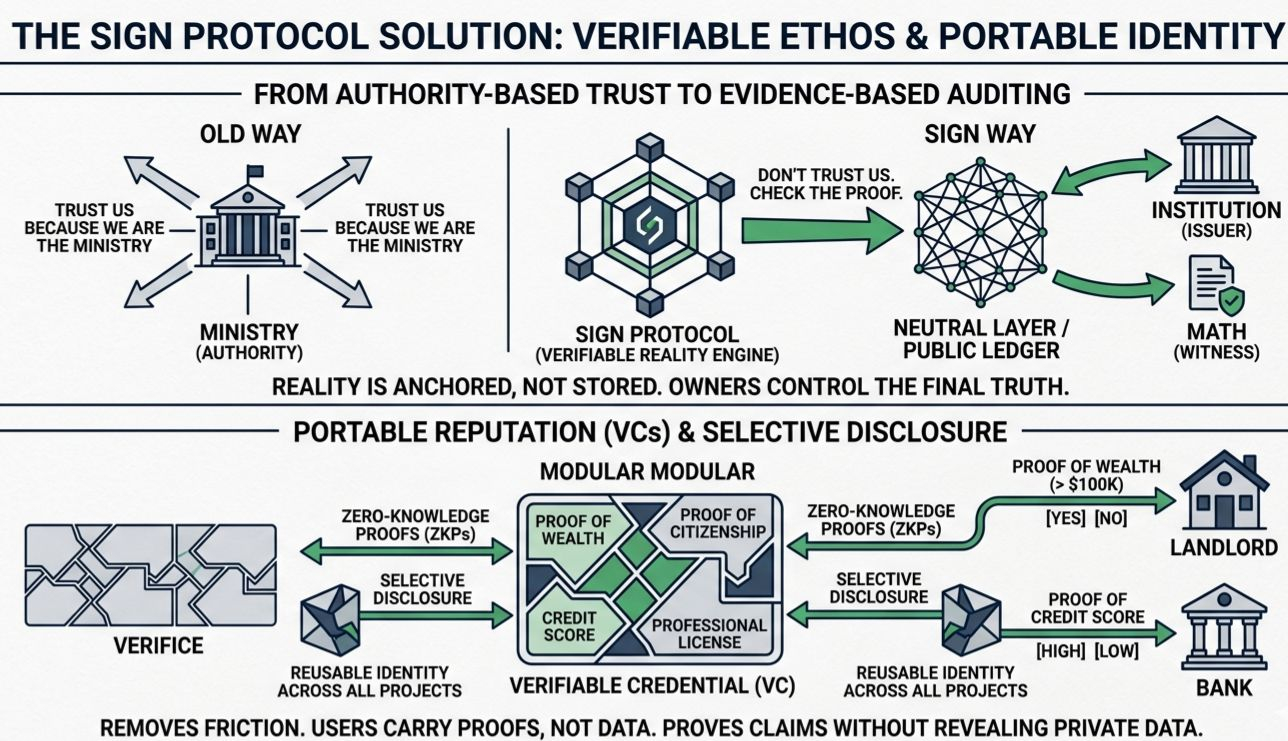
When I look at the Sign Protocol, I don’t see a "crypto project." I see a Verifiable Reality Engine. The core shift is simple but profound:
The Old Way: "Trust us because we are the Ministry."
The SIGN Way: "Don't trust us. Check the cryptographic proof we just anchored to a neutral layer."
This changes the ownership of "The Final Truth." If a government issues a permit, they still issue it. But once it’s "Signed" and anchored, they can’t quietly delete it or change the date later without the world seeing the digital fingerprint change.
My Personal Insight: This creates a world where the institution is the Issuer, but the math is the Witness. You don’t need the institution's permission to verify that what they said is true. That is true sovereignty.
The Retention Crisis: Web3’s Dirty Secret
Let’s talk about the market. I’m tired of seeing "1 Million Users" metrics that are actually just 1,000 bots and 999,000 people who used an app once for an airdrop and never came back.
Retention is the only metric that matters. And why is retention so bad in Web3? Friction.
Every time you join a new project, you have to "Prove" yourself again. Connect wallet. Sign message. Upload ID. Join Discord. Link Twitter. It’s exhausting. The user isn't rejecting the project; they are rejecting the Trust Tax.
The "Portable Reputation" Solution
What I find fascinating about SIGN’s use of Verifiable Credentials (VCs) is the concept of "Selective Disclosure." Imagine you want to join a private investment club.
Old way: Send them your bank statement (massive privacy leak).
SIGN way: You have a "Proof of Wealth" credential from your bank. You show the club a "Zero-Knowledge" proof that says "Yes, I have >$100k" without showing the exact balance or your account number.
If I can carry that proof from Project A to Project B to Project C, the friction disappears. This is how you move from "Airdrop Hunters" to "Long-term Users." You make the identity reusable.
The Infrastructure: Why the Tech Stack Actually Matters
I’m a skeptic of "Narrative-only" tokens. I want to see the plumbing.
When I see SIGN implementing W3C Standards, SD-JWT, and OIDC4VP, my ears perk up. These aren't just acronyms; they are the languages of the "Real World" tech industry (Google, Microsoft, Apple).
If a protocol doesn't support Offline Verification (via QR or NFC), it’s useless for 90% of human interactions. SIGN’s focus on being an "Operational Layer" rather than just a "Settlement Layer" tells me they are thinking about the coffee shop and the border crossing, not just the DeFi swap.
The Danger Zone: Integrity vs. Justice
I have to be honest with you—and this is a point many people miss.
A perfectly transparent system can still be an evil system.
If a government passes a law that says "Certain people cannot own land," and they use SIGN to perfectly record every transaction, the Integrity of the record is 100%. But the Justice is 0%.
SIGN proves that an action happened according to the rules. It doesn’t prove the rules are fair. As an observer, I worry about "Transparency Theater"—where an organization looks clean because their "Signed" records are perfect, while the real corruption happens in the "Unsigned" shadows.
The Paradox: A "semi-transparent" system is more dangerous than an opaque one. Why? Because it gives you the Illusion of Truth.
What I’m Monitoring (The "Investor" Lens)
If you’re watching the SIGN token or the ecosystem, don't look at the price. Look at the Issuers.
Who is issuing the credentials?
Are they reputable?
Is there a "Revocation" mechanism that actually works?
Are developers building apps like TokenTable where the identity actually means something for the distribution of value?
The "Alpha" isn't in the code; it’s in the Adoption Curve. If "Verifiable Identity" becomes the standard for how we interact with the internet, then the protocol that sits at the center of that web becomes the most valuable piece of real estate in the digital age.
$SIGN @SignOfficial #SignDigitalSovereignInfra
