
On March 28, 2026, the global cryptocurrency market experienced severe turbulence. Bitcoin briefly fell below $66,000, Ethereum dropped to $1,987, and nearly 120,000 people were liquidated, with the liquidation amount reaching $446 million. Meanwhile, gold surged past $4,550, setting a new historical high, with risk assets and safe-haven assets showing extreme divergence. The Federal Reserve's March meeting maintained interest rates and released hawkish signals, while the situation in the Middle East continued to deteriorate. Multiple macroeconomic headwinds led to a deep adjustment phase in the cryptocurrency market. This report conducts a systematic analysis from four dimensions: capital flow, technical aspects, macro environment, and operational strategies, to provide decision-making references for investors.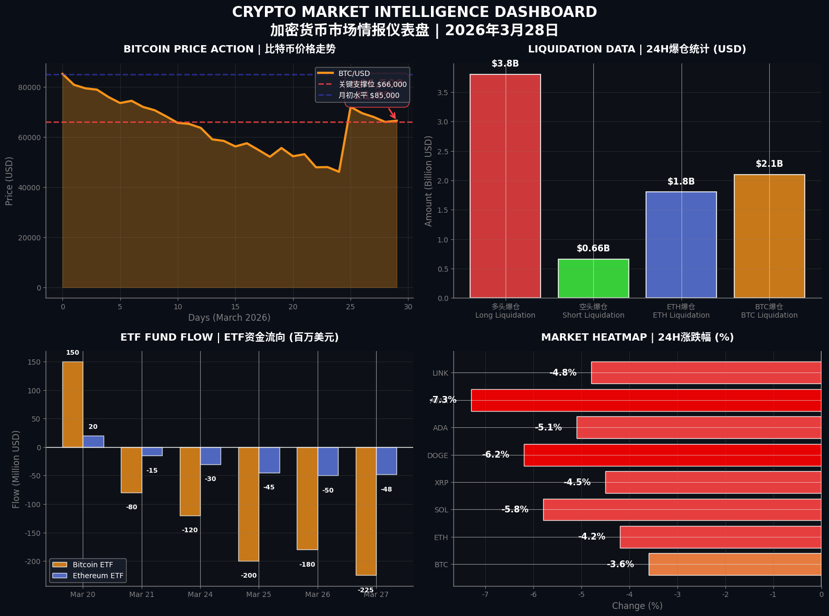
1. Market Overview: Structural differentiation in a bloodbath
1.1 Spot Market: Across the board heavy losses, liquidity crisis begins to emerge
As of the morning of March 28, Bitcoin was in the $66,000 range, with a 24-hour decline of over 3.6%, nearly 50% down from the historical high of $126,080 in October 2025. Ethereum performed even weaker, dropping to $1,987, down over 3%, and mainstream coins like SOL, XRP, and Dogecoin had declines generally in the 4%-5% range. It is noteworthy that this decline exhibited characteristics of "indiscriminate selling," even previously relatively resilient blue-chip coins did not escape, indicating that the market has entered a phase of panic deleveraging.
From the ETF fund flows, on March 27, Eastern Time, Bitcoin spot ETF saw a total net outflow of $225 million, and Ethereum spot ETF saw a total net outflow of $48.54 million, with Ethereum ETF continuing to see net outflows for 8 days. This echoes the trend previously observed by JPMorgan: since the outbreak of the Iran war in late February, there has been a significant divergence in fund flows between Bitcoin and gold ETFs, with the world’s largest gold ETF—SPDR Gold Shares seeing outflows of approximately 2.7% of its asset size, while iShares Bitcoin Trust recorded inflows of about 1.5%. However, this "alternative to gold" narrative was broken this week, with funds beginning to flee both gold and Bitcoin, turning to cash in dollars and short-term U.S. Treasuries.
1.2 Derivatives Market: Leveraged liquidations and volatility surges
Coinglass data shows that nearly 120,000 people in the cryptocurrency market were liquidated in the past 24 hours, with liquidation amounts reaching $446 million. The perpetual contract funding rate has turned negative across the board, with Binance's BTC/USDT perpetual contract funding rate dropping below -0.01%, indicating that bearish forces dominate. Implied volatility (IV) in the options market has surged significantly, with Bitcoin's short-term options IV surpassing 80%, while Ethereum is close to 100%, indicating extreme pessimism about future price volatility.
More attention should be paid to liquidity conditions. According to Chainalysis data, the depth order book of major exchanges saw significant deterioration on the evening of March 27, with the slippage of a $1 million market order for Bitcoin widening to 0.15%, the worst level since August 2025. This means that even moderate inflows and outflows of funds may trigger dramatic price volatility, and the market is in a typical "liquidity black hole" state.
2. Macro Environment: The darkest hour of triple storms overlapping
2.1 Monetary Policy: The Fed's hawkish turn, interest rate cut expectations completely dashed
The Fed's interest rate meeting on March 18 became the last straw that broke the market’s back. The Federal Open Market Committee decided to keep interest rates unchanged at 3.5%-3.75% by an 11-1 vote, but the dot plot shows only one expected rate cut in 2026, significantly lower than previous market expectations. Fed Chair Powell clearly stated in a press conference: "If we don't see progress on inflation, we won't cut rates," even mentioning the "possibility of the next rate hike." This statement completely shattered the market's fantasies about rate cuts in the first half of the year.
The upward revision of inflation expectations is the core basis for the hawkish turn. The Federal Reserve raised its 2026 core PCE inflation forecast from 2.5% to 2.7%, and the GDP growth forecast from 2.3% to 2.4%. Powell admitted that the surge in oil prices caused by the Middle East situation will push up overall inflation and may transmit to core inflation. For the cryptocurrency market, the persistent high interest rate environment means that the risk-free rate remains high, significantly increasing the opportunity cost of funds and forcing the valuation center of risk assets to move down.
2.2 Geopolitics: Prolonged conflict in the Middle East, chaotic risk-hedging logic
On March 26, Israeli media reported that a commander of the Iranian Revolutionary Guard Corps was killed during Israeli military operations. The Iranian Revolutionary Guard immediately threatened to strike any vessels attempting to pass through the Strait of Hormuz, claiming it "will not let oil flow out of the Gulf region." This escalation caused oil prices to soar, with Brent crude breaking through $85 per barrel, sharply increasing global stagflation risks.
In traditional thinking, geopolitical conflicts should favor safe-haven assets such as gold and Bitcoin, but the market’s response this time has shown a "risk asset-style sell-off." The reasons are: firstly, the conflict has caused energy prices to soar, directly pushing up inflation expectations, forcing central banks to maintain tight policies; secondly, the uncertainty of the duration of the war has triggered liquidity demand, leading investors to sell off all non-cash assets; thirdly, as the third largest crypto mining country, Iran's deteriorating situation may trigger regulatory ripple effects. This phenomenon of "safe-haven assets not being safe" reflects that the crypto market is still not fully mature, and its "digital gold" narrative still needs to be tested under extreme pressure.
2.3 Regulatory Environment: Policy friendly but lagging in implementation
From a regulatory perspective, 2026 was supposed to be the "friendly year" for cryptocurrency policies. The Trump administration's second term took a clearly supportive stance towards cryptocurrencies, multiple investigations by the SEC against major crypto companies have been withdrawn, and banks received clearer custody permissions for crypto assets. The Senate Banking Committee announced discussions on the CLARITY Act, and the GENIUS Act provides a federal framework for stablecoins.
However, the policy benefits have not yet translated into market momentum. On one hand, the legislative process is slow, with the CLARITY Act still in committee stages, full implementation is expected to take until the second half of 2026; on the other hand, the deterioration of the macro environment has overshadowed positive signals of regulatory improvement. The market is currently more focused on the Fed's policy and geopolitical situation, rather than the long-term compliance process. This kind of "short-term bearish, long-term bullish" pattern requires investors to have a stronger structural perspective.
3. Technical Analysis: The life-and-death struggle of key support levels
3.1 Bitcoin: Weekly support level facing examination
From the daily chart perspective, Bitcoin is currently in a clear downward channel. On March 27, the sharp drop briefly broke below $66,000, touching the $65,000 round number, which just happens to be the long-term uptrend line support since August 2024. If the closing price this week is below $65,000, it will confirm a weekly level break, with strong support shifting down to the psychological level of $60,000, or even the previous low at $56,800.
Technical indicators are overwhelmingly bearish. The MACD has formed a death cross below the zero axis, and the green bars continue to expand; the RSI has dropped to around 35, though it has not entered the oversold range, but downward momentum is sufficient; the Bollinger Bands are opening downwards, with prices running along the lower track, indicating a trend of decline. It is noteworthy that trading volume has significantly increased during the decline, with daily trading volume on March 27 hitting a new high since December 2025, indicating that bearish forces are concentrating their release.
From on-chain data, the selling pressure from long-term holders is nearing exhaustion. Glassnode data shows that the net selling volume of Bitcoin held for over 365 days has significantly narrowed from 243,700 coins in early February to 32,000 coins in early March, a drop of over 85%. Meanwhile, the number of whale entities holding over 1,000 Bitcoins increased from 1,207 in October 2025 to 1,303, with whale addresses beginning to accumulate quietly. This kind of "retail panic selling, whales quietly accumulating" differentiation often occurs in mid-term bottoming areas.
3.2 Ethereum: Ecological pressure, performance weaker than the market
Ethereum’s recent adjustment has exceeded that of Bitcoin, with the ETH/BTC exchange rate dropping below 0.03, hitting a new low since 2024. This reflects the structural pressures facing the Ethereum ecosystem: the diversion caused by Layer 2 solutions has led to a decline in mainnet revenue, the attractiveness of staking yields has weakened, and continuous outflows from ETFs indicate a decreased willingness of institutions to allocate funds.
Technically, Ethereum has breached the key psychological level of $2,000, with subsequent support at $1,900 (August 2024 low) and $1,750 (October 2023 high). If $1,900 is lost, it may trigger a larger scale of leveraged liquidations. However, from on-chain activity, Ethereum network gas fees have dropped to below 10 Gwei, at historic low ranges, which typically corresponds to extremely low market sentiment, with inverse indicators suggesting that the probability of a rebound is accumulating.
4. Operational Strategy: Finding anchor points in the storm
4.1 Position Management: Cash is king, dynamic balance
The current market is in a high volatility, high uncertainty "double high" environment, and position management should follow the "defense first" principle. It is recommended to keep total positions within the 30%-50% range, reserving 50%-70% in cash or stablecoins to cope with potentially more extreme market conditions. For investors who already hold positions, it is crucial to avoid high leverage, with contract leverage multiples recommended to be kept below 3 times, and strict stop-loss lines set for spot financing positions.
Referring to the asset allocation framework you previously proposed—using gold as a risk control anchor to allocate 30%-40% of positions, with the remaining funds laid out in Bitcoin and quality mainstream coins—this current environment can be adjusted appropriately: the gold position can be increased to 40%-50%, the Bitcoin position reduced to 20%-30%, and altcoins like Ethereum controlled within 10%. This adjustment not only meets the defensive needs after the reversal of the "sell gold, buy coins" trend but also reserves ample ammunition for future bottom fishing.
4.2 Bottom Fishing Strategy: Build positions in batches, refuse left side
For long-term investors, the $65,000-$70,000 range can be viewed as Bitcoin's mid-to-long-term value range, but one should avoid heavily bottom fishing all at once. It is recommended to adopt a "pyramid-style" batch building strategy: first purchase at $65,000 (10% position), if it drops to $60,000 add 15%, and if it drops to $55,000 add 20%. This gradual layout can reduce the average cost while avoiding the "catching a falling knife" risk.
It is important to emphasize that the prerequisite for bottom fishing is the appearance of clear signals of a stop decline, including but not limited to: a long lower shadow or morning star pattern on the daily chart, a rebound in trading volume after a contraction, the perpetual contract funding rate turning positive, and ETF fund flows shifting from negative to positive. Before the signal appears, patiently holding cash and waiting is better than blindly bottom fishing.
4.3 Trading Opportunities: Volatility arbitrage and cross-asset hedging
For short-term traders, the current high volatility environment provides abundant trading opportunities. Firstly, volatility arbitrage: by selling wide-strangle option combinations, collecting time decay profits, but strict control of Delta exposure is necessary; secondly, cross-asset hedging: going long on the ETH/BTC exchange rate, betting on a rebound of Ethereum from an oversold position, this exchange rate is at a historically extreme low, offering a relatively favorable risk-reward ratio; thirdly, event-driven: closely monitor key events such as Trump’s tariff policy implementation on April 2 and the Federal Reserve’s interest rate meeting on April 29, to layout volatility trades in advance.
4.4 Risk Warning: Beware of liquidity crises and black swans
The biggest risk in the current market is the spiral contraction of liquidity. If Bitcoin effectively breaks below $60,000, it could trigger large-scale institutional stop-loss orders, leading to a chain liquidation. Additionally, the following black swan events should be noted: firstly, if the Middle East situation escalates into full-scale war, it could halt global financial markets; secondly, unexpected shifts in U.S. regulatory policy, such as the SEC restarting investigations into crypto exchanges; thirdly, the risk of stablecoins becoming unpegged, if USDT or USDC encounter a trust crisis, it will trigger systemic sell-offs.
5. Conclusion: The rational light in the darkest hour
As of March 2026, the cryptocurrency market is undergoing a brutal stress test. The Fed's hawkish turn, the prolonged conflict in the Middle East, and the continuous outflow of ETF funds, the triple negatives push the market to an emotional freezing point. However, historical experience shows that extreme panic often breeds mid-term bottoms. The selling pressure from long-term holders is nearly exhausted, whale addresses are beginning to accumulate quietly, and technical oversold signals are accumulating—these microstructural improvements will eventually translate into upward momentum after the macro environment stabilizes.
For investors, the most important thing right now is not to predict the exact position of the bottom, but to ensure that they still have funds and confidence when the bottom arrives. Maintain patience, respect the trend, strictly control risks, and one can welcome the rainbow after the storm. Just as you judged at the end of 2025, the allocation framework of gold and Bitcoin remains effective in the long run, but at the tactical level, adjustments need to be dynamically made according to changes in the macro environment, finding the optimal solution between the "risk control anchor" and the "growth engine."
Disclaimer: This report is for market analysis reference only and does not constitute any investment advice. The cryptocurrency market is highly volatile, and investment should be cautious, please make decisions independently based on your risk tolerance.


