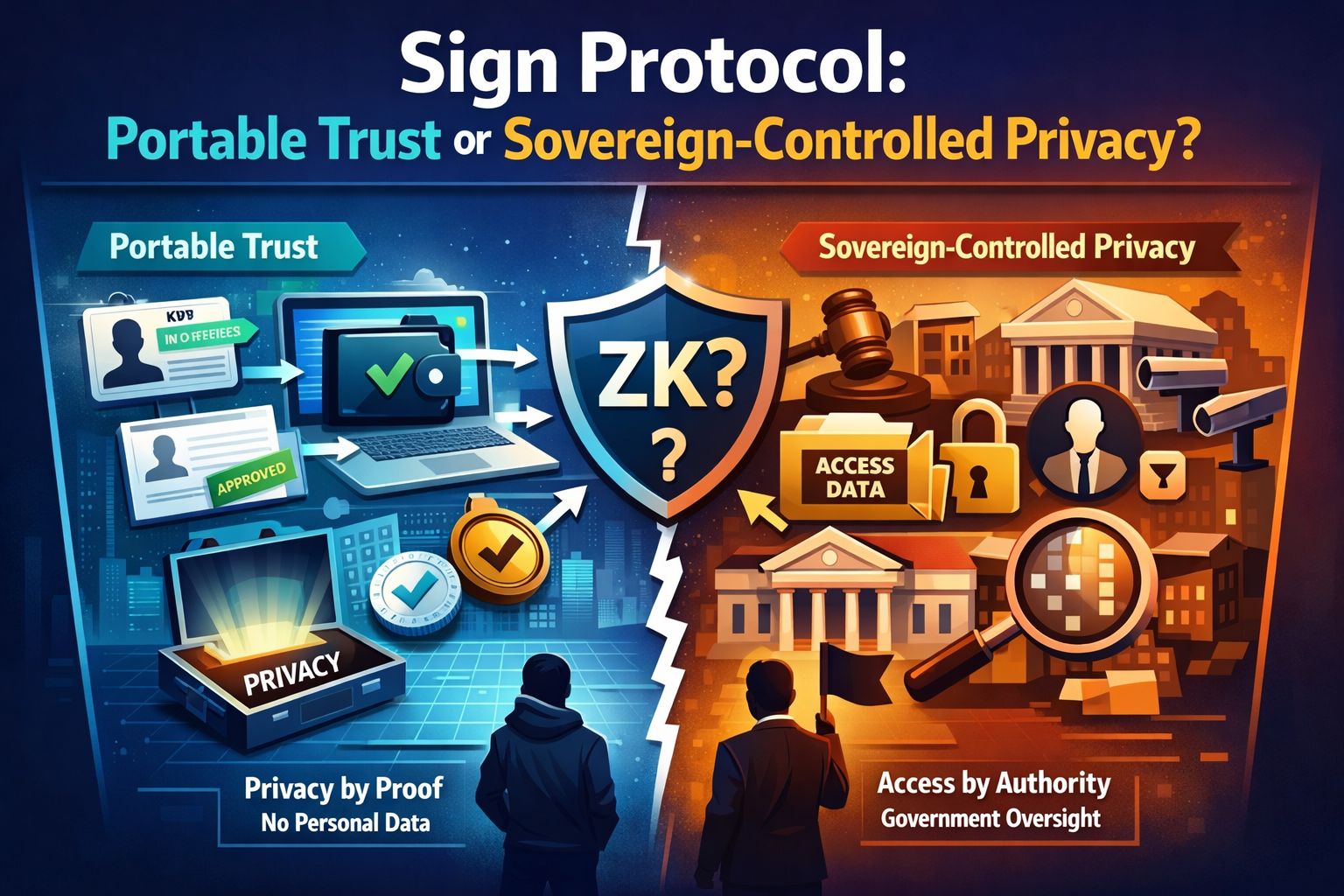
I’ve been thinking about Sign Protocol a lot lately, and one part of their thesis keeps sticking with me. Incentives also matter. Nodes will naturally prioritize what makes their operations easierspeed over correctness, efficiency over extra verification. These aren’t attacks, just human behavior. SIGN designs around these incentives, trying to make it easier to follow the rules than to bend them, but no system can make everyone act perfectly all the time.
At first glance, SIGN may look like another attestation or credential layer in crypto. But that view misses the real point. The real opportunity is not just creating proofs. It is building a framework where institutions, governments, and applications can verify information without giving up control over their own rules.
That distinction matters.
In the traditional model, every institution operates like an island. A government has its own records. A bank has its own KYC. A university has its own certifications. A healthcare system has its own credentials. Each one may be trustworthy on its own, but they rarely work together cleanly. The result is duplication, friction, and slow verification.
SIGN is trying to solve that problem by connecting systems instead of replacing them.
That approach is more practical than trying to rebuild everything from scratch. Real infrastructure rarely starts clean. It has to work with what already exists. Birth records, identity systems, certificates, licenses, and institutional databases are already in place. The challenge is not inventing more data. The challenge is making that data usable across different environments without breaking authority or trust.
This is where sovereignty becomes more complicated.
A system may fully control what it issues, but it does not fully control how that information is recognized elsewhere. A credential can be valid in one environment and receive only partial trust in another. Another platform may decide whether to accept it, downgrade it, or ignore it entirely. So sovereignty at the point of issuance does not automatically mean sovereignty at the point of recognition.
And recognition is where the real value lives.
If no one else accepts what you issue, the credential has limited practical power. That is why interoperability is so important. But interoperability brings its own challenge. Common standards are necessary, yet standards also shape the network. Whoever defines the schema, the rules, and the update path begins to influence what counts as valid across the entire system.
That is a powerful position.
This is why the quieter parts of SIGN matter so much. Schemas, querying, SDKs, and different attestation modes are not just technical details. They are the foundation that makes the system usable in the real world. If those layers are designed well, then credentials can be created once and used many times without falling apart when they move across platforms.
That is the difference between theory and infrastructure.
A strong verification system is not only about proving something is true. It is about making truth portable. It is about allowing institutions to trust data without surrendering their own policies. It is about reducing friction while preserving control.
That is also where SIGN’s moat may form.
Not in open access alone. Not in product lock-in alone. But in the handoff between proof and adoption. In the space where verified data becomes something other systems are actually willing to depend on. If SIGN can make that handoff smoother, safer, and more reusable, then it becomes harder to replace.
Because the best infrastructure is not the one that forces people to stay.
It is the one that keeps working when it matters.
And that is the real test for SIGN. Can it preserve local authority while enabling network-wide usefulness? Can it make trust portable without making sovereignty meaningless? Can it connect fragmented systems without flattening the differences that make those systems legitimate in the first place
That is the risk I cannot ignore.There is a certain kind of crypto project that shows up wearing a leather jacket and speaking in dramatic slogans. It wants to change everything. Reinvent finance. Rebuild the internet. Liberate humanity before lunch. Very inspiring. Very cinematic. Then you look a little closer and realize it still cannot answer a painfully basic question like who qualifies, who gets approved, or why the same user has to prove the same thing five different times across five different systems.
@SignOfficial #SignDigitalSovereignInfra $SIGN