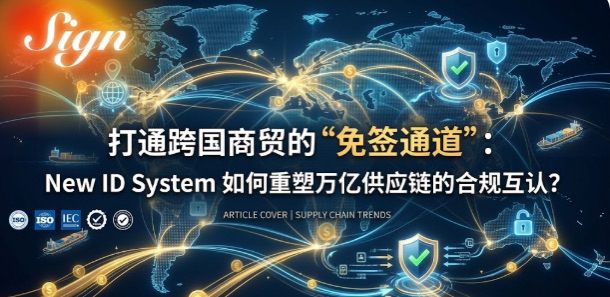
Families are facing extremely serious 'trust friction' losses in the operation of the global macroeconomic gears, as multinational supply chains and B2B trade struggle. According to estimates from top global consulting firms, large multinational financial institutions and companies spend hundreds of billions of dollars each year on repetitive KYC (Know Your Customer), anti-money laundering audits, and corporate qualification verifications. Each commercial cooperation that crosses borders is accompanied by lengthy background checks and the circulation of paper documents.
Against the grand backdrop of vigorously promoting the 'Digital Gulf' and economic diversification in the current Middle East region, eliminating this inefficient transnational trust friction and establishing a seamless 'digital economic visa-free corridor' connecting Asia, Europe, and America has become an absolute necessity for sovereign wealth funds (SWF) and top-tier consortia.
However, traditional centralized identity authentication systems (such as those relying on a single agency's database) cannot meet this level of cross-border mutual trust requirement. Data silos, extremely high risks of privacy breaches, and lack of interoperability make it extremely difficult for multinational corporations to prove their innocence.
In-depth analysis of @SignOfficial 's underlying architecture, its New ID System, specifically designed for national and institutional level applications, is fundamentally ending this decades-long commercial pain point.
New ID System is not simply about scanning a company's business license onto the blockchain; it is the next-generation digital passport system built on W3C international standards for Verifiable Credentials (VCs) and Decentralized Identifiers (DIDs). In this architecture, business entities have complete control over their identity and qualifications, and can demonstrate their compliance to any node globally through cryptographic signatures.
The most shocking technological breakthrough for Wall Street and multinational giants lies in its underlying 'Selective Disclosure' mechanism.
Let’s conduct an extremely hardcore corporate-level business simulation:
Suppose a high-end manufacturing company in Asia wishes to enter the supply chain finance system in Abu Dhabi, UAE, to obtain substantial low-interest loans from local sovereign banks. The banks in the UAE require extremely strict compliance audits, demanding proof that 'the revenue for the past year exceeded 500 million dollars and that core suppliers are not on any international risk lists.'
If using traditional models, this Asian company must submit all core financial statements, customer lists, and procurement flows without reservation to banks and third-party auditing agencies in the Middle East. This is an unacceptable exposure of business secrets for any Fortune 500 company.
However, through the Sign Protocol's New ID System, this Asian company can utilize the underlying ZK (Zero-Knowledge) technology and selective disclosure mechanism to independently extract and prove these two specific boolean values (True/False) — namely, 'revenue meets standards' and 'clean list.'
Extremely cold code logic takes over commercial trust here: what banks in the UAE receive is not a thick stack of original financial statements, but a highly lightweight cryptographic proof. The underlying smart contract (Hooks) verifies the validity of this proof at the millisecond level. Once the mathematical verification passes, the UAE bank's lending system will instantly give the green light.
Businesses maintain the most core commercial privacy baseline, while financial institutions gain absolute tamper-proof compliance assurance.
This cryptographic feature of 'proving results without exposing processes' fundamentally breaks the zero-sum game of 'transparency versus business secrecy' in international trade.
New ID System upgrades traditional, fragmented regional commercial audits to a globally unified, mathematically-based 'programmable compliance.' As more and more multinational corporations and sovereign financial institutions begin to adopt this standardized digital passport, the only economic link maintaining the operation of this vast proof network and preventing witch-hunt attacks — token $SIGN — will experience extremely large real business consumption. Each issuance, update, and invocation of multinational smart contracts for enterprise-level VCs is rigidly locked in and consumes $SIGN. Understanding this underlying demand for rights confirmation driven by the trillion-dollar real economy is essential to truly measure the macro valuation ceiling of this sovereign digital infrastructure.