


The market saw heavy activity yesterday with over $40 billion in volume, mainly driven by liquidations that pushed the price below $66,000. Geopolitics continues to weigh heavily on the market, but short-term momentum seems to be slightly recovering, with the current price hovering around $66,200.
Trump posted this morning that “Iran wants to make a deal” and that he is extending the deadline for strikes on nuclear facilities again (until April 6). He mentioned “productive conversations” and said that Tehran is “decimated” and ready to negotiate.
But the market remains skeptical:
> Investors aren’t buying it, as Iran has already denied a similar claim before.
> Iran has still not officially confirmed any serious negotiations (only cautious statements)
> The Iran–Israel/US conflict continues (attacks on nuclear and industrial sites, Houthis striking in support of Iran 🇮🇷)
> The “war premium” on oil remains elevated. Brent is around $114, ~ +6% in 24h, the biggest spike since the start of the tensions, maintaining inflationary pressure and a risk-off sentiment
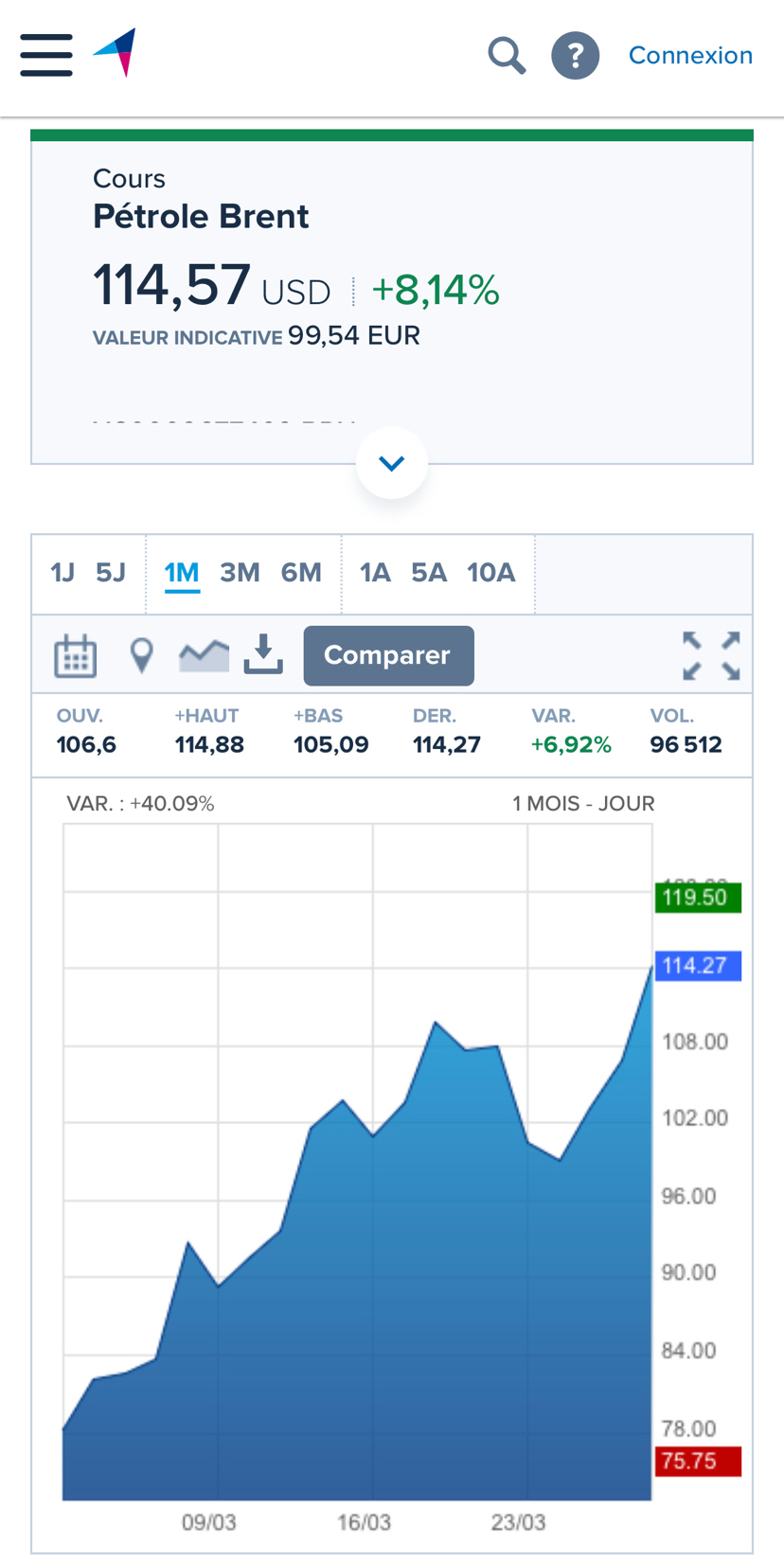
Some analyses suggest the US is exploring multiple options to force the reopening of the Strait of Hormuz, but Iran appears to have several ways to retaliate, leaving a constant risk of oil price spikes in case of a misstep by the US 🇺🇸
In short: institutional investors are rotating out of risk assets, and we’re seeing a clear pullback triggering massive liquidations (~$300–400M in 24h), following last week’s mini pump.
The “War Premium”
The war premium is the extra price that traders and institutions add to oil (or sometimes other commodities) purely due to the risk of war or geopolitical conflict.
Normally, oil prices depend on supply, demand, production costs, and inventories. The war premium is the additional portion everyone pays out of fear that conflict could disrupt supply.
Concrete example (March 28, 2026):
Without Iran tensions, Brent would likely be around $85–90. With Trump’s ultimatum, threats of strikes on Iranian sites (Natanz/Fordow), ongoing attacks, and the risk of the Strait of Hormuz being closed (through which ~20% of global oil flows), the market is adding roughly $20–30 of war premium. Result: Brent at $114 today.
It’s essentially like insurance that buyers pay “just in case” everything suddenly breaks down.
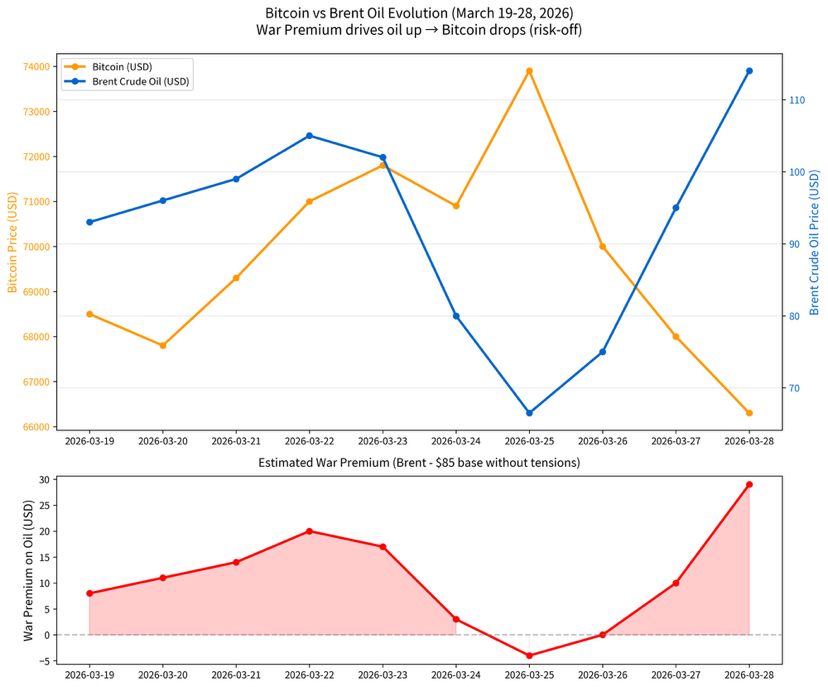
What you see on the chart:
$BTC in orange and Brent Oil in blue
Clear inverse correlation: every time oil spikes (due to war premium), Bitcoin drops (risk-off)
Oil peak on March 28 at $114 then BTC drops to ~66,300
Trump’s mini de-escalation (March 24–25) lead oil to temporarily drops the small BTC pump to $73,850
How do we estimate the war premium?
Very simple: take the Brent spot price and subtract a “fundamental base” (supply/demand without geopolitical shocks). Here, I used $85 as the base (pre-Trump ultimatum level). Analysts from Goldman, JPMorgan one, etc.) do the same in real time with more sophisticated models.
Impact on Bitcoin
When the war premium spikes, economic activity is affected by a “risk-off” sentiment from investors; meaning reduced risk-taking. This leads to selling of risk assets like $BTC and tech stocks, in favor of cash, gold, or Treasury bonds. That’s why we’ve seen BTC drop to ~$66 000 in recent days.
The war premium is currently at its highest level since the start of the tensions (+$29). It’s the main driver behind Bitcoin’s recent decline. As soon as Trump or Iran announces real progress in negotiations, this premium could drop quickly; leading to lower oil prices and a rebound in BTC.
Short-term outlook
By the end of next week, if Trump manages to secure a mini-deal or visible truce (and he’s clearly pushing in that direction), we could expect:
> Strong stabilization around $65–67k (major support tested multiple times)
> A rebound toward $68–70k if oil declines and Fear & Greed exits Extreme Fear (currently ~13/100)
> High volume as long as Iran dominates the headlines
Long-term outlook
The long-term bullish cycle remains intact: Spot Bitcoin ETFs still seeing massive cumulative inflows (+$56B+), MicroStrategy continues accumulating, The Clarity Act is progressing in the US. Bitcoin will quickly reclaims its role as a digital hedge once geopolitical tensions ease.
Bottom line: this is an ultra-volatile week dominated by Iran. The market is digesting uncertainty, but the underlying trend remains bullish.
If you like the content, feel free to join my private group, link below 👇🏾