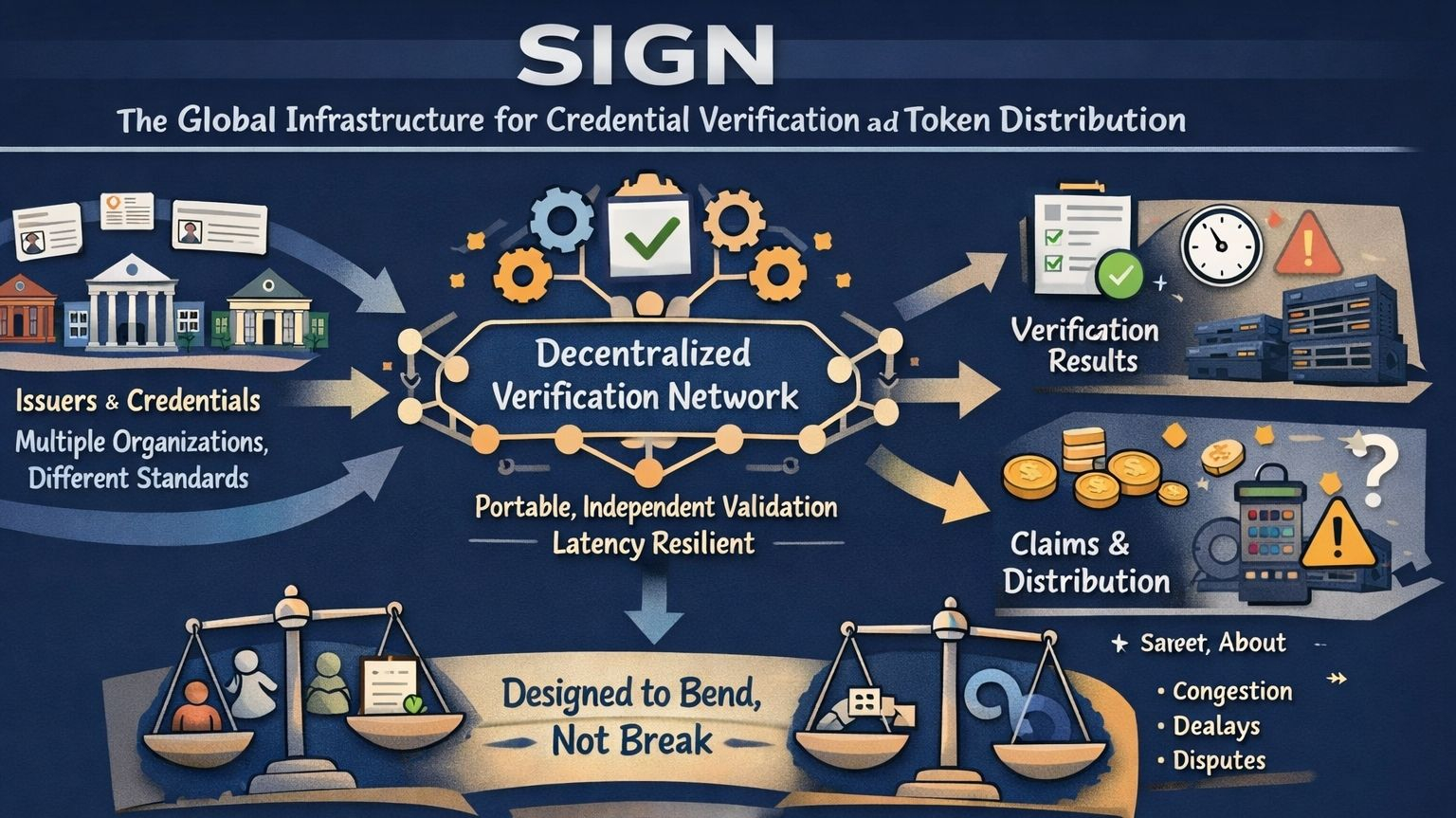
I keep circling back to a simple question whenever I study credential verification systems tied to token distribution: what does this look like when incentives are real and users are not behaving politely? On paper, it’s easy to describe a clean infrastructure layer that verifies credentials and routes tokens accordingly. In practice, the moment tokens carry value, every assumption inside that system gets tested. Users optimize, validators adapt, and the structure itself starts shaping behavior in ways that aren’t obvious at first glance.
The core issue isn’t whether credentials can be verified. That part is mostly solved at a technical level. The real tension sits in distribution. A credential that unlocks tokens stops being informational and becomes economic. It attracts attention. It invites manipulation. The system has to quietly answer a difficult question: how costly is it to appear legitimate compared to the reward for doing so? If that balance is even slightly off, the network begins to drift. What looks like broad participation can mask coordinated control, and what appears to be organic demand often compresses into a smaller number of actors who understand the rules better than others.
I’ve noticed that the architecture itself dictates how this drift unfolds. When credential issuance is cheap and loosely enforced, the system expands quickly. More users, more claims, more surface-level activity. But underneath, dilution creeps in. Tokens spread widely, yet ownership consolidates through behavior rather than allocation. You see it in on-chain flows—many wallets touch the system briefly, then value aggregates elsewhere. Tightening issuance flips the trade-off. Participation slows, friction increases, but the quality of distribution improves. The system becomes harder to exploit, though less accessible. Neither extreme holds up well over time. What matters is how the system manages that tension as conditions change.
Validator behavior adds another layer that rarely gets enough attention. These actors aren’t passive checkpoints; they respond directly to incentives. If rewards scale with volume, verification standards loosen. If penalties for mistakes are high, validators become cautious, sometimes to the point of exclusion. Over time, this creates uneven trust across the network. Certain pathways become dominant not because they’re more reliable, but because they are easier to pass through. Users adapt quickly. They route around friction, and in doing so, they redefine the practical boundaries of the system.
Storage design subtly shifts user expectations. Permanent credentials carry weight. They signal finality, which builds confidence but raises the cost of errors. Revocable credentials introduce flexibility, but at the expense of certainty. I’ve seen systems where easy revocation leads to careless issuance. The burden shifts downstream, and recipients adjust their behavior accordingly. Tokens tied to uncertain credentials tend to move faster. Holders are less inclined to wait when the foundation of their claim can change.
Settlement speed influences more than just convenience. Faster systems compress time, and with it, decision-making. When distribution and verification happen almost instantly, participation becomes competitive. Automation thrives. Users pre-position capital, scripts replace manual interaction, and the system starts rewarding preparation over presence. Slower systems filter some of this out, but they introduce their own friction. Participation becomes less reactive, more deliberate, but also less inclusive. The infrastructure doesn’t just process actions—it determines who is able, or willing, to act.
Liquidity formation around distributed tokens reveals another layer of truth. When supply enters the market in predictable bursts tied to credential events, behavior begins to synchronize. Traders anticipate distribution windows. Some position ahead, others react immediately. This creates patterns that repeat often enough to become expected. Over time, distribution itself becomes part of market structure. It’s no longer just about who receives tokens, but when and under what conditions they are likely to move.
Identity assumptions remain one of the most fragile parts of the system. Many designs lean on the idea that credentials map cleanly to unique participants. In reality, that mapping is porous. Users fragment themselves when it’s profitable. Strengthening identity checks can reduce this, but it introduces privacy concerns and onboarding friction. Most systems settle somewhere in between, accepting a degree of duplication as a cost of openness. The real question is whether that leakage distorts outcomes enough to matter. Often, it does—but not always in obvious ways.
What I find most revealing is how these systems behave after the initial phase, when easy incentives fade and participants become more strategic. Early activity can look healthy under almost any design. Sustained activity is harder. It depends on whether users can navigate the system without feeling that the rules are either too loose to trust or too strict to engage with. If the infrastructure continues to function under that pressure, it starts to prove itself. Not because it’s perfect, but because it remains usable when users are no longer forgiving.
On-chain patterns eventually expose the underlying reality. Repeated behaviors, clustered interactions, timing correlations—these signals show how the system is actually being used, not how it was intended to be used. And that’s where the real evaluation happens. Infrastructure doesn’t need to eliminate manipulation entirely. It needs to make it costly enough, visible enough, and limited enough that the system still works in spite of it.
I don’t see this category as something that resolves cleanly. It evolves. The design choices made at the protocol level ripple outward into user behavior, liquidity flows, and long-term sustainability. What matters is whether those ripples settle into something coherent, something that participants can understand and adapt to without constantly second-guessing the rules. When that happens, the system stops feeling like an experiment and starts behaving like infrastructure, not because it avoids pressure, but because it continues to function under it.@SignOfficial #SignDigitalSovereignInfra $SIGN