

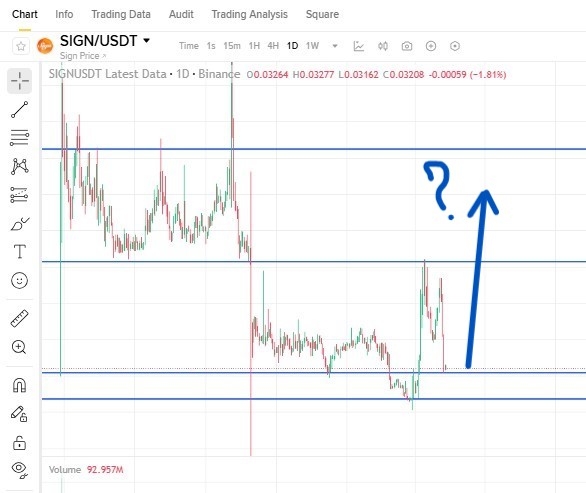
It’s not unusual to see the crypto market move in sync—when things drop, most tokens follow. That’s why days like today stand out. While much of the market is in the red, SIGN is holding steady and even showing slight gains. At first glance, it might seem surprising, but when you look deeper, it starts to make sense.
This kind of price behavior often signals that something more than short-term sentiment is at play. While many assets are driven by speculation and quick reactions, SIGN appears to be benefiting from a stronger underlying narrative one that is less dependent on market mood and more focused on long-term infrastructure.
At the core of this is SIGN’s approach to digital identity. Unlike many projects that attempt to build a single, unified identity system, @SignOfficial operates at a more fundamental level. It focuses on the trust layer --the infrastructure that allows different institutions to issue, verify, and manage credentials without forcing everything into one centralized database.
This distinction matters.
In the real world, identity is not controlled by one system. Governments, private organizations, and various institutions all play a role in issuing credentials. Trying to replace that complexity with a single solution often creates more problems than it solves. SIGN takes a more practical route by enabling these systems to interoperate securely while maintaining their independence.
Its design reflects this philosophy. It emphasizes clear governance, where issuers are identifiable and accountable. It enables selective disclosure, meaning users can share only the information required rather than exposing entire datasets. It also incorporates mechanisms for revocation and status updates, ensuring that credentials remain accurate and reliable over time.
Perhaps most importantly, SIGN prioritizes verifiable evidence over blind trust. In traditional systems, many processes rely on assumed credibility. In digital environments, especially those operating across multiple entities, that assumption becomes fragile. SIGN addresses this by introducing verifiable proofs -- structured records that can be checked, validated, and trusted without needing to reveal unnecessary information.
This approach also helps balance two critical needs: transparency and privacy. By allowing proof to travel while keeping the underlying data protected, SIGN avoids the risks associated with large centralized data silos. It creates systems where visibility is intentional and controlled, rather than automatic.
So what does this have to do with today’s price movement?
When a project is building at the infrastructure level -- especially in areas like identity and trust—its value proposition tends to resonate differently. It’s not just about short-term excitement, but about long-term relevance. This can lead to periods where the asset behaves independently of broader market trends, as participants begin to recognize its potential beyond immediate cycles.
SIGN’s relative strength today may be a reflection of that shift.
It suggests that at least part of the market is starting to look beyond volatility and focus on what is being built underneath. While it’s too early to draw definitive conclusions from a single day, moments like this often provide insight into how a project is being perceived.
In a space where many narratives come and go, infrastructure tends to last.
And #SignDigitalSovereignInfra is positioning itself right at that foundation --building systems designed not just to function, but to be trusted at scale.
$SIGN
