
"Fully audited" is the phrase I have heard too many times, so much that it no longer holds much meaning.
Each cycle, each narrative, each project... has a report, an audit logo. A familiar name stands behind it and somehow it becomes a form of "safe evidence" that people accept almost reflexively.
But then everything still shattered.
Terra collapsed.
FTX went bankrupt.
Wormhole was exploited.
And all of the projects above have been audited.
That is the part I always look back on and ponder, not to deny auditing but to see more clearly what it really is.
At least from my perspective, auditing has never been about 'absolute safety'. It resembles a mechanism for transferring trust more, a form of outsourcing trust. You do not self-verify but borrow the credibility of a third party to feel secure.
But the problem is this system works well… until it doesn’t work anymore.
The feeling of 'safety' that auditing brings seems to be more psychological than technical. A report cannot cover every state of the system, a snapshot cannot represent something that is always changing, yet we still act as if it can.
And that is the slightly skewed part.
This industry has a rather strange habit of trying to freeze the truth at a certain point and then using it as a guarantee for the future. The smart contract is audited at block A, under condition B, with assumption C… and then trusted in countless different states that no one actually verifies.
Too many systems are operating that way.
They audit code but do not audit behavior.
They audit logic but do not audit how it is used.
They audit one version while the reality is always multiple overlapping versions.
And then when there is an incident, everything is explained as an 'edge case'.
Sounds familiar.
It seems the issue here is not a lack of audits, but rather that we are setting the wrong expectations for it.
At some level, auditing is like a ritual. It helps the project look 'legitimate', it gives users a reason to trust, but it does not force the system to continuously prove that it is still operating as promised.
And the market began to realize that.
You can see the change even if it’s not too noisy. Major platforms like Binance seem to no longer rely entirely on static claims. They add layers of checks, add filters, add conditions.... Not to replace trust but to reduce dependence on it. It’s no longer just 'trust the report' but continuously verify.
And then here I see another approach emerging. Not too new, but the way it is packaged is different. That is SIGN, things like Sign Protocol at least from my perspective do not seem to be trying to make a better audit but are going in a different direction.
It’s not a one-time evaluation but continuous proof.
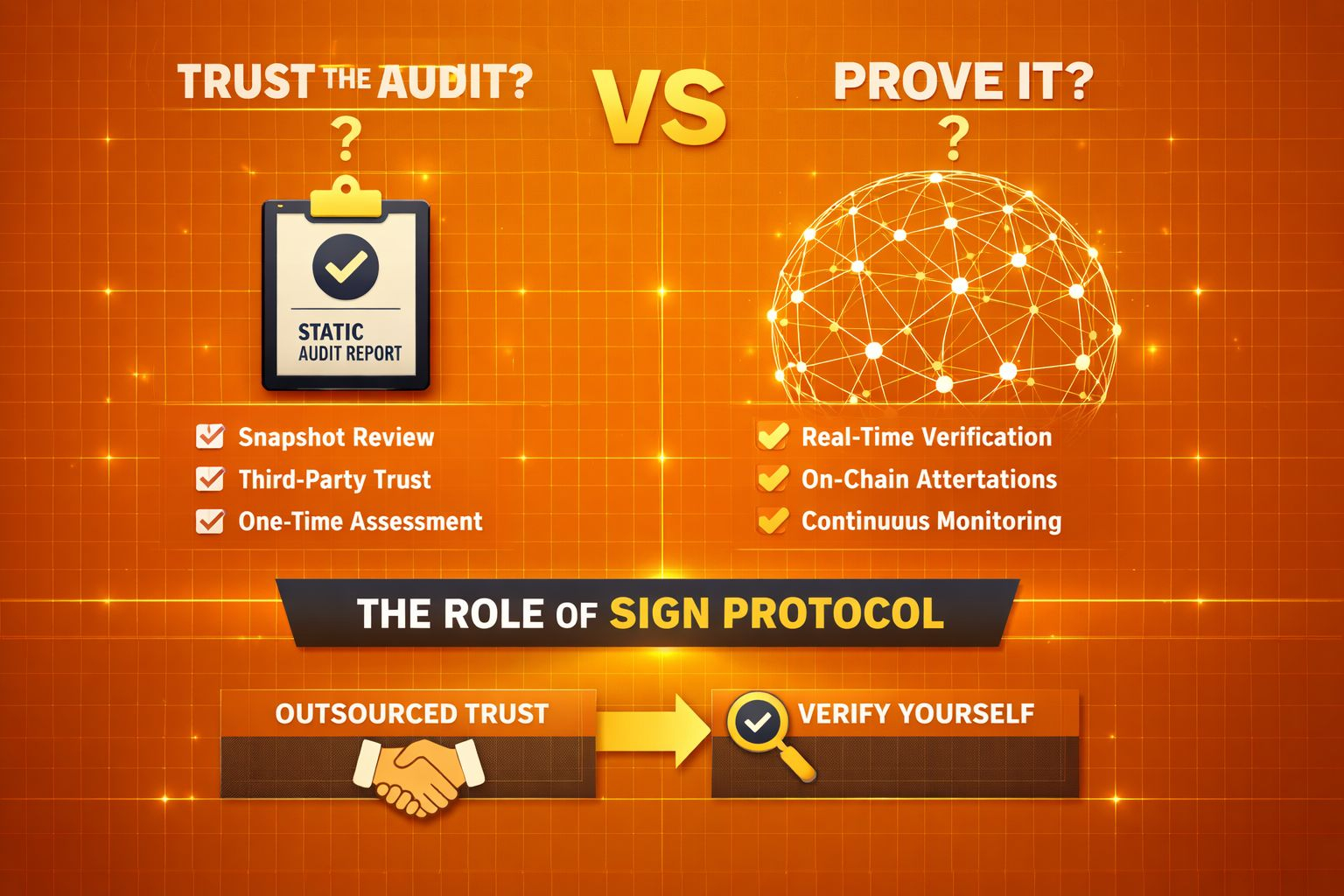
It’s not a PDF report but a system of attestation where data, behavior, or state can be verified, updated, and retrieved over time.
It may sound small, but the difference lies there.
Audit answers the question: Was everything okay at that point in time?
As for this type of system, it tries to answer: Right now, can you verify that?
One side is the past, one side is the present.
I don’t think this is a silver bullet and I also don’t think it will completely replace audits. It seems to be just another layer, another approach to handle the same old problem of trust.
But one noteworthy point: it shifts the focus from 'trusting someone' to 'being able to verify something'. Even if it's just a small part, it is still a shift.
The question is whether users actually use it because ultimately, everything in crypto comes back to usage. Not the whitepaper, not the narrative, not what 'could be done', but what is actually used in real situations when things start to get tense.
A 'prove it' system sounds reasonable, but it only makes sense when someone actually needs to prove. And there is enough motivation to do so.
And if users continue to seek a quick sense of safety, then audits with all their limitations will still exist because they are convenient, because they are familiar, and because they provide an easy answer.
As for the part like Sign Protocol… I think it is trying to enter a less comfortable area where you cannot just trust but must verify.
Whether that will be widely accepted, I'm not so sure... But that's the part I’m still keeping an eye on.