

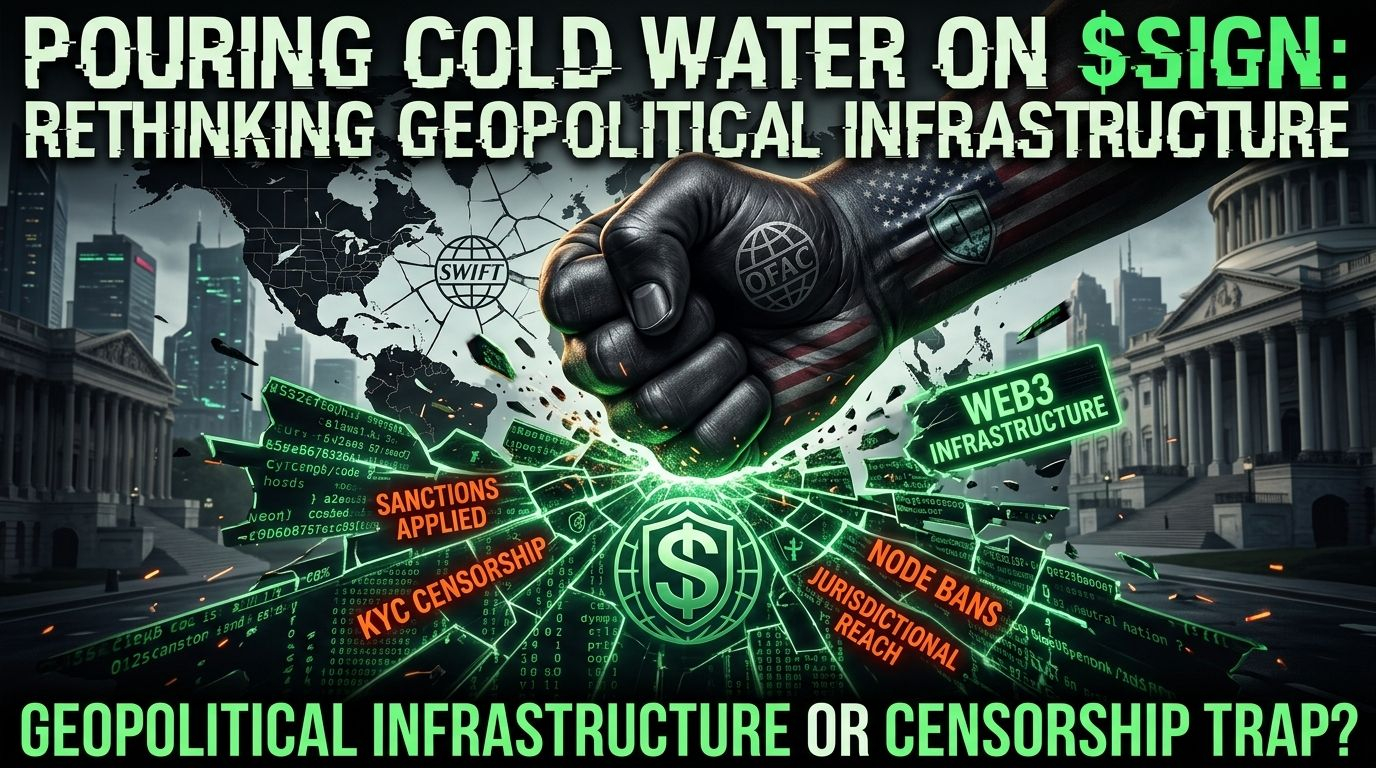
 Recently, in the square, $SIGN the narrative is indeed grand to the point of being dizzying, especially the set of signatures like 'Reconstructing Geopolitical Infrastructure' and 'Web3 Neutral Nations', which are practically worshipped as the ultimate tool to end traditional financial hegemony and break global trade sanction barriers. To be honest, this set of stories is extremely charming: bypassing the SWIFT system, which is firmly controlled by the Americans, and the cross-border clearing network that is restricted everywhere, establishing an absolutely neutral and censorship-resistant global business collaboration layer on the ruins using pure cryptography. In today's market, where there is a zero-sum game and everyone is looking for the next grand narrative breakthrough point, such infrastructure projects with a hint of 'financial anarchism' and 'reconstructing geopolitical order' can naturally cause those yearning for decentralized utopias to collectively climax. But every time I see those in the group equating 'open source code' with 'absolute anti-censorship' in a fervent preaching, I can't help but want to pour a bucket of cold water. Today, I won't talk about its offline execution capabilities, nor the cliché expectations of TVL; I just want to discuss the fatal black hole hanging over all those claiming 'geopolitical infrastructure'—'the dimensionality reduction strike of OFAC compliance and sovereign sanctions.'
First, let’s take a look at the mindless FOMO logic of retail investors. Whenever the future of Sign is mentioned, everyone dreams of a future where Russian energy oligarchs, secret billionaires in the Middle East, and even Latin American traders who have been rejected by the traditional financial system no longer have to look to Wall Street and the Federal Reserve, but can directly click a mouse on Sign to establish multi-sign contracts, with funds freely traversing between the global dark web and the clear web, completely shattering long-arm jurisdiction. The expectations of buyers are extremely crude: 'If even sanctioned multinational trade can be accommodated, this is equivalent to creating a Web3 version of SWIFT; how big is this deal?' Retail investors are frantically buying up, influencers are waving flags, as if just holding this protocol's tokens means collecting tolls for the future global financial order.
This is precisely the most fatal and easily missed logic blind spot in the grand narrative track of the entire Web3.
To be fair, @SignOfficial the ambition of this borderless collaborative network is indeed sky-high. But in the world of crypto, you need to understand a brutally cold reality: between 'decentralized protocols' and the 'iron fist of sanctions from superpowers', there is no such thing as an absolute safe zone. Many retail investors naively believe that as long as the contract code is on the chain and there are distributed nodes, this war against sovereign states is guaranteed to succeed. Really? Just imagine, if tomorrow an entity blacklisted by OFAC (Office of Foreign Assets Control) signs a supply chain contract worth hundreds of millions of dollars with an Asian consortium on Sign.
What do you think will happen then?
Smart contracts can indeed faithfully execute code, but who runs the underlying nodes that run these codes? It's those node operators who host their servers on AWS and Google Cloud; those RPC service providers backed by real companies and venture capital from Silicon Valley; even the development team of Sign itself. Superpowers don’t need to crack your cryptography; they only need to send a subpoena to Infura, send a warning letter to the institutions running verification nodes, or simply block all IPs related to the protocol's frontend. The outcome is extremely frustrating: you hold that impressive 'anti-censorship Web3 contract', but find the frontend won't load, RPC won't connect, and nodes collectively refuse to package transactions belonging to the sanctioned address for their own protection. At this point, that so-called absolutely neutral underlying protocol instantly becomes a 'compliance web that can only play house with clean funds'. The ultimate weapon of geopolitical power—'long-arm jurisdiction'—has not been circumvented at all. This is clearly a collision of the most geeky ideals with the hardest of walls.
This is called the 'anti-censorship false proposition.' The larger the geopolitical infrastructure is laid out, if it cannot solve the vulnerability of the protocol layer to extreme political pressure, then in the end this system can only become a good child under the watchful eyes of Wall Street and regulators, unable to accommodate those truly needing 'decentralization and anti-censorship' massive gray funds. In this circle, we have seen too many 'so-called king-level projects that claimed to overturn financial hegemony and connect fiat currencies with crypto islands, only to shrink into a half-dead pawn due to a few regulatory letters and executive arrests (think of the fate of Tornado Cash).
So now I look at the fundamentals of Sign, completely separating the 'technical layer' and the 'political layer':
The first line is to closely watch 'the physical ownership of the underlying nodes and the degree of centralization of the sorters': stop just looking at the official press releases about high concurrency and low gas fees, and focus on who really holds the power to produce blocks. When extreme geopolitical sanctions happen, does its network really have the capacity to withstand them? If its core validators or sorters are still highly concentrated in a few North American or European institutions, then it is nothing more than a 'U.S. censorship tool' wrapped in a Web3 shell, and the bubble of this geopolitical infrastructure narrative is obviously huge. Without real, hardcore nodes scattered in non-mainstream jurisdictions to support it, all claims of anti-censorship will not withstand a single OFAC iron fist test.
The second line is to focus on 'the degree of compliance compromise of the protocol frontend and API layer': the current robustness of the market is because it is still in a phase of wild growth, not yet on the radar of regulators, and everyone is speculating on the expectations of 'neutral countries'. Once one day, hundreds of billions of sensitive multinational funds are really running on it, will the official frontend of Sign be pressured into integrating KYC modules? Will it proactively block IPs from specific countries? If mainstream access directly cuts off the access of blacklisted users, then this infrastructure is simply a case of burying one's head in the sand. In this game, which highly values financial hegemony and regulatory violence, the romance of crypto punks and the majesty of the U.S. Treasury have never been on the same channel. If you cannot handle the most basic 'node resistance', I absolutely dare not play for high stakes.
My attitude towards Sign remains straightforward: I acknowledge that it is doing something extremely ambitious, using cryptographic technology to challenge the collaborative barriers of global traditional finance, which is indeed the vast ocean of Web3. But in the secondary market, the vast ocean cannot be eaten. Until it truly proves it can 'resist sanctions and not crash or censor' in extreme power games, I will only treat it as a 'high-level emotional play that eats the grand geopolitical dividend' and not as a 'heirloom that overturns SWIFT'. True veterans will never be brainwashed by the utopia imagined in white papers, but will know exactly who bears the 'cost of resisting sovereignty.'
As usual, here are three 'clear bottom lines' for friends who are preparing to get high on the narrative of geopolitical infrastructure:
I will repeatedly ask myself: am I buying into its genuine network resilience that can withstand superpower sanctions, or am I simply paying an IQ tax for the extremely eye-catching slogan of 'overthrowing the dollar hegemony'?
If tomorrow regulators really take action, and nodes collectively compromise to start censoring specific addresses, those massive funds that came in for 'absolute neutrality' will instantly withdraw. Can the current market consensus still support its enormous FDV (Fully Diluted Valuation)?
The most critical point—when political pressure from the real world really arrives, do the project team and governance token holders have enough decentralized confidence to choose 'hard forks or fight to the death', rather than letting this great protocol degenerate into a 'Web 2.5 version that can only act according to regulatory whims'?
If these three questions cannot be clearly answered, then even if you earn money today through narratives, you will lose it back in the cruel verification of regulatory iron fists tomorrow.