
Most people talk about digital identity like it’s something countries still need to “build.” But that’s not reality. Identity already exists everywhere — in government records, banks, telecom systems, and even manual processes that quietly keep everything running. The real issue isn’t absence. It’s fragmentation.
Different systems don’t speak the same language. Each one holds a piece of truth, but none sees the full picture in a clean, coordinated way.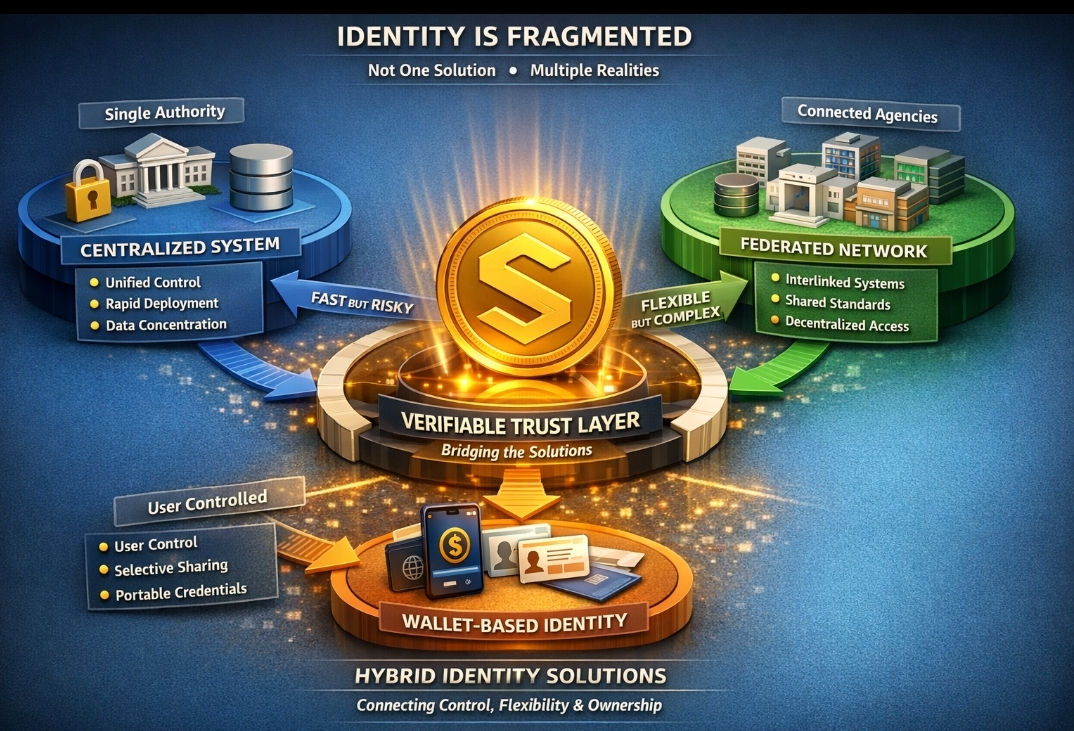
Some countries try to fix this by centralizing everything. It works fast and creates uniformity, but it also gathers too much power and data in one place. Others take a federated path, connecting systems without merging them. That respects structure, but adds complexity and often creates hidden control points. Then there's the wallet model, in which people keep their own credentials and only share what they need.It seems more like actual ownership, but scaling necessitates close collaboration.
What becomes clear over time is simple: no single model is enough.
Real systems need control, flexibility, and user ownership — all at once. That’s why hybrid identity isn’t a compromise, it’s reality.
This is where @SignOfficial and $SIGN come into focus. Instead of forcing one model, they operate underneath, allowing trust to move without exposing unnecessary data.
Not replacing systems. Just making them finally work together.#sign
$SIGN #SignDigitalSovereignInfra

