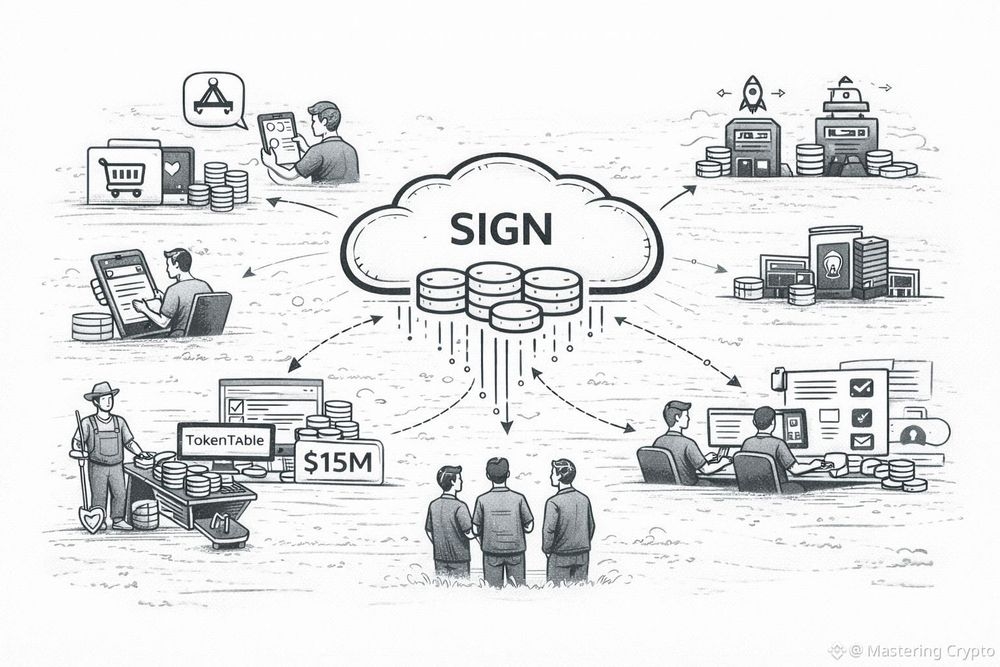
We like to believe that privacy, once digitized, becomes programmable. That if something can be expressed in code, it can be controlled, contained, and ultimately owned. A toggle becomes sovereignty. A permission screen becomes consent. A cryptographic proof becomes a shield. But this belief rests on a quiet assumption—that the system offering these controls is neutral. It rarely is.
What we call “privacy settings” are often not guarantees. They are interfaces layered on top of deeper architectures shaped by institutions, incentives, and rules. In decentralized identity systems, this tension becomes more subtle, not less. The removal of centralized custody does not eliminate power; it redistributes it into protocols, governance layers, and policy frameworks that are less visible but equally consequential.
Technically, the foundation is elegant. Protocols like the Protocol enable credential issuance, verification, and tokenized attestations across ecosystems without relying on a single controlling authority. Through cryptographic primitives, users can prove statements about themselves without exposing the underlying data. This is where Selective Disclosure becomes central—the ability to share only the Minimum Viable Data necessary to satisfy a request. You are over 18, without revealing your birthdate. You are solvent, without revealing your balance sheet.
This is not just a feature; it is a philosophical shift. It reframes identity from a static bundle of exposed attributes into a dynamic negotiation of proofs. It reduces data leakage, minimizes attack surfaces, and aligns with a long-standing ideal in privacy engineering: disclose as little as possible, as late as possible.
And yet, the presence of this capability does not guarantee its use.
Because between what the technology allows and what the system requires lies a critical layer: policy.
Policy-Controlled Boundaries define the real perimeter of user autonomy. They determine which credentials are accepted, which attributes are mandatory, and which proofs are considered sufficient. A protocol may support zero-knowledge proofs, but a platform built on top of it may still require full disclosure of identity fields to comply with regulatory standards or internal risk models.
This is the point where the narrative begins to fracture.
From a purely technical standpoint, the user retains control. They hold their credentials. They decide when to present them. They can, in theory, refuse. But in practice, refusal carries consequences. Access is denied. Services are restricted. Participation is limited.
This is where Conditional Choice emerges.
A user is not explicitly forced to reveal information. Instead, they are presented with a structured decision: disclose the required data or forfeit access. The choice exists, but it is shaped by external constraints. It is not freedom in the absolute sense; it is freedom within a predefined corridor.
Over time, this corridor can narrow.
Not abruptly, but incrementally.
A new compliance requirement introduces an additional field. A platform update changes what constitutes a valid credential. A regulator expands the scope of verification for certain transactions. Each change is justified. Each change is rational. But collectively, they produce a phenomenon that is easy to overlook: Quiet Erosion.
Privacy does not disappear overnight. It is not revoked in a single act. It is adjusted, refined, and optimized—until the space in which a user can operate privately becomes smaller than it once was. And because each step is incremental, resistance is minimal. Adaptation feels easier than opposition.
The irony is that the underlying cryptography remains unchanged. The same Selective Disclosure mechanisms still exist. The same proofs can still be generated. The system is still, in principle, privacy-preserving.
But the lived experience of the user tells a different story.
Because privacy, in practice, is not just about what is possible. It is about what is permitted—and what is required.
The Protocol plays a pivotal role in this landscape. It acts as an infrastructure layer that enables the creation, distribution, and verification of credentials in a decentralized manner. It reduces reliance on centralized authorities, enhances interoperability, and introduces new models of trust based on attestations rather than raw data exchange.

But it is important to recognize what it does not do.
It does not define the rules of participation.
It does not decide which credentials are necessary for access to financial systems, social platforms, or governance mechanisms. It does not enforce or resist regulatory mandates. It provides the rails, not the route.
And those who define the route—regulators, platforms, issuers—operate under their own sets of incentives.
For regulators, the priority is often visibility and control. More data can mean better enforcement, reduced fraud, and increased systemic stability. For platforms, data can enhance user experience, enable personalization, and reduce risk exposure. For issuers, stricter verification can increase the perceived value and trustworthiness of their credentials.
None of these objectives are inherently misaligned with user interests. In many cases, they are necessary. But they introduce a structural asymmetry: the entities defining the rules of disclosure are not the same as the individuals subject to them.
This asymmetry is where power resides.
And it is where the philosophical promise of decentralized identity encounters its practical limits.
The early narrative of Web3 identity was built on the idea of self-sovereignty—that individuals would fully own and control their data, free from the constraints of centralized intermediaries. But sovereignty, in its pure form, implies the absence of external authority. It implies the ability to act without imposed conditions.
What we are seeing instead is something more nuanced.
A system of Negotiated Participation.
In this model, users do not unilaterally control their data. They engage in a continuous negotiation with the systems they wish to access. They present credentials, satisfy requirements, and adapt to evolving policies. Their agency is real, but it is contextual. It exists within a framework that they do not fully control.
This does not render decentralized identity systems ineffective or disingenuous. On the contrary, it highlights their true function.
They are not tools of absolute liberation.
They are tools of structured negotiation.
They allow users to enter digital environments with greater leverage than before. They reduce unnecessary data exposure. They introduce transparency into verification processes. But they do not eliminate the need to comply with external rules. They do not dissolve the influence of institutions.
Instead, they make the terms of engagement more explicit.
And perhaps that is their most valuable contribution.
Because once the illusion of absolute control is removed, a more honest conversation can begin. A conversation about who sets the rules, how those rules evolve, and what mechanisms exist to challenge or renegotiate them.
If privacy is being redefined—not as a static right, but as a dynamic process—then the focus must shift. From building better cryptography alone to building better governance. From enabling selective disclosure to questioning mandatory disclosure. From celebrating decentralization to scrutinizing the structures that operate within it.
The infrastructure is here. The capabilities are real. The Protocol and similar systems have laid the groundwork for a new model of identity—one that is more flexible, more secure, and more user-centric than what came before.
But the final shape of that model will not be determined by code alone.