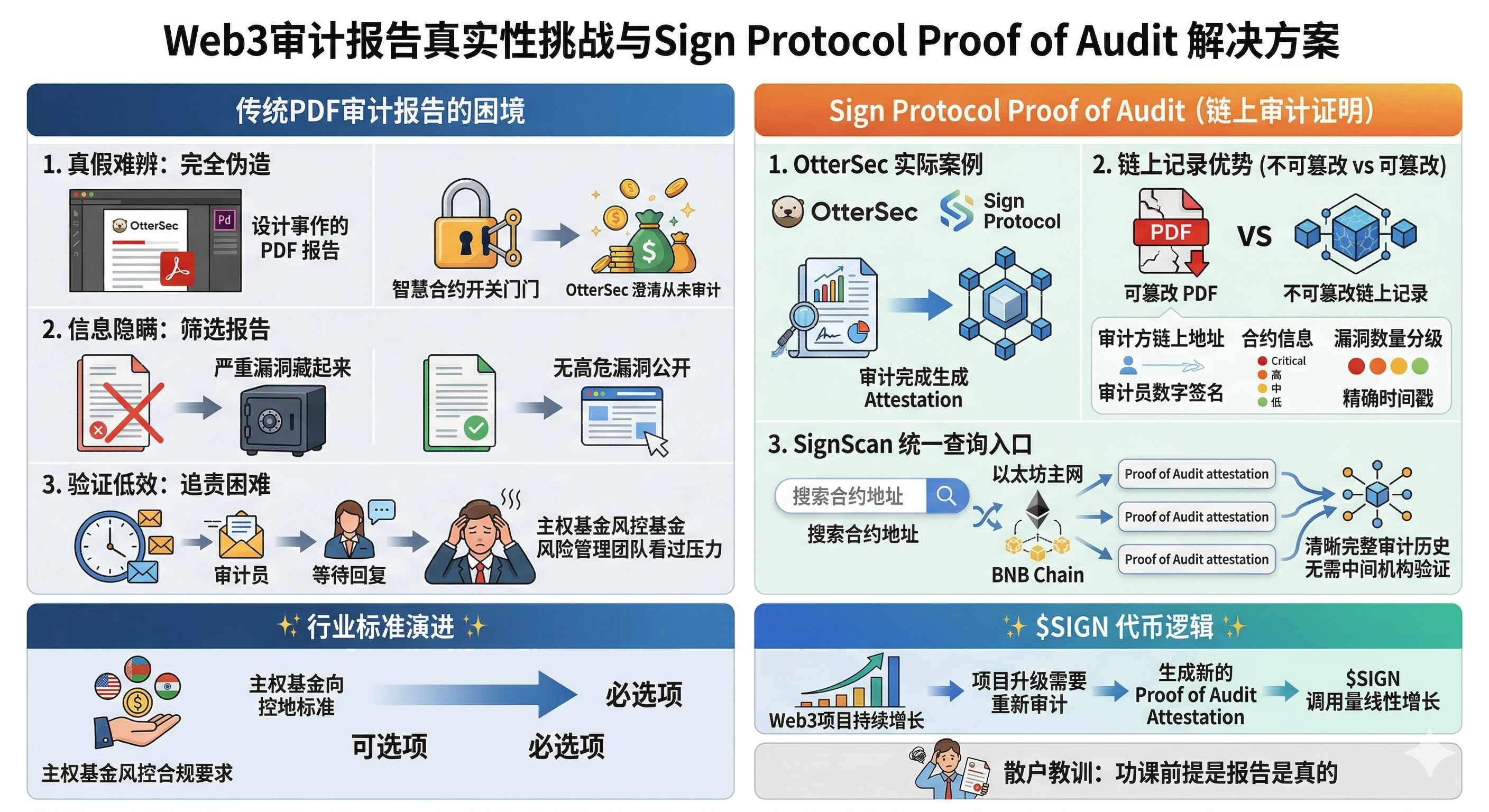
Almost everyone reviews the audit report before investing in a project. Seeing this line made me feel at ease. No high-risk vulnerabilities were found after the audit by OtterSec. But there's one question I've never figured out. How can you be sure that this PDF is genuine?
Such an incident has really happened before. A project used design software to create an audit report. The color scheme and font were almost identical to those officially produced by OtterSec. After it was posted on the official website, retail investors rushed in. The contract had a huge backdoor. The money was taken away. Afterward, OtterSec clarified that they had never audited this project. But by that time, the money was already gone.
A more covert operation is that some projects did conduct audits, but they only publicly disclosed the version that passed. The report that found serious vulnerabilities was directly hidden. What you see is information that has been filtered. Such things cannot be seen at all from the PDF itself.
Middle Eastern sovereign funds have made a significant entry into Web3 in the past two years. Their risk control teams are faced with the challenge of distinguishing between genuine and fake audits. How does the compliance department of a sovereign fund verify the authenticity of a PDF? By calling the auditing agency for confirmation and waiting for their reply. This process is highly inefficient, and if problems arise, there is no way to hold anyone accountable.
@SignOfficial The white paper records the practical case of OtterSec conducting Proof of Audit. After the audit is completed, an on-chain attestation is generated directly on the Sign Protocol. This record includes the on-chain address of the auditing party, the audited contract information, the number of vulnerabilities found (categorized by critical, high, medium, low), the digital signature of the auditor, and an accurate timestamp. All content is immutable once on-chain.
What is the fundamental difference from a PDF? A PDF can be altered. Signatures can be forged. Dates can be arbitrarily written. But on-chain records cannot be changed. More importantly, the verification method has changed. Previously, you could only determine whether an audit report was issued by OtterSec by checking the format and asking via email. Now, you can open SignScan and search for this contract address. You can directly see if there is an audit attestation issued by the on-chain address of OtterSec. If there is, it is real. If not, it is fake. Anyone can verify independently without contacting any intermediary.
SignScan is the unified query entry for the Sign Protocol. It supports cross-chain searches. The audit record of a project on the Ethereum mainnet and its record on the BNB Chain can be verified in the same place. The audit history is clear and complete. No omitted versions can be hidden.
This design is more significant for the industry than most people realize. Every time a Web3 project upgrades, it should theoretically undergo an audit again. Each new version of the Proof of Audit is a new on-chain attestation. If auditing agencies treat this issuance method as standard, the protocol's call volume will increase linearly along with the total number of industry projects. This usage does not depend on market heat; it is driven by normal industry operations.
Of course, the resistance in reality is real. Whether auditing agencies are willing to actively engage in the issuance process of the Sign Protocol is another matter. Changing a delivery method that has been in operation for many years requires motivation. OtterSec has already had practical cases. However, for the entire industry to adopt this as standard operating procedure, time is still needed. This is not a technical issue; it is a matter of willingness to adopt.
After the influx of Middle Eastern sovereign funds into Web3, new compliance requirements have emerged. The risk control departments of sovereign funds will not lower the requirements for the authenticity of audits for the convenience of project parties. They will impose industry standards through conditions for capital entry. Once this direction is opened, it will only be a matter of time before on-chain audit records become mandatory rather than optional. The significance of the OtterSec precedent lies here.
$SIGN The logic of usage is very straightforward. There are thousands of Web3 projects and they are still growing. Each project should undergo a re-audit for every major version upgrade. Each issuance of Proof of Audit on-chain is an attestation generation. This call volume follows the normal iterative rhythm of the industry. It does not need to rely on any hot events to drive it; it is generated continuously through daily development.
One retail investor who paid tuition said something that left a deep impression on me. He said he thought that looking at the audit report meant he had done his homework. But he did not realize that the prerequisite for this homework was that the report itself was authentic.