
In Tokyo at six in the evening, the lights outside look lonelier than usual. I just turned off a few data scripts running in the terminal, and beside me is a cup of black coffee that has already gone cold. The Middle Eastern geopolitical news that popped up on the screen completely woke me up; there was another incident on the Red Sea route, and the credit system of the supply chain almost collapsed in that instant. As someone who has been in this industry since 2017, I have long been accustomed to the ups and downs of the market, but I am extremely averse to those so-called big projects that can only produce beautifully crafted PPTs. The current crypto world is full of such grandiose and empty things, lacking anything that can truly dig into the dirt.
I am concerned @SignOfficial It's been a long time, not because it has any glamorous background, but because its logic is solid. In the current chaotic situation, traditional trust intermediaries are collectively failing. When even the most basic air navigation agreements between countries can turn into scrap paper at any moment, who can you expect to be the notary? At this time, the agreements that many people originally viewed as "digital notaries" suddenly found extremely realistic survival soil. This is the topic I want to discuss today: in such extreme environments, do we really need a cross-border verification?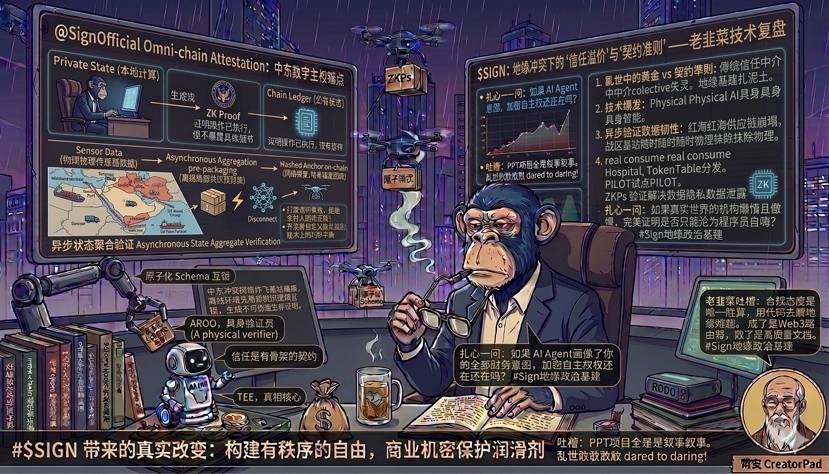
Many people see the Sign Protocol merely as a signing tool on the blockchain, which is really superficial. When I reviewed their technical white paper, I noticed an innovative point that had been overlooked by the market, which is "asynchronous state aggregation verification." To put it simply, in a network environment as poor as the Middle East, where base stations can be blown up at any moment, you cannot expect every piece of data to be synchronized online in real-time. This technology allows evidence generated in offline environments to be "pre-packaged" through local consensus, and once the network is restored, it can be immediately anchored back to the chain through hashing. This data resilience in extreme environments is the true foundation of infrastructure.
To be honest, I quite dislike the current projects that are clustered around AI, each one boasting extravagantly, while in reality, they don't even have a basic physical grounding. What Sign is doing in terms of geopolitical infrastructure, although it doesn't sound sexy and is even a bit dull, solves the problem of "who told the truth." For example, in the cross-border allocation of materials in the Middle East, if one party claims that the goods have been dispatched while the other says they haven't received them, this kind of argument is fatal during wartime. Utilizing this asynchronous verification technology, every transfer node of materials can be verified by third-party physical sensors or witnesses, making it tamper-proof. This is more reliable than any bureaucratic stamp.
Let’s talk about the premium logic of $SIGN . In times of peace, trust is cheap. But in an era of intensifying geopolitical conflicts, trust is the most expensive luxury. When the original centralized credit system is shattered by sanctions and blockades, this decentralized verification protocol becomes a necessity. What I value is not its short-term price fluctuations but this "trust premium." If Bitcoin is the gold in chaotic times, then this verification protocol is the covenant criterion in chaos. It is not some air coin that relies on hype to maintain its heat; its value growth space comes from being a substitute for traditional credit intermediaries.
That said, some so-called top investment institutions really deserve to be criticized; many projects they invest in yield no output except for consuming liquidity. What Sign is doing is digging tunnels, laying foundations, the kind of work that no one sees on a daily basis but can save lives at critical moments. Its territory is not just wandering around a few DEXs; its territory is in those areas where the rules are most needed and the order is most lacking.
Of course, as a pragmatic developer, I also have to say some unpleasant things. Currently, the threshold for promoting such protocols is still very high; do you expect those with guns to understand what "hash roots" are? Clearly not. Sign's future challenge is how to make this profound technology a foolproof black box, allowing people to complete the transfer of credit unconsciously. If this cannot be achieved, even the most advanced logic will remain gathering dust in the white paper.
In the end, I don't want to talk about any grand narratives. This geopolitical crisis made me realize one thing: the essence of human society is actually a thick stack of contracts, and war is the process of shredding those contracts. After all these years of blockchain turmoil, if it is just to speculate on a few worthless coins, that is indeed quite dull. Things like this $SIGN exist, actually trying to use mathematics to weld a bottom line to this crazy world. Trust is not a moral requirement; it is essentially a structural cost. When human hearts become unpredictable, letting code bear this burden may be a kind of cold romance in the digital age.