


There is a fundamental difference between a protocol that talks about governments and one that works with governments. This distinction is exactly what made me pay attention to the @SignOfficial nos últimos meses.
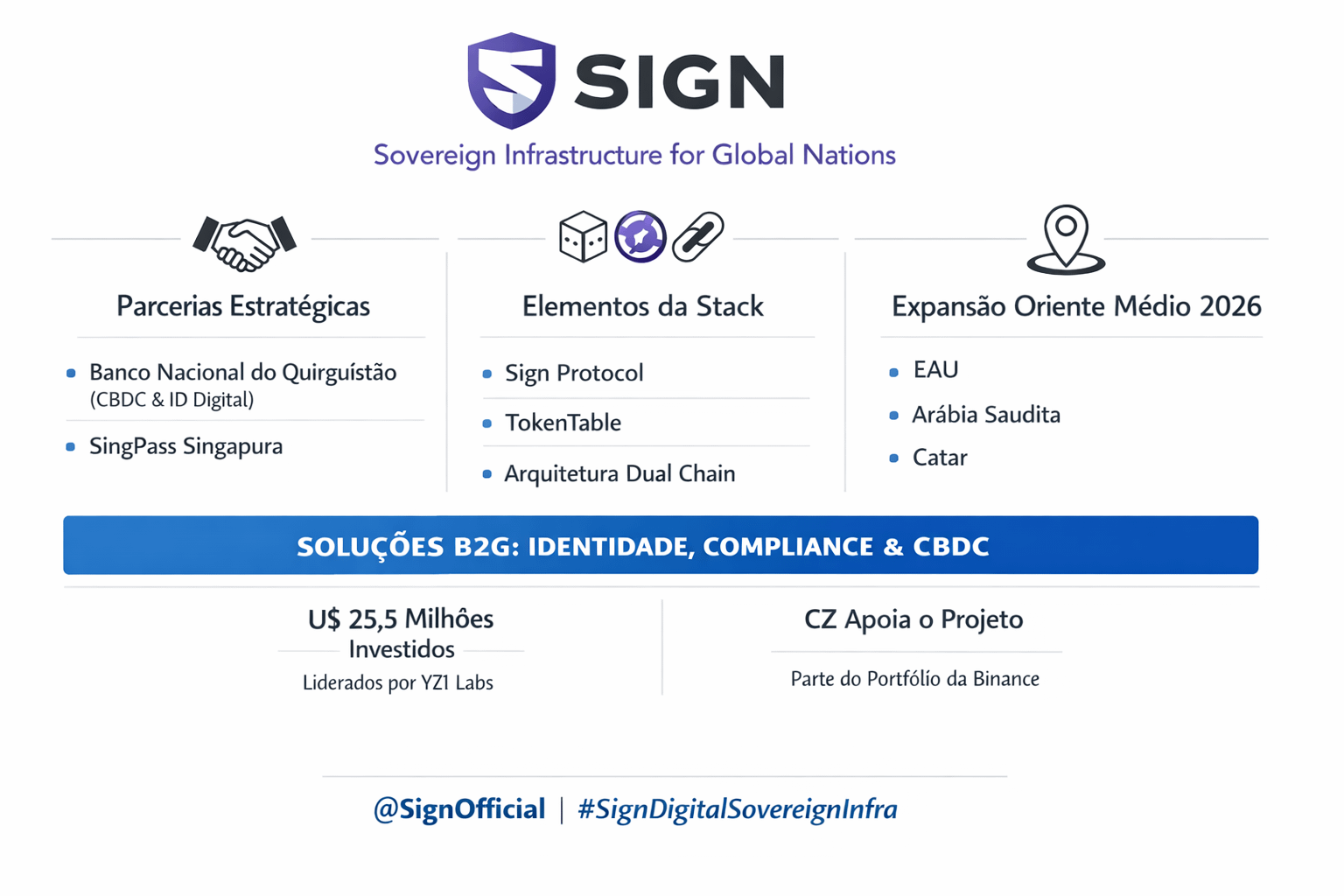
While much of the crypto ecosystem is still debating price and speculation, Sign is building something of a different nature: sovereign digital infrastructure. The S.I.G.N. concept — Sovereign Infrastructure for Global Nations — is not marketing. It is a real technical proposal, with a partnership already established with the National Bank of Kyrgyzstan for the development of CBDC and national identity system, integration with Singapore's Singpass, and expansion of teams dedicated to the Middle East in 2026.
Why is the Middle East so important here? Because the region is experiencing a historic window of economic transformation. Countries like the United Arab Emirates, Saudi Arabia, and Qatar are actively modernizing their digital infrastructures — and they need solutions that combine regulatory compliance, verifiable identity, and token distribution on a national scale. The $SIGN offers exactly this stack: Sign Protocol (omni-chain attestations), TokenTable (token distribution via smart contracts), and a dual chain architecture that separates public operations from private CBDC transactions.
What catches my attention from an investor's perspective is that Sign raised $25.5 million led by YZi Labs — and CZ publicly cited the project as part of the portfolio. This is not noise. It's institutional validation that the B2G (business-to-government) blockchain infrastructure thesis has real demand.
I'm not saying the path will be without volatility — the monthly unlocks of ~96 million tokens are a constant pressure vector in the short term. But what I’m observing is a project that is using this period of depressed prices to secure government contracts, hire experts in ZK-proofs, and expand geographically. This is base building, not top speculation.
The digital sovereignty of the Middle East will need a layer of verifiable trust. The $SIGN is positioning itself to be that layer.