
Honestly… I didn't expect a crypto whitepaper to make me think about borders.
But here we are.
There's a kind of fatigue that sets in after enough cycles. not the dramatic kind. just the slow, quiet exhaustion of watching the same movie with different actors. new tokens. same promises. projects that solve problems nobody actually has, marketed to people who mostly just want number to go up.
so when I came across SIGN, my first reaction wasn't curiosity.
it was that specific skepticism that only comes from having been here too long.
but then I read what problem they're actually pointing at.
and it stopped me.
because there are people right now who can't prove who they are. not because they did anything wrong. not because they're hiding anything. just because the system that was supposed to record them decided, for whatever reason, that they didn't matter enough to include.
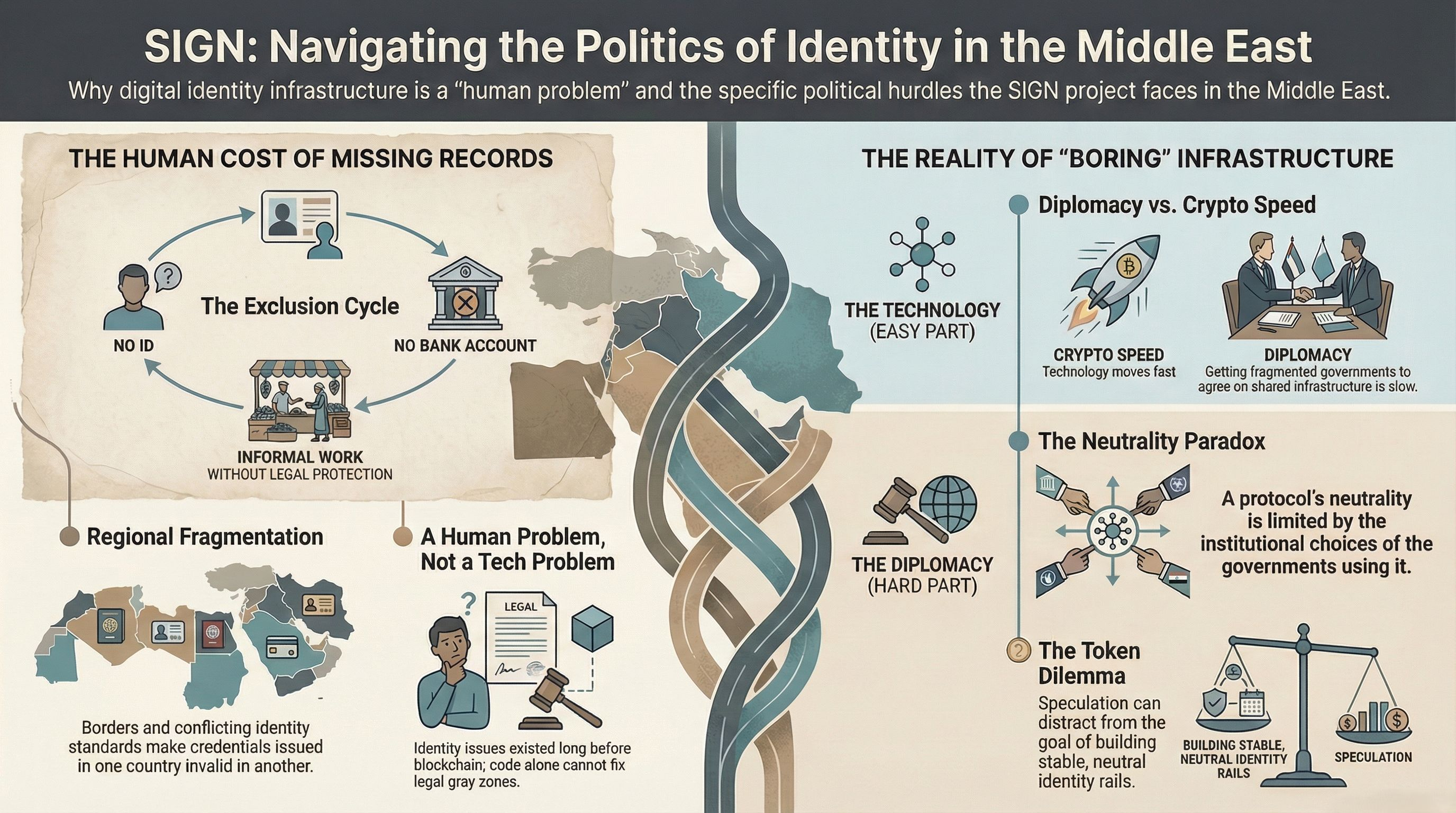
no record means no bank account. no bank account means no salary transfer. no salary transfer means informal work. informal work means no protection. no protection means the same story repeating across generations.
that's not a crypto problem. that's a human problem that's been sitting there long before anyone invented a blockchain.
and the Middle East context makes it sharper.
because this isn't one place. it's a collection of countries that don't always agree on maps, let alone identity standards. credentials issued in one country can mean nothing the moment you cross into the next. populations exist in legal gray zones that no smart contract can fix on its own. governments have their own definitions of who counts and who doesn't.
so when a protocol says it wants to become the identity backbone of this region… the technology is almost the easy part.
the hard part is neutrality.
because identity infrastructure in this context inherits the politics of whoever issues the credentials. a technically permissionless protocol can still be operationally captured, not by code, but by the institutional choices made at deployment. SIGN's neutrality is only as real as the neutrality of the governments it partners with.
and governments are not neutral. they never have been.
then there's adoption. which nobody ever wants to talk about honestly.
getting one ministry to pilot something new is hard enough. getting competing governments across a politically fragmented region to agree on shared infrastructure is a completely different category of problem. that's not a product challenge. that's a diplomatic one.
and crypto moves fast. diplomacy does not.
then the token. because of course.
infrastructure doesn't always need a token to function. sometimes it makes sense. sometimes it just attracts the wrong kind of attention at the wrong time. speculation layered on top of something that's supposed to be neutral has a way of making the neutral thing look less neutral.
we've seen both outcomes. but honestly… one of them happens a lot more than the other.
there's also something quietly contradictory about building fair identity infrastructure inside an ecosystem that still rewards early access and insider positioning. better rails help. but they don't reprogram the people running on top of them.
still.
SIGN feels like someone looked at the hard version of a hard problem and didn't look away.
that's rarer than it sounds.
boring infrastructure takes time. and this space has never been good at waiting for the boring things to matter.
but sometimes the boring things are the only ones that last.