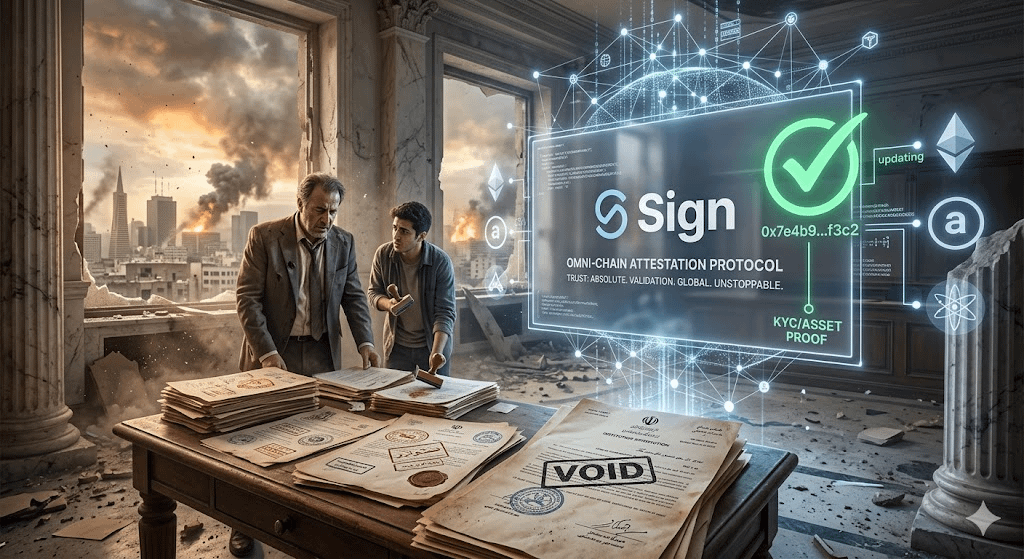
Yesterday at a tea restaurant in Central, my old class leader in foreign trade, faced with a table full of roast goose and milk tea, looked like a lost wooden figure. He tightly held a few multinational VAT invoice verification certificates stamped with red seals.
"Brother, these few pieces of paper are now heavier than my life, but in HSBC's lobby, they said this thing can't prove it's real." His voice was trembling.
Due to geopolitical friction, the banking system of his Southeast Asian raw material supplier is half-paralyzed. This original credit system, which relies entirely on physical seals and manual phone verifications, is as fragile as a wet tissue in the face of rumors of internet disconnection and evacuation.
I sat opposite, looking at the bright red seal, suddenly feeling that this is simply the biggest absurdity of the 21st century: with a global trade scale of hundreds of billions, the lifeline is actually tied to a few physically engraved rubber stamps.
Last night, when the news of multiple airstrikes in Tehran pushed gold prices to the sky, I opened the @SignOfficial developer documentation. At that moment, I felt like a soldier who suddenly stumbled upon an AK-47 in the cold weapon era.
1. It is the 'digital notary office' of the real world.
The Schema registration mechanism developed by Sign is simply a 'dimensionality reduction strike' tailored for finance and audit professionals.
In the past, to prove the authenticity of a trade, we had to run around to get stamps, notarizations, and endorsements. But in the logic of Sign, whether it's a delivery note, tax payment certificate, or asset audit report, it can directly generate a unique on-chain declaration (Attestation) through a custom data structure (Schema).
This is not just digitization; this is **'the immortality of credit'**. As long as the declaration is generated, even if the issuing factory is bombed, or the bank goes bankrupt, the legality of this trade is still firmly locked on the blockchain.
2. Aesthetic of violence: how to elegantly 'reduce burden'
What I admire most is their approach to data. As someone with a financial background, I fear throwing sensitive data around carelessly.
The solution of Sign is extremely hardcore: it throws those extremely private flows and contracts into permanent storage like Arweave, or keeps them locally by enterprises.
Only a needle is left on the chain: a state hash that has been cryptographically signed.
This perfectly resolves the deadlock between 'data privacy' and 'immutability'. For those old foreign trade bosses who can't even distinguish mnemonic phrases, they don't need to understand code; they just need to see that green checkmark for on-chain verification. That is the 'get out of jail free card' of the digital age.
3. $SIGN : 'Digital bulletproof vest' in the geopolitical rift
Now, the friction in geopolitics is essentially destroying the 'physical trust' we established over the past few decades. When banks no longer trust each other, and official seals no longer count, the only way for funds is to seek **'mathematical certainty'**.
The huge funds that crazily flowed into $SIGN are not buying coins at all, but rather the tickets for the reconstruction of underlying infrastructure for global trade in the next decade.
What it is doing is decentralizing the assets of BTC and decentralizing the computation of ETH, truly pushing towards the last mile of the real world—consensus decentralization.
4. Firepower, script, and the final entry ticket
Just early this morning, Tehran was once again bombarded fiercely. The actions of the US and Israel show no signs of stopping. Looking at the flickering flames on the screen and glancing at the stagnant $BTC market, I actually felt quite stable inside.
The script of war has long been written in history books: no matter how fierce the fighting is now, the ultimate victory of a strong order is a statistical inevitability. Once the smoke clears, the retaliatory rebound in the financial market that has been pent up for a long time will leave all those who panicked and sold behind.
This doesn't require any financial expertise; it's the most basic situational judgment. So, don't cut losses before dawn; for those with surplus grain, look at these truly geopolitically risk-averse underlying infrastructures.
The old class leader finally tore those few pieces of paper. He said, "Brother, next time let's just prove it on-chain; I'm fed up with these days of begging for help."