
I spent the last few days looking into how digital currencies actually work for a whole country. Most of the time, we hear about Bitcoin or Ethereum, but when a government wants to make a digital version of its own money, things get complicated fast.
The biggest headache is usually the last mile. It is easy for banks to send millions of dollars to each other using a computer. It is much harder to make sure a farmer in a remote village can receive a government subsidy on their phone without a bank account.
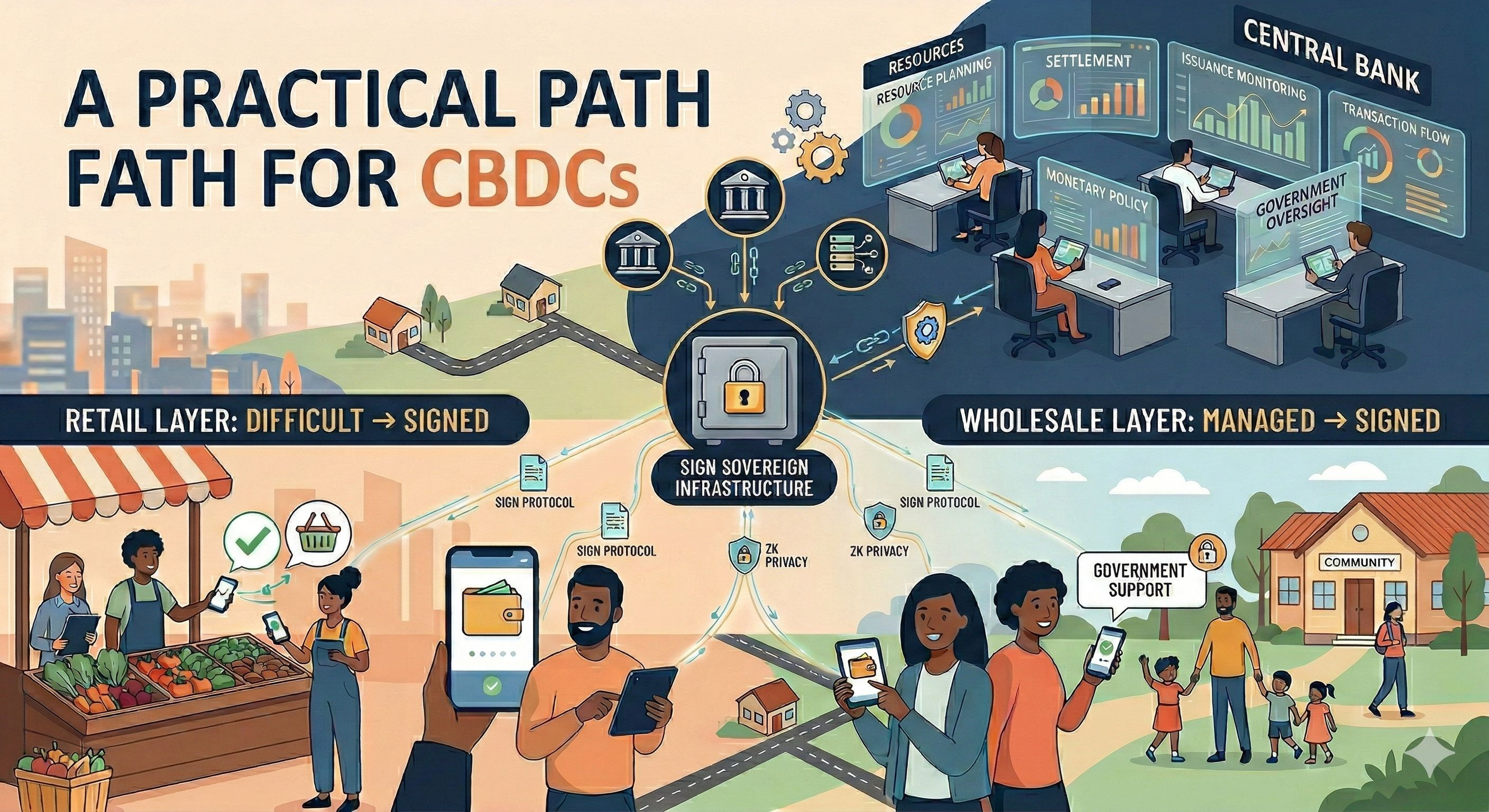
This is where $SIGN caught my attention. They aren't just building another coin. They are building the plumbing that makes digital national money actually work for regular people.
Why most digital currencies fail:
Usually, governments have two bad choices. They can make a private system that is just like the old banks, which is boring and slow. Or they can use a public blockchain, which is too open and risky for a central bank to control.
$SIGN does something different. They use a split system. One side is private and super fast for the government to manage things securely. The other side is open, so it can connect to the rest of the world and new apps.
Practical ways this changes things
I think the real value is in the utility. Here are a few ways this actually helps people in real life:
Getting help to the right people:
Imagine a government wants to give money to students for books. Usually, that money goes through many offices and some of it might go missing. With @SignOfficial Ecosystem , the government can send "programmable" money. This money can only be spent at bookstores. It goes straight from the government to the student's digital wallet. No middleman and no path for the money to be wasted.
Privacy that actually works:
Most people worry that if the government uses digital money, they will see every single thing you buy. Sign uses a technology called Zero-Knowledge proofs. This is a fancy way of saying you can prove you are eligible for a benefit or old enough to buy something without showing your name, address, or bank balance. You keep your ID, and the system just sees a "green light" to finish the transaction.
Helping people without banks:
This is the most impressive part to me. In places like Sierra Leone, many people don't even have a smartphone. Sign has already worked on tools to help these people get a digital ID and receive funds. It brings people into the financial system who were left behind for decades.
A tool for the real world:
By opening up their code recently, $SIGN is letting developers around the world help build this infrastructure. They are moving away from just talking about "blockchain theory" and moving toward building tools that countries are actually using right now, like in Kyrgyzstan.
It makes me wonder which region will be next to skip the old banking hurdles and jump straight to this. My guess is we will see a lot of movement in Africa as there is less ecosystem and Central Asia because they have the most to gain from fixing their financial systems quickly.
What do you think? Would you feel comfortable using a digital currency if it meant getting your tax refund or subsidies instantly without a bank in the middle?
@SignOfficial #SignDigitalSovereignInfra
