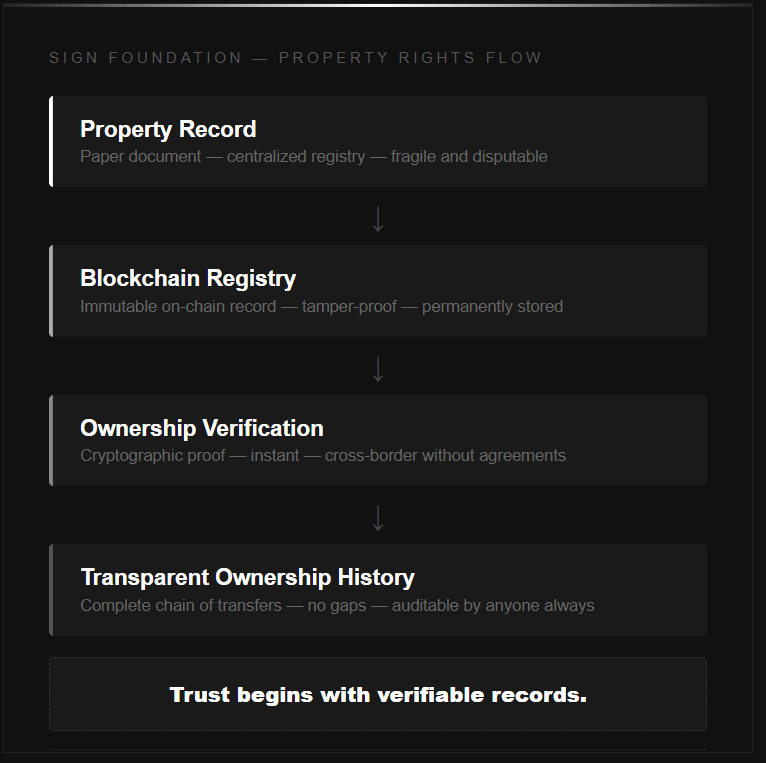
Property ownership sounds simple on paper. In reality, it rarely is.
Land records are often scattered across paper files, outdated databases, and offices that still rely on manual verification. A single missing document can delay transactions for months. In some regions, it can trigger legal disputes that last years.
The uncomfortable truth is that property ownership systems were never designed for transparency. They were designed for administration.
That difference matters.
When records are fragmented, verification becomes slow. When verification becomes slow, fraud finds room to grow. Duplicate claims, forged papers, and disputed ownership become common problems in many property markets.
Tokenized land registries attempt to solve this from the infrastructure level.
Instead of relying on isolated databases, ownership records can be anchored to blockchain-based registries. Each change in ownership becomes a verifiable transaction. Each record becomes traceable. The entire history of a property can be audited without relying on multiple institutions.
But the technology alone does not solve everything.
Land ownership carries legal, regulatory, and cultural implications. Governments still need governance frameworks, dispute resolution mechanisms, and secure identity verification layers.
That is where digital identity infrastructure becomes essential. Verifiable credentials, attestations, and trusted registries allow ownership claims to connect with real-world identities without exposing unnecessary personal data.
The result is not just faster transactions.
It is a system where verification becomes predictable, transparent, and harder to manipulate.
Still, implementation remains complex. National registries cannot simply migrate overnight. Legal frameworks must adapt, institutions must coordinate, and citizens must trust the system.
Infrastructure rarely moves quickly.
But if property ownership records become verifiable, portable, and tamper-resistant, the long-term implications are significant.
Because once ownership becomes provable without friction, entire markets move more efficiently.
The real question is not whether property records will become digital.
It is whether the infrastructure behind them will finally become trustworthy.
@SignOfficial $SIGN #SignDigitalSovereignInfra