I trade every day, and I’ve learned to ignore what projects say they are building and focus on what actually moves on-chain. Credential verification and token distribution sound like back-office infrastructureboring, invisible, easy to dismiss. But that’s exactly why most traders are missing it. Markets don’t misprice narratives; they misprice plumbing. And right now, the plumbing around identity-linked distribution is starting to leak alpha.
Here’s the uncomfortable truth: most tokens don’t fail because of bad techthey fail because distribution is either too loose or too manipulated. Airdrops hit wallets that never intended to hold. Incentives attract farmers, not users. Liquidity gets manufactured, not earned. You see it on charts all the time—sharp vertical spikes followed by slow bleed-outs. That’s not volatility; that’s misaligned distribution unwinding in real time.
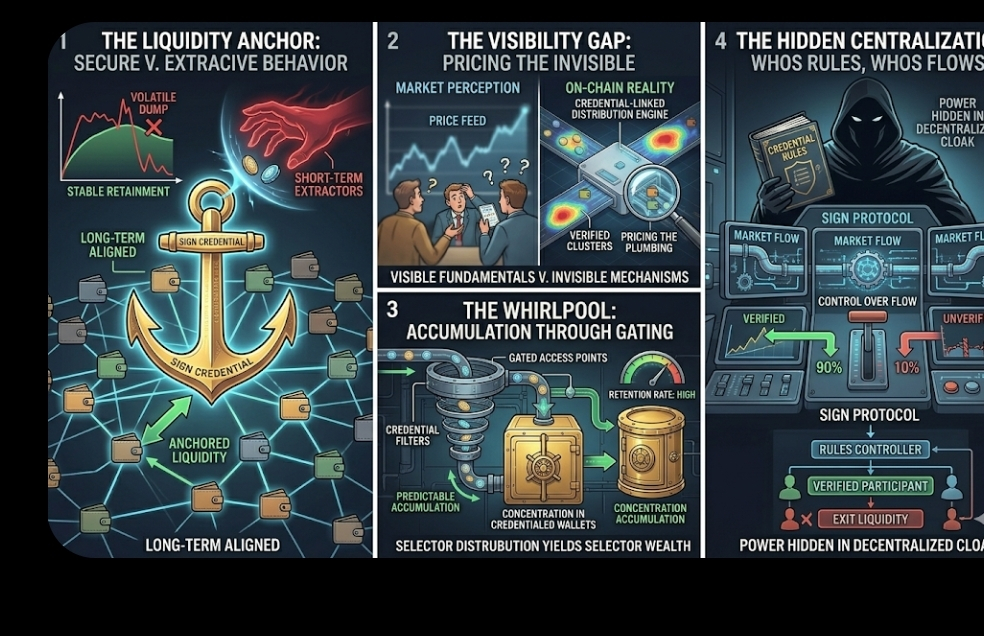
What a system like SIGN changes is not just verification—it changes who is allowed to participate in token flows. That sounds small, but it fundamentally rewires market behavior. When credentials become filters, distribution stops being random and starts being selective. And selective distribution creates something traders rarely get: predictable behavior.
If you’ve been watching on-chain activity lately, you’ve probably noticed a subtle shift. Wallet clusters are becoming more “sticky.” Tokens aren’t rotating as fast after initial distribution. That’s not just macro conditions—it’s design. When participants are verified or segmented based on behavior, history, or reputation, they’re less likely to dump instantly because their access to future value depends on it. That introduces a feedback loop: hold now, earn later.
From a chart perspective, this shows up in ways most traders misread. Instead of violent wicks and immediate retracements, you start seeing tighter consolidation ranges after distribution events. Volume doesn’t disappearit stabilizes. That’s not lack of interest; that’s controlled circulation. The market becomes less about speculation spikes and more about gradual repricing.
But there’s a darker side most people won’t talk about. Credential-based systems can quietly centralize power while pretending to decentralize access. Whoever controls the rules of verification controls the flow of tokens. And in markets, control over flow is everything. It decides who gets in early, who gets size, and who becomes exit liquidity.
I’ve seen this play out in smaller ecosystems already. When access is gated—even slightly—you start seeing asymmetry in wallet performance. Some addresses consistently outperform, not because they trade better, but because they’re positioned inside the distribution layer itself. That’s not alpha you can chart—it’s structural advantage.
For traders, the implication is clear: stop looking only at price and start looking at who is receiving tokens and why. If a project is using credential-based distribution, you need to ask different questions. Are these recipients long-term aligned or short-term extractors? Is the system rewarding behavior that supports price stability or just masking volatility temporarily?
Right now, the market is in a phase where narratives are weak but infrastructure is evolving fast. That’s why you see choppy price action across majors and inconsistent follow-through on breakouts. Liquidity is there, but conviction isn’t. In this environment, systems that can anchor participationnot just attract ithave an edge.
And that’s where credential verification becomes more than a feature. It becomes a liquidity filter.
If you were to overlay on-chain metrics, you’d likely see lower token velocity in systems with structured distribution. You’d see higher retention rates post-airdrop. You might even notice fewer new wallets but higher engagement per wallet. These are not vanity metricsthey directly translate to how price behaves under pressure.
The average trader won’t notice this until it’s obvious in hindsight. They’ll call it “strong fundamentals” or “community strength” without understanding the mechanism behind it. But if you’re paying attention now, you can see the shift before it fully prices in.
Because at the end of the day, markets don’t reward what is visiblethey reward what is inevitable but ignored. And right now, the idea that identity and distribution are merging into a single control layer isn’t being priced correctly.
I’m not saying every project in this space will succeed. Most won’t. But the model itselfverified participation shaping token flowis already starting to influence how markets move. And once that becomes standard, the days of chaotic, easily farmed distribution events will start to fade.When that happens, trading won’t just be about reading charts. It’ll be about reading systems.And most people aren’t ready for that shift
#SignDigitalSovereignInfra @SignOfficial $SIGN