
Paid Partnership with @SignOfficial
Some projects write whitepapers. Sign delivers infrastructure that governments actually use.
For years the crypto industry focused on replacing systems. The thinking was simple: build faster blockchains, better wallets, and users will come. But adoption stalled at the institutional door.
Why? Because governments remain the gatekeepers of identity, assets, and public services. They define ownership. They issue currency. They enforce regulation. And they don't outsource control to unproven systems.
This is where Sign operates differently.
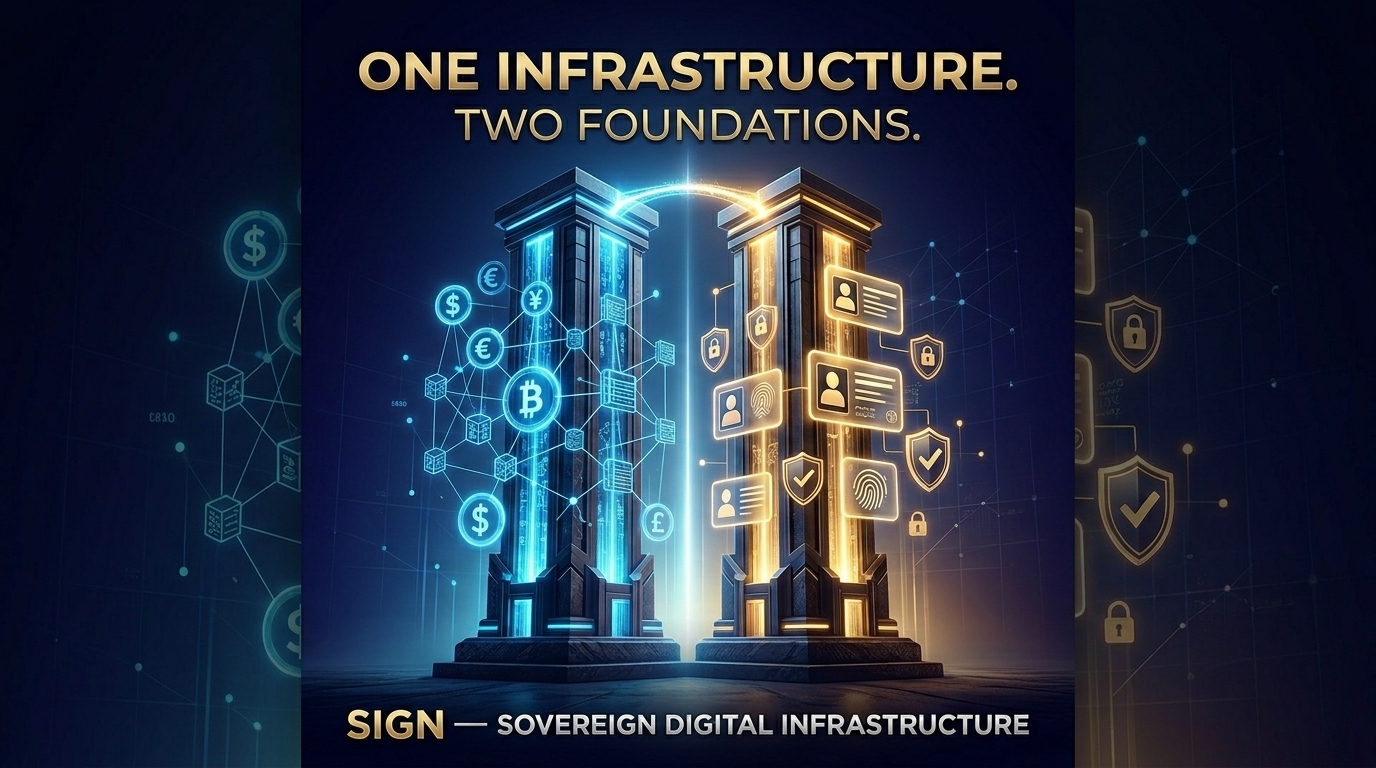
Two Systems, One Infrastructure
Sign is building the foundational layers that sovereign nations need to digitize:
Digital Money System. A sovereign digital money rail that supports both CBDCs and regulated stablecoins. By Q3 2026, Sign's digital currency system will begin deployment at national scale—serving millions of users and forming the core financial infrastructure of an entire economy.
Digital ID System. A national identity and verifiable credentials layer. Governments can issue cryptographically signed claims—identity, licenses, permissions—that verify across agencies and regulated operators. No centralized data silos. No single point of failure.
These two systems don't exist in isolation. Sign connects them.
Why Governments Choose Sign
The B2G (business-to-government) model is not for everyone. Sales cycles are long. Compliance requirements are brutal. Trust is earned slowly.
But once earned, the moat is deep. Long-term contracts. High switching costs. Deep integration into government workflows.
Sign earned that trust through delivery. TokenTable, Sign's distribution engine, has executed $3 billion in token distribution across 55 million wallets. That's not a demo. That's delivery.
For governments issuing welfare, digital currency, or any form of value at scale, that level of proven infrastructure matters. You don't bet on unproven systems when moving real value for real citizens.
The Middle East Is Moving
Abu Dhabi granted Sign compliance endorsements. Central banks across the region are moving from research to implementation on CBDCs and digital ID. Kyrgyzstan and Pakistan are already in partnership.
The Gulf Cooperation Council (GCC) is diversifying fast. Saudi Vision 2030. UAE's economic expansion. Digital trade corridors. All require infrastructure that is both modern and sovereign.
Traditional fintech wasn't built for this. Crypto-native projects often ignore government realities. Sign sits in the middle: crypto infrastructure designed for government adoption.
What to Watch
Mainnet is imminent. The first 10K whitelist spots are open now.
B2G expansion continues. Sign's footprint across the Middle East and Central Asia is growing.
· The convergence of money and identity. Sign connects two foundational systems that have historically lived in separate silos.
The Findings
$SIGN represents more than a token. It's exposure to a thesis: the next phase of crypto adoption will happen through governments, and Sign is building the on-ramp.
Not a whitepaper. Not a promise. Delivery at scale.
What's your take—does sovereign infrastructure actually scale?
@undefined @SignOfficial @undefined #SignDigitalSovereignInfra $SIGN