

I've been in crypto long enough to be deeply suspicious of anything that sounds too clean. Government partnerships? Sequoia backing? A former Binance founder making introductions? Usually when you pull the thread on stuff like that, it falls apart. So I pulled the thread on SIGN. Kept pulling. And what I found genuinely surprised me not because it's perfect, it isn't but because the gap between what this project has actually done and what its price implies people think it's done is one of the biggest disconnects I've seen in a while.
Let me just talk through it the way I'd explain it to a friend.
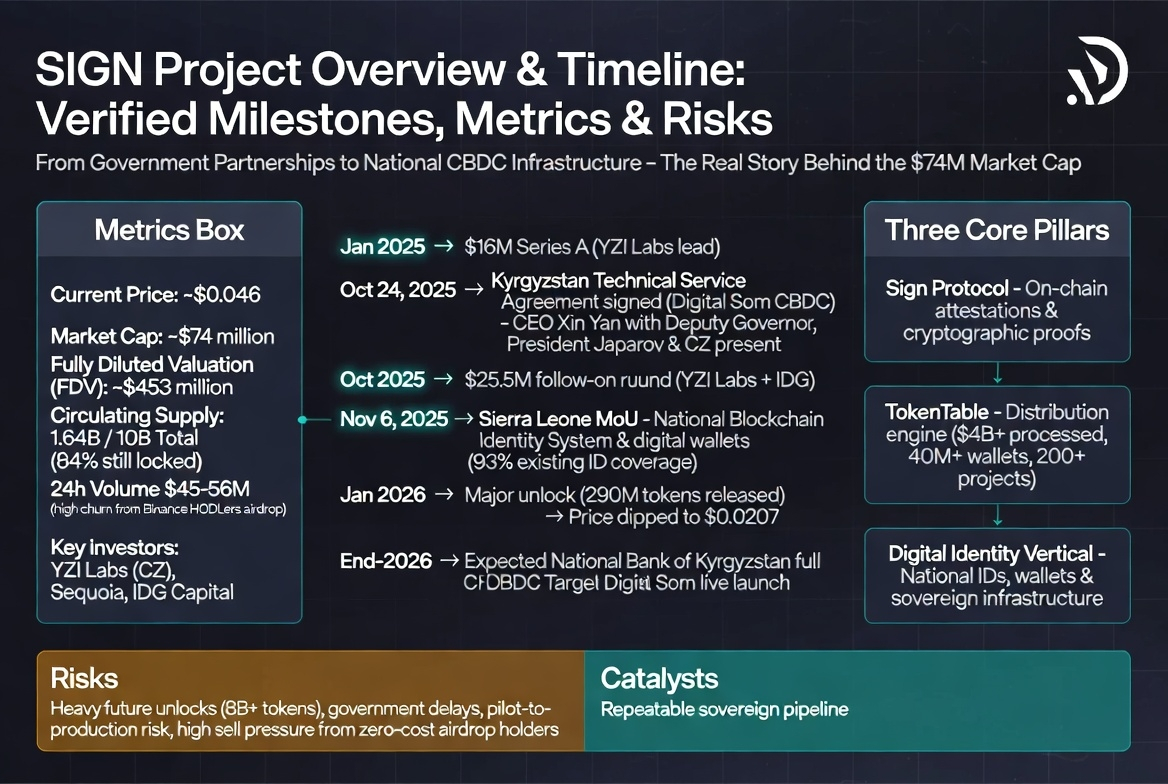
Right now SIGN trades around $0.046. That gives it a market cap of about $74 million. Here's the first thing that jumps out the total supply is 10 billion tokens, but only 1.64 billion are actually circulating right now. So the real number, if you count everything that will eventually exist, is closer to $453 million. That's the fully diluted valuation. Most of the supply we're talking over 8 billion tokens is still locked. That's a lot of future selling pressure, and I'll be honest about that later. But the reason I didn't close the tab when I saw that is what's sitting on the other side of it.
Because this isn't some team with a whitepaper and a Discord.
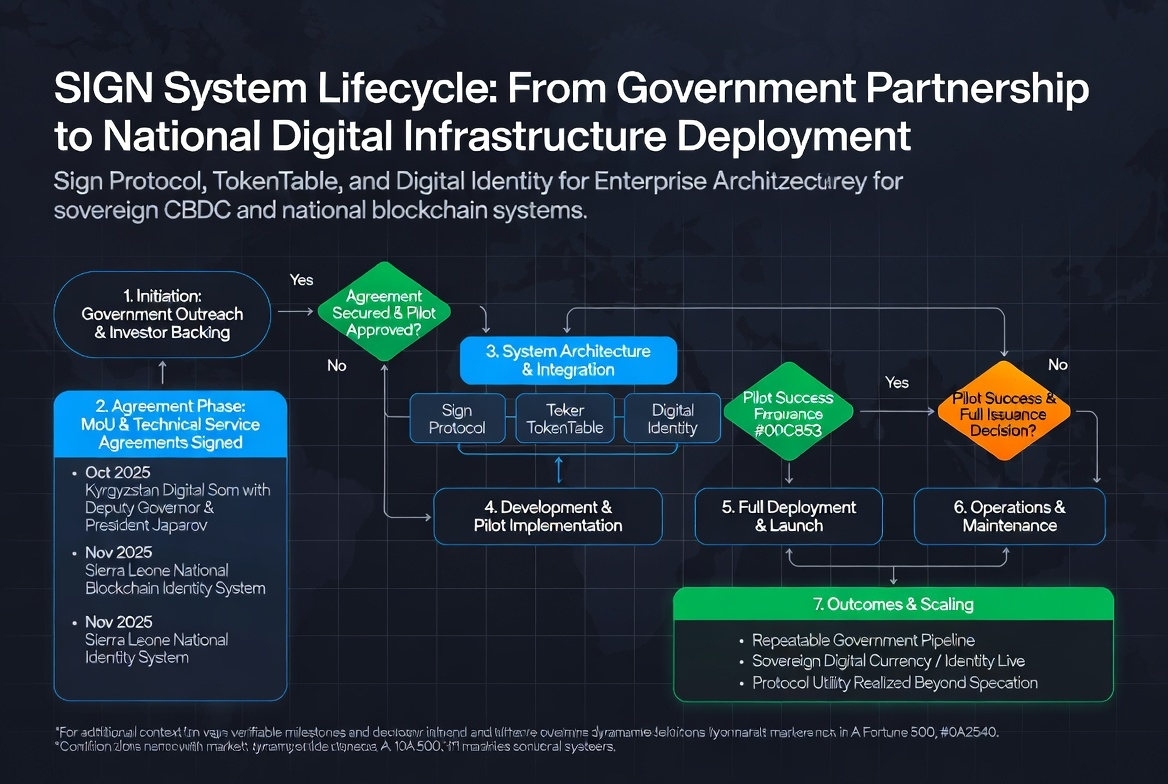
On October 24, 2025, SIGN's CEO Xin Yan sat in a room with the Deputy Governor of the National Bank of Kyrgyzstan and signed a technical service agreement for the country's digital currency the Digital Som. President Japarov was there. CZ was there. Not as a hype moment, as a working agreement. Two weeks later, November 6, Sierra Leone's Ministry of Communication and Technology signed an MoU with SIGN to build the country's national blockchain identity system, digital wallets, the whole infrastructure stack. Sierra Leone already has 93% national ID coverage this isn't a country figuring out identity from scratch, they're plugging an existing system into a blockchain backbone. These things happened. I checked. Multiple times.
And this is where I started getting genuinely interested rather than just mildly curious.
SIGN isn't really just one thing. It's three things that work together. There's Sign Protocol, which handles on-chain attestations basically cryptographic proof that something is true about you or your assets. There's TokenTable, which is the distribution engine it's already processed over $4 billion in token distributions to more than 40 million wallets, with 200 plus live projects using it across Starknet, Notcoin, and a bunch of others. And then there's the whole digital identity vertical that the government deals plug into. When Kyrgyzstan wants to run a CBDC, they need all three of those pieces. That's why SIGN is in that room and not some other project.
Now the funding picture because this is where it clicked for me. In January 2025, YZi Labs, which is CZ's venture fund, led a $16 million Series A. Fine. But then in October 2025 after the token had already launched, after the price had already started declining, after they could see exactly how the market was treating it they came back. Another $25.5 million, alongside IDG Capital. Sequoia is also in the picture across three geographies. That October decision is the one that got my attention. Nobody writes a follow-on check into a struggling token out of loyalty. They do it because they believe something the market hasn't figured out yet.
And I think what they believe is that the government pipeline is repeatable.
The Kyrgyzstan deal has a specific timeline. The National Bank is expected to make a decision on full CBDC issuance by end of 2026, with a target launch of January 2027. If that happens if the Digital Som goes live as a functioning national currency on SIGN's infrastructure the token utility case becomes something completely different from what anyone is pricing today. You're not talking about DeFi speculation anymore. You're talking about a protocol embedded in the financial system of a country.
That said, I want to be straight with you. None of that has happened yet. The Kyrgyzstan deal is a pilot. Sierra Leone is an MoU. These things can stall. Governments change their minds, procurement processes take forever, politics gets in the way. I'm not pretending those risks aren't real they absolutely are, and anyone parking significant money in SIGN on the assumption that these deployments happen on schedule is taking a real gamble.
The supply situation also keeps me from going all-in on the excitement. That 8 billion locked supply coming into circulation over time creates real selling pressure regardless of how good the story gets. The January 2026 unlock alone pushed 290 million new tokens into the market when sentiment was already shaky. The price slid to $0.0207 by late February. That's what unlock pressure looks like in practice. The market absorbed it, which was actually more impressive than I expected given the volume profile, but it wasn't painless.
Speaking of volume here's something that looked scary until I thought about it differently. SIGN regularly trades $45 to $56 million a day against a $74 million market cap. That ratio is way higher than healthy. At first I thought this means nobody wants to hold it. Then I remembered it launched through Binance's HODLers airdrop. Those people received free tokens. Of course they're selling. Of course the volume looks like churn. The interesting question is what happens to the price when those zero cost basis sellers eventually exhaust their supply. If genuine buyers are quietly accumulating underneath all that noise, the setup gets a lot more interesting. If not, the price finds lower support.
So where does that leave me?
I think SIGN is one of those projects where the story is legitimately ahead of the token mechanics, but not in the usual "this is vaporware" way in the "the catalysts are real but they haven't landed yet" way. The infrastructure is live. The clients are real. The governments are actual governments with signed paperwork. The investors came back twice. CZ is making introductions. The Central Asian CBDC deadline is end of 2026. All of that is verifiable.
What would make me more confident? A second sovereign government moving from MoU to a technical service agreement. The National Bank of Kyrgyzstan officially confirming full CBDC issuance. A systematic buyback program tied to actual project revenue rather than one-off market interventions. Those are concrete things I can watch for. If they happen, the $453 million FDV starts to look like the real benchmark, not the ceiling. If they don't, $74 million will look generous by the time the rest of that supply unlocks.
For now I'm watching closely. This is the kind of project that quietly does the thing while everyone else is chasing noise and either ends up looking like the most obvious setup in retrospect, or a cautionary tale about how government timelines don't care about your investment thesis. Either way, I wanted to write it down before the outcome is obvious. Because right now it genuinely isn't and I find that more interesting than almost anything else I've looked at recently.
@SignOfficial #SignDigitalSovereignInfra $SIGN
