

I first started thinking about Sign when I realized how invisible most economic decisions are to the markets that depend on them. I’ve watched prices move, narratives shift, and traders scramble to interpret outcomes, but almost never do we see the decisions themselves the approvals, the compliance checks, the eligibility confirmations that actually set things in motion. Markets respond to what’s observable: announcements, filings, transactions. The real work happens quietly, behind closed doors, and the market only sees the tail end.
Sign changes that. At its core, it’s a system for making decisions verifiable before they become observable events. Through attestations, it creates structured, reusable claims that can be independently verified. A bank can attest that a loan has passed regulatory checks. A corporation can confirm that an internal compliance review is complete. A government office can prove that someone meets eligibility criteria. None of these attestations exposes raw data, but they leave a clear, verifiable trace that a decision occurred.
When I first wrapped my head around this, I realized the implications: we could start seeing signals from decisions before they hit the market. And that subtle shift in timing, I think, could be transformational.
Markets today are reactive. I spend time analyzing how traders and analysts interpret signals after the fact earnings, funding announcements, policy approvals. By the time the market reacts, the decision that mattered has often been made weeks earlier. All we get are outcomes, trailing indicators of actual activity.
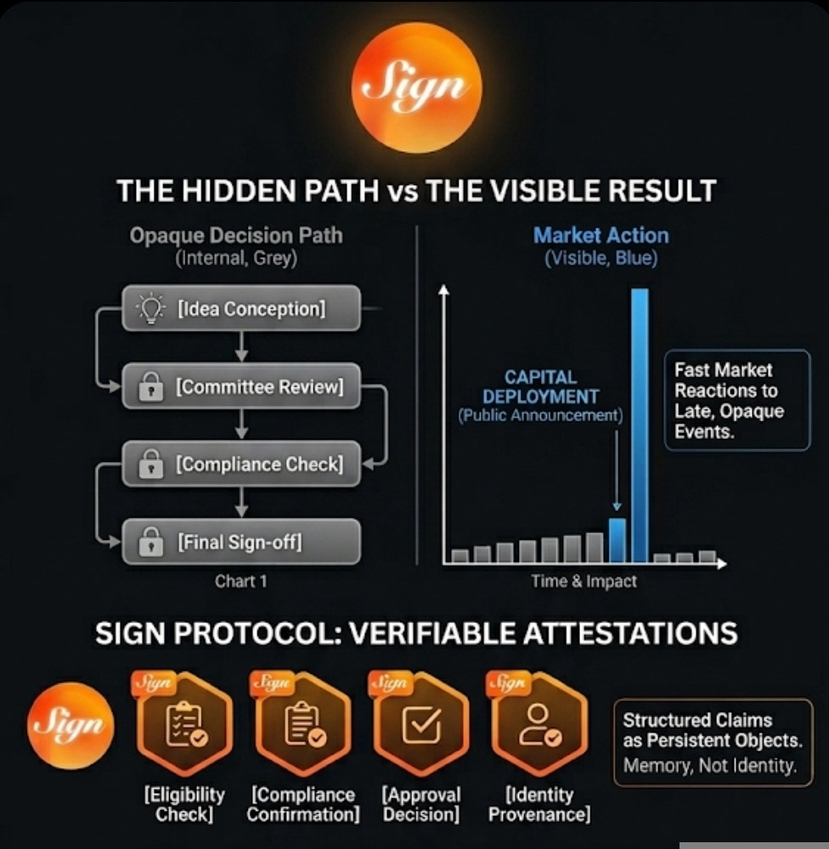
Sign lets decisions leave verifiable footprints before those outcomes show up. The data itself doesn’t move only proof of it. That’s crucial in regulated or privacy-sensitive environments, where raw data can’t freely flow, but verified proof can. I can imagine a world where I, as an analyst, see clusters of attestations and start modeling probable market outcomes weeks before an official announcement. It doesn’t remove uncertainty, but it gives a window into the process that never existed before.
When I think about it, this is almost like a new class of market signal: one based on action rather than outcome. It’s subtle, but powerful.
For me, the real insight comes when I consider how attestations might change the way we interpret information. An attestation is simple: it’s proof that a process happened under defined rules. It doesn’t reveal every detail, but it shows that a decision passed a check or received approval.
I remember imagining a venture fund attesting that a funding round passed internal approval. The attestation doesn’t tell me the company, the amount, or the investors. But if I have context as an institutional participant, that’s actionable. I now have a signal of decision activity without the need for leaks or insider access. Multiply this across institutions, and the pattern of attestations becomes a web of verifiable memory an early signal that markets could interpret long before traditional disclosures appear.
It’s this interplay between privacy and transparency that fascinates me. Organizations don’t have to expose confidential details, but the fact that a decision exists becomes public in a verifiable way. That balance is rare in financial markets, and it changes how I think about information flow.
I also see Sign differently because of its token model. The token isn’t just a speculative instrument—it’s the mechanism for creating and verifying attestations. Every approval, every verification, every compliance check can drive token utility.
From my perspective, this means the network is inherently event driven. I don’t expect constant activity. What I do expect are bursts of usage: attestations happening across multiple actors, verifications being performed, repeated proof creation. As someone observing token economics, it’s clear that metrics like attestation frequency, cross-network reuse, and institutional adoption tell me far more about utility than raw trading volume.
I’ve watched other identity-related networks struggle because adoption was disconnected from utility. Sign feels different: activity is meaningful, and value accrues through engagement, not hype.
I’ve thought a lot about the challenges Sign faces. Institutions are naturally cautious. They want privacy, regulatory certainty, and a clear understanding of how these proofs interact with existing processes. But I can also see why Sign could succeed where others struggle. In regulated industries finance, insurance, public procurement being able to produce verifiable proof without moving sensitive data is a huge advantage.
From my perspective, the key to adoption is credibility and usability. Attestations must be verifiable, tamper-proof, and interoperable. Privacy can’t be sacrificed for transparency, but transparency is what gives the system value. Watching how Sign navigates that balance is one of the more interesting things I’ve followed in blockchain-based infrastructure recently.
What excites me most is how Sign shifts the temporal structure of signals. I’ve spent years analyzing outcomes: prices, announcements, filings. Sign introduces a new layer—pre-event, verifiable traces of decisions. Analysts like me can start interpreting activity as it happens, instead of always chasing what already occurred.
I can imagine plotting attestation density, frequency, and corroboration across a sector and seeing patterns of decision activity emerge before any outcome is public. That doesn’t remove market noise, but it does give me a new lens for understanding liquidity, pricing, and information asymmetry. Markets remain unpredictable, but the way we interpret early signals changes.
Sign make markets predictable, but it makes decisions accountable, traceable, and verifiable in ways I’ve never seen before. And in a system built on trust, proof, and verification, that feels like a real shift in how markets can operate.
#SignDigitalSovereignInfra @SignOfficial $SIGN