I’ll be honest—when I first started looking into SIGN Protocol, I wasn’t expecting much. A lot of projects talk about “trust” and “infrastructure,” but most of the time it’s just the same idea packaged differently. So I went in a bit skeptical.
But after digging deeper, the angle here felt… quieter. Less about hype, more about fixing something basic that’s been ignored for a while: verification.
Not transactions. Not speed. Just proof.
Because if you think about it, a lot of systems we use—banks, apps, even government services—run on one simple thing: verifying who you are and whether you qualify for something. And yet, the process is painfully repetitive.
Have you ever felt frustrated showing the same KYC documents 10 times? I have.
Different platforms. Same ID. Same forms. Same waiting.
It’s not complicated—it’s just inefficient.
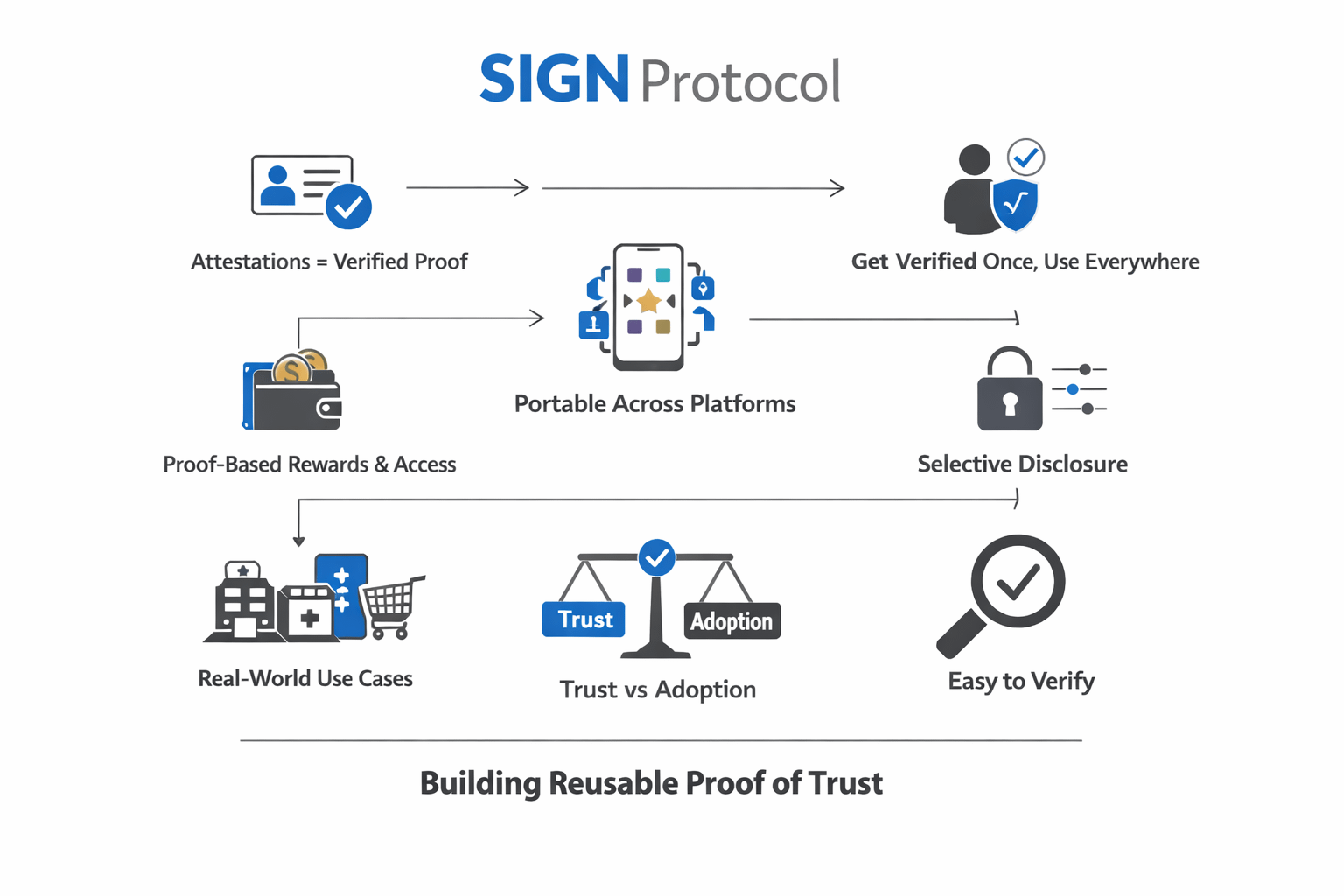
This is where SIGN starts to make sense. It introduces something called “attestations.” Sounds technical, but the idea is actually very simple. Think of it like this: you show your ID somewhere once, and instead of repeating the whole process everywhere else, you carry a verified proof of that check.
Like entering a club. The bouncer checks your age—you’re in. You don’t need to hand over your full identity every single time, just the part that matters. SIGN is trying to bring that same logic into digital systems.
And honestly… that part clicks.
But then again, a fair question: don’t we already have systems doing something similar?
Kind of. But most of them are closed. You get verified on one platform, and that verification stays there. It doesn’t follow you. SIGN is trying to make it portable—usable across different systems.
That’s useful… if it actually gets used.
And that’s where things get a bit uncertain.
Take the whole multi-chain angle. A lot of projects highlight it like it’s something groundbreaking. It’s not. Being on multiple chains is pretty common now. But SIGN’s approach feels a bit more grounded. It’s not trying to force everything into one ecosystem. It just accepts that things are fragmented—and builds around that reality.
Not revolutionary, but practical.
Another concept it uses is “selective disclosure.” Again, sounds complex, but it’s really not. It just means you only share what’s necessary. Nothing extra.
In real life, we already expect this. If someone asks your age, you don’t hand over your entire personal file. But online, that boundary is often missing. SIGN is basically trying to fix that.
Simple idea. Hard to implement properly.
Where it gets more interesting is in how value gets distributed. Whether it’s rewards, access, or incentives, deciding who qualifies is always messy. Either too many people slip through, or the system becomes overly strict.
SIGN’s approach is straightforward—tie everything to proof. Not guesses. Not assumptions. Actual verification.
It makes sense. But again… only if people trust and adopt those proofs.
Recent progress around the project seems focused on making these verifications easier to access and check. Which is important, because if no one can verify the verification, then what’s the point?
There’s also movement toward real-world use cases—not just theory. That’s a good sign. Still early though.
And maybe that’s the most honest takeaway here.
SIGN Protocol doesn’t feel like a flashy product. It feels like infrastructure. The kind you don’t notice unless it’s missing.
It’s trying to reduce repetition. To make proof reusable. To let trust travel instead of being rebuilt every single time.
Will it work?
Technically, probably yes.
But the real challenge isn’t technology. It’s adoption. Always has been.
Because at the end of the day, a system of trust only works when people actually decide to trust it.